Gonnelli Stefano, Al Refaie Antonella, Baldassini Leonardo, De Vita Michela, Caffarelli Carla
Department of Medicine, Surgery and Neuroscience, University of Siena, Italy.
Indian J Endocrinol Metab. 2022 Nov-Dec;26(6):518-523. doi: 10.4103/ijem.ijem_347_22. Epub 2023 Feb 7.
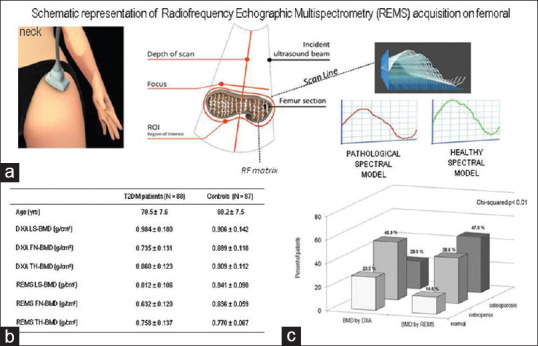
Bone fragility is increasingly recognized as an important complication of diabetes mellitus (DM), and both type 1 (T1DM) and type 2 (T2DM) diabetes are associated with a higher risk of fracture. The causes of bone fragility in diabetic patients are not yet fully understood; probably they are linked to low bone mineral density (BMD), poor bone quality due to the alterations in bone remodelling, microarchitecture and composition of the bone matrix. Quantitative ultrasound (QUS) is a validated, low-cost and free ionizing radiation alternative to DXA measurement of BMD for the assessment of fracture risk. The results obtained by using QUS in T1DM and T2DM have been summarized and reported in this review. QUS technique presents some benefits but also some limits. These limits could be overcome by radiofrequency echographic multispectrometry (REMS) that is a non-ionizing technology recently introduced for the assessment of bone status that can also calculate parameters related to bone quality and strength. Therefore, REMS may represent a promising approach to evaluate bone status and fragility fracture risk in DM subjects.
骨脆性日益被认为是糖尿病(DM)的一种重要并发症,1型糖尿病(T1DM)和2型糖尿病(T2DM)都与较高的骨折风险相关。糖尿病患者骨脆性的原因尚未完全明确;可能与骨矿物质密度(BMD)低、由于骨重塑、微结构和骨基质组成改变导致的骨质量差有关。定量超声(QUS)是一种经过验证的、低成本且无电离辐射的替代方法,可用于替代双能X线吸收法(DXA)测量BMD以评估骨折风险。本综述总结并报告了在T1DM和T2DM中使用QUS获得的结果。QUS技术有一些优点,但也有一些局限性。这些局限性可以通过射频超声多光谱测定法(REMS)来克服,REMS是一种最近引入的用于评估骨状态的非电离技术,它还可以计算与骨质量和强度相关的参数。因此,REMS可能是评估糖尿病患者骨状态和脆性骨折风险的一种有前景的方法。