Department of Geriatrics, The First Affiliated Hospital of China Medical University, Shenyang, Liaoning 110001, China.
J Diabetes Res. 2020 Jan 27;2020:1508258. doi: 10.1155/2020/1508258. eCollection 2020.
Previous evidence has demonstrated an increased fracture risk among the population with type 2 diabetes mellitus (T2DM). This study investigated the prevalence of bone fractures in elderly subjects (with and without type 2 diabetes) and identified any fracture risk factors, especially the risk factors for common known fractures in particular diabetic populations.
This cross-sectional study was conducted with community-dwelling people over 60 years old in nine communities from the city of Shenyang, which is the capital of Northeast China's Liaoning Province. A total of 3430 elderly adults (2201 females, mean ± standard deviation age 68.16 ± 6.1 years; 1229 males, 69.16 ± 6.7 years) were included. Our study measured the heel bone mineral density (BMD) and used the timed "up and go" (TUG) test and other indicators. In addition, we performed logistic regression analysis to explore the risk factors for fractures in the general population and the diabetic population and to analyze the differences.
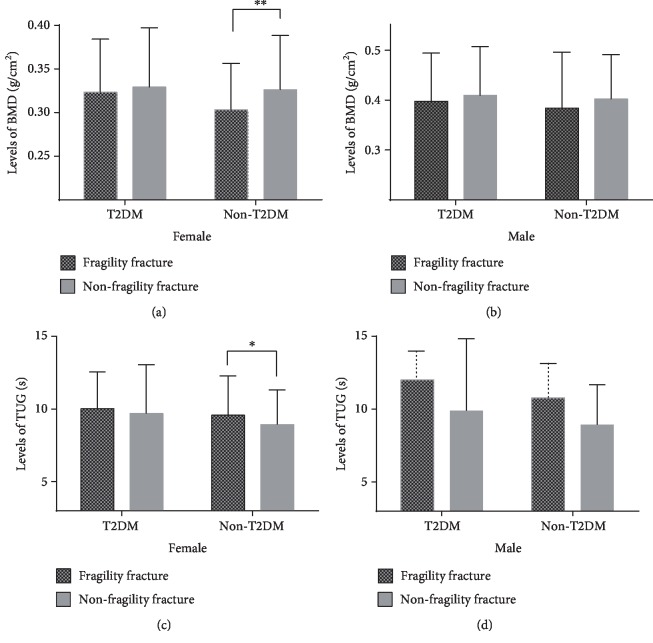
The results revealed that a total of 201 elderly persons (5.8%), with an average age of 70.05 ± 6.54 years, suffered from a history of fragility fractures, which affected more females (74.6%) than males ( = 0.001). The prevalence of fractures in the T2DM population was 7.3%, which was much higher than the 5.2% in non-T2DM population ( = 0.001). The prevalence of fractures in the T2DM population was 7.3%, which was much higher than the 5.2% in non-T2DM population ( = 0.001). The prevalence of fractures in the T2DM population was 7.3%, which was much higher than the 5.2% in non-T2DM population ( = 0.001). The prevalence of fractures in the T2DM population was 7.3%, which was much higher than the 5.2% in non-T2DM population (-score≤-2.5 (OR 1.750) were independent risk factors for fragility fractures in the non-T2DM population, but they were not risk factors in the T2DM population.
This study found that low BMD and slow TUG time were independent risk factors for fractures in non-T2DM patients, while no associations were found in the T2DM population. Patients with T2DM have a higher risk for fractures even when they have sufficient BMD and a short TUG time. TUG and BMD underestimated the risk for fractures in the T2DM population.
先前的证据表明,2 型糖尿病(T2DM)患者的骨折风险增加。本研究调查了老年人群(有和没有 2 型糖尿病)中骨折的患病率,并确定了任何骨折的危险因素,特别是在特定糖尿病人群中常见已知骨折的危险因素。
这项横断面研究在辽宁省省会沈阳市的九个社区进行,纳入了 3430 名 60 岁以上的社区居民(2201 名女性,平均年龄 68.16 ± 6.1 岁;1229 名男性,69.16 ± 6.7 岁)。我们的研究测量了脚跟骨密度(BMD),并使用了定时“站起来和走”(TUG)测试和其他指标。此外,我们进行了逻辑回归分析,以探讨一般人群和糖尿病人群中骨折的危险因素,并分析其差异。
结果显示,共有 201 名(5.8%)老年人(平均年龄 70.05 ± 6.54 岁)有脆性骨折史,其中女性(74.6%)多于男性(=0.001)。T2DM 人群的骨折患病率为 7.3%,明显高于非 T2DM 人群的 5.2%(=0.001)。T2DM 人群的骨折患病率为 7.3%,明显高于非 T2DM 人群的 5.2%(=0.001)。T2DM 人群的骨折患病率为 7.3%,明显高于非 T2DM 人群的 5.2%(=0.001)。T2DM 人群的骨折患病率为 7.3%,明显高于非 T2DM 人群的 5.2%(=0.001)。T2DM 人群的骨折患病率为 7.3%,明显高于非 T2DM 人群的 5.2%(=0.001)。在非 T2DM 人群中,BMD 评分≤-2.5(OR 1.750)是脆性骨折的独立危险因素,但在 T2DM 人群中并非危险因素。
本研究发现,低 BMD 和 TUG 时间延长是非 T2DM 患者骨折的独立危险因素,而 T2DM 患者则无相关性。即使 T2DM 患者的 BMD 充足且 TUG 时间短,他们的骨折风险也更高。TUG 和 BMD 低估了 T2DM 人群的骨折风险。