Ma Gang, Huo Binliang, Shen Yanwei, Zhu Xulong, Cheng Chong, Li Wensheng, Cao Wei, Li Jianhui
Department of Surgical Oncology, Shaanxi Provincial People's Hospital, Xi'an, China.
Department of Pathology, Shaanxi Provincial People's Hospital, Xi'an, China.
J Cancer. 2024 Jun 17;15(14):4467-4476. doi: 10.7150/jca.84832. eCollection 2024.
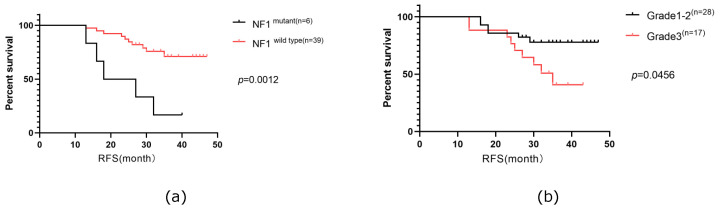
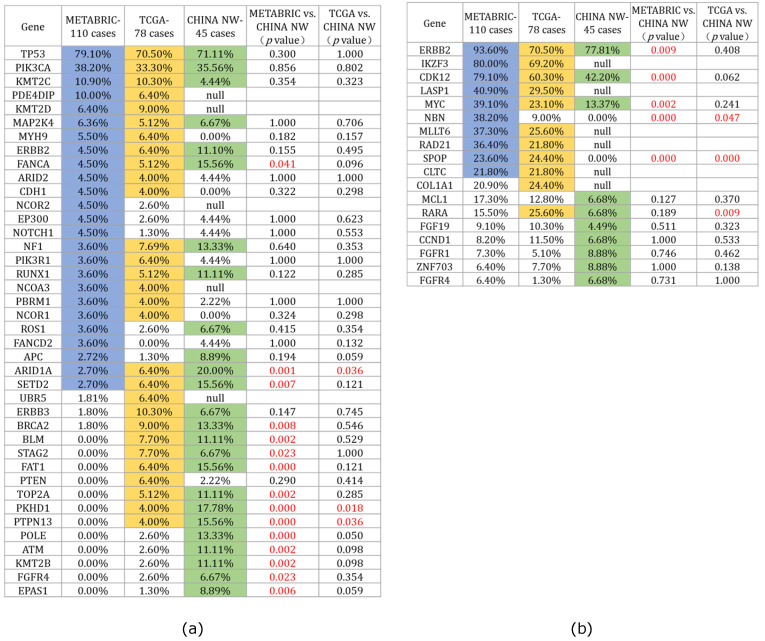
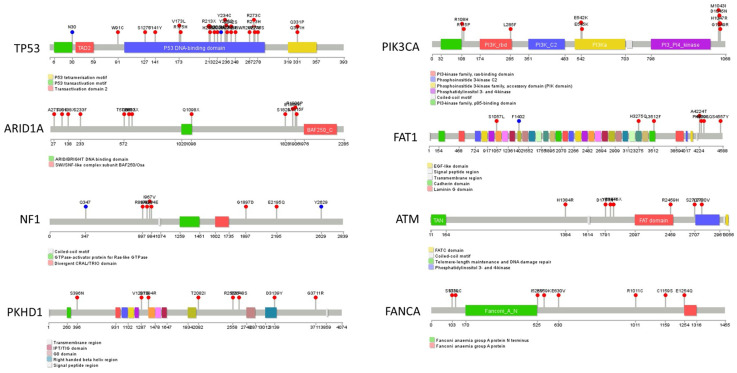
Anti-HER2 therapy has significantly improved the survival rates of patients with HER2+ breast cancer. However, a subset of these patients eventually experience treatment failure, and the underlying genetic mechanisms remain largely unexplored. This underscores the need to investigate the genomic heterogeneity of HER2+ breast cancer. In this study, we focus on HER2+/HR- breast cancer, as it differs from HER2+/HR+ breast cancer in terms of genetic and biological characteristics. We performed gene-targeted genome sequencing on 45 HER2+/HR- breast cancer samples and identified 650 mutations across 268 cancer-related genes. TP53 (71.1%) and PIK3CA (35.6%) were the most frequently mutated genes in our sample. Additionally, ERBB2 (77.8%), CDK12 (42.2%), and MYC (11.1%) exhibited a high frequency of copy number amplifications (CNAs). Comparative analysis with two other HER2+/HR- breast cancer cohorts revealed that our cohort had higher genetic variation rates in ARID1A, PKHD1, PTPN13, FANCA, SETD2, BRCA2, BLM, STAG2, FAT1, TOP2A, POLE, ATM, KMT2B, FGFR4, and EPAS1. Notably, in our cohort, NF1 and ATM mutations were more prevalent in trastuzumab-resistant patients (NF1, p=0.016; ATM, p=0.006) and were associated with primary trastuzumab resistance (NF1, p=0.042; ATM, p=0.021). Moreover, patients with NF1 mutations (p=0.009) and high histological grades (p=0.028) were more likely to experience early relapse. Ultimately, we identified a unique cancer-related gene mutation profile and a subset of genes associated with primary resistance to trastuzumab and RFS in patients with HER2+/HR- breast cancer in Northwest China. These findings could lay the groundwork for future studies aimed at elucidating the mechanisms of resistance to trastuzumab and improving HER2-targeted treatment strategies.
抗HER2治疗显著提高了HER2阳性乳腺癌患者的生存率。然而,这些患者中的一部分最终会出现治疗失败,其潜在的遗传机制在很大程度上仍未得到探索。这突出了研究HER2阳性乳腺癌基因组异质性的必要性。在本研究中,我们聚焦于HER2阳性/激素受体阴性(HER2+/HR-)乳腺癌,因为它在遗传和生物学特征方面与HER2阳性/激素受体阳性(HER2+/HR+)乳腺癌不同。我们对45例HER2+/HR-乳腺癌样本进行了基因靶向基因组测序,在268个癌症相关基因中鉴定出650个突变。TP53(71.1%)和PIK3CA(35.6%)是我们样本中最常发生突变的基因。此外,ERBB2(77.8%)、CDK12(42.2%)和MYC(11.1%)表现出高频率的拷贝数扩增(CNA)。与另外两个HER2+/HR-乳腺癌队列的比较分析显示,我们的队列在ARID1A、PKHD1、PTPN13、FANCA、SETD2、BRCA2、BLM、STAG2、FAT1、TOP2A、POLE、ATM、KMT2B、FGFR4和EPAS1中具有更高的遗传变异率。值得注意的是,在我们的队列中,NF1和ATM突变在曲妥珠单抗耐药患者中更为普遍(NF1,p = 0.016;ATM,p = 0.006),并且与原发性曲妥珠单抗耐药相关(NF1,p = 0.042;ATM,p = 0.021)。此外,NF1突变患者(p = 0.009)和高组织学分级患者(p = 0.028)更有可能早期复发。最终,我们在中国西北地区的HER2+/HR-乳腺癌患者中确定了独特的癌症相关基因突变谱以及与曲妥珠单抗原发性耐药和无复发生存期相关的基因子集。这些发现可为未来旨在阐明曲妥珠单抗耐药机制和改进HER2靶向治疗策略的研究奠定基础。