Adeyemo Adebolajo A, Adedokun Babatunde, Adeolu Josephine, Akinyemi Joshua O, Omotade Olayemi O, Oluwatosin Odunayo M
Institute of Child Health, College of Medicine, University of Ibadan, Ibadan, Nigeria.
Department of Otolaryngology, University College Hospital, Ibadan, Nigeria.
Front Neurol. 2024 Jun 28;15:1412645. doi: 10.3389/fneur.2024.1412645. eCollection 2024.
Aminoglycosides, such as Streptomycin, are cheap, potent antibiotics widely used Sub-Saharan Africa. However, aminoglycosides are the commonest cause of ototoxicity. The limited prospective epidemiological studies on aminoglycoside ototoxicity from Sub-Saharan Africa motivated this study to provide epidemiological information on Streptomycin-induced ototoxicity, identify risk factors and predictors of ototoxicity.
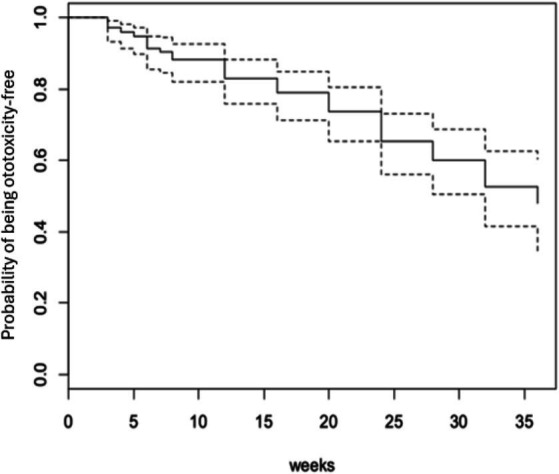
A longitudinal study of 153 adults receiving Streptomycin-based anti-tuberculous drugs was done. All participants underwent extended frequency audiometry and had normal hearing thresholds at baseline. Hearing thresholds were assessed weekly for 2 months, then monthly for the subsequent 6 months. Ototoxicity was determined using the ASHA criteria. Descriptive statistics were used to analyze socio-demographic variables. Ototoxicity incidence rate was calculated, and Kaplan-Meier estimate used to determine cumulative probability of ototoxicity. Chi-square test was done to determine parameters associated with ototoxicity and Cox regression models were used to choose the predictors of ototoxicity.
Age of participants was 41.43 ± 12.66 years, with a male-to-female ratio of 1:0.6. Ototoxicity was found in 34.6% of the participants, giving an incidence of 17.26 per 1,000-person-week. The mean onset time to ototoxicity was 28.0 ± 0.47 weeks. By 28th week, risk of developing ototoxicity for respondents below 40 years of age was 0.29, and for those above 40 years was 0.77. At the end of the follow-up period, the overall probability of developing ototoxicity in the study population was 0.74. A significant difference in onset of ototoxicity was found between the age groups: the longest onset was seen in <40 years, followed by 40-49 years, and shortest onset in ≥50 years. Hazard of ototoxicity was significantly higher in participants aged ≥50 years compared to participants aged ≤40 years (HR = 3.76, 95% CI = 1.84-7.65). The probability of ototoxicity at 40 g, 60 g and 80 g cumulative dose of Streptomycin was 0.08, 0.43 and 2.34, respectively. Age and cumulative dose were significant predictors of ototoxicity.
The mean onset time to Streptomycin-induced ototoxicity was 28 weeks after commencement of therapy. Age and cumulative dose can reliably predict the onset of Streptomycin-induced ototoxicity. Medium to long term monitoring of hearing is advised for patients on aminoglycoside therapy.
氨基糖苷类药物,如链霉素,是价格低廉、效力强大的抗生素,在撒哈拉以南非洲广泛使用。然而,氨基糖苷类药物是耳毒性最常见的病因。撒哈拉以南非洲关于氨基糖苷类药物耳毒性的前瞻性流行病学研究有限,促使本研究提供有关链霉素所致耳毒性的流行病学信息,确定耳毒性的危险因素和预测因素。
对153名接受基于链霉素的抗结核药物治疗的成年人进行了一项纵向研究。所有参与者均接受了扩展频率听力测定,且基线时听力阈值正常。在2个月内每周评估听力阈值,随后6个月每月评估一次。使用美国言语、语言和听力协会(ASHA)标准确定耳毒性。使用描述性统计分析社会人口统计学变量。计算耳毒性发病率,并使用Kaplan-Meier估计法确定耳毒性的累积概率。进行卡方检验以确定与耳毒性相关的参数,并使用Cox回归模型选择耳毒性的预测因素。
参与者的年龄为41.43±12.66岁,男女比例为1:0.6。34.6%的参与者出现耳毒性,发病率为每1000人周17.26例。耳毒性的平均发病时间为28.0±0.47周。到第28周时,40岁以下受访者发生耳毒性的风险为0.29,40岁以上者为0.77。在随访期结束时,研究人群中发生耳毒性的总体概率为0.74。各年龄组之间耳毒性的发病存在显著差异:发病时间最长的是<40岁组,其次是40 - 49岁组,≥50岁组最短。年龄≥50岁的参与者耳毒性风险显著高于年龄≤40岁的参与者(风险比[HR]=3.76,95%置信区间[CI]=1.84 - 7.65)。链霉素累积剂量为40克、60克和80克时,耳毒性的概率分别为0.08、0.43和2.34。年龄和累积剂量是耳毒性的显著预测因素。
链霉素所致耳毒性的平均发病时间为治疗开始后28周。年龄和累积剂量可以可靠地预测链霉素所致耳毒性的发生。建议对接受氨基糖苷类药物治疗的患者进行中长期听力监测。