Jackson Nathan D, Dyjack Nathan, Goleva Elena, Bin Lianghua, Montgomery Michael T, Rios Cydney, Everman Jamie L, Taylor Patricia, Bronchick Caroline, Richers Brittany N, Leung Donald Y M, Seibold Max A
Center for Genes, Environment & Health, National Jewish Health, Denver, Colorado, USA.
Department of Pediatrics, National Jewish Health, Denver, Colorado, USA.
JID Innov. 2024 Apr 2;4(4):100279. doi: 10.1016/j.xjidi.2024.100279. eCollection 2024 Jul.
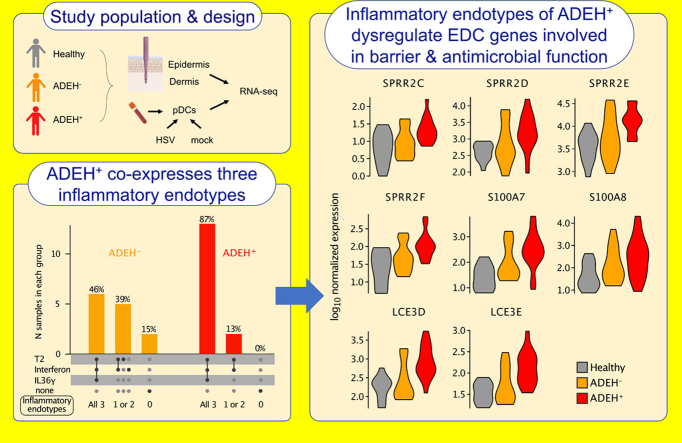
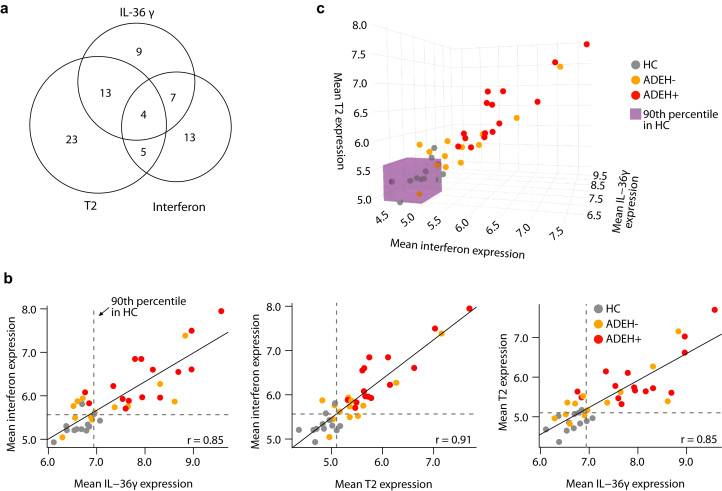
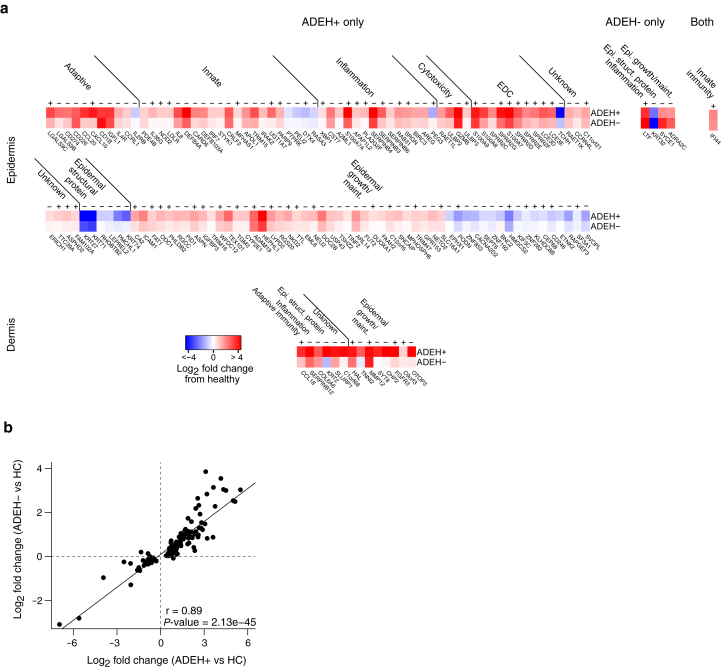
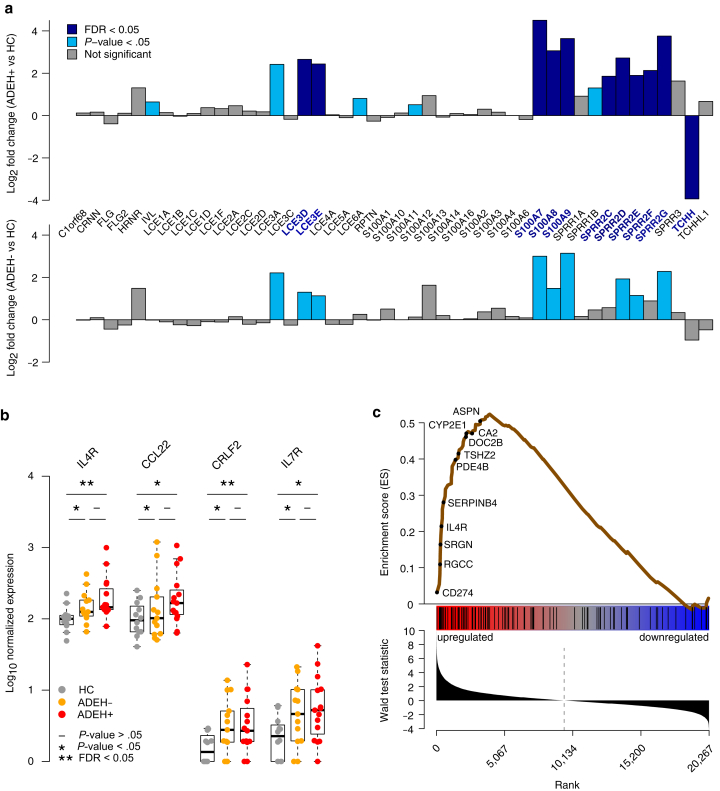
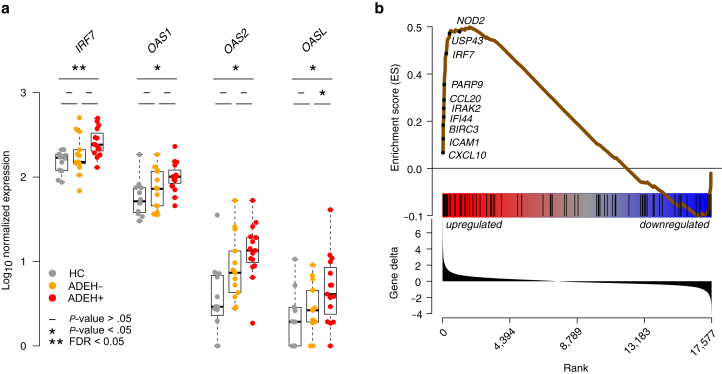
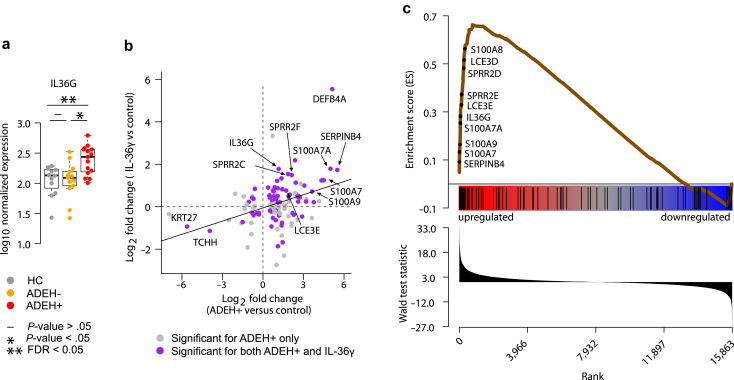
A subgroup of patients with atopic dermatitis (AD) suffers from recurrent, disseminated herpes simplex virus skin infection, termed eczema herpeticum. To determine the transcriptional mechanisms of the skin and immune system pathobiology that underlie development of AD with eczema herpeticum (ADEH), we performed RNA-sequencing analysis of nonlesional skin (epidermis, dermis) from AD patients with and without a history of ADEH (ADEH, n = 15; ADEH, n = 13) along with healthy controls (n = 15). We also performed RNA sequencing on participants' plasmacytoid dendritic cells infected in vitro with herpes simplex virus 1. ADEH patients exhibited dysregulated gene expression, limited in the dermis (14 differentially expressed genes) and more widespread in the epidermis (129 differentially expressed genes). ADEH-upregulated epidermal differentially expressed genes were enriched in type 2 cytokine ( , , ), interferon (, , and IL-36γ () inflammatory gene pathways. All ADEH participants exhibited type 2 cytokine and inteferon endotypes, and 87% were IL36G-high. In contrast, these endotypes were more variably expressed among ADEH participants. ADEH skin also had dysregulated epidermal differentiation complex gene expression of the late-cornified envelope, S100A, and small proline-rich gene families, which are involved in skin barrier function and antimicrobial activities. Plasmacytoid dendritic cell transcriptional responses to herpes simplex virus 1 infection were unaltered by ADEH status. The study concluded that the pathobiology underlying ADEH risk is associated with a unique, multifaceted epidermal inflammation that accompanies dysregulation of epidermal differentiation complex genes. These findings will help direct future studies that define how these inflammatory patterns may drive risk of eczema herpeticum in AD.
特应性皮炎(AD)患者的一个亚组会反复出现播散性单纯疱疹病毒皮肤感染,称为疱疹样湿疹。为了确定伴有疱疹样湿疹的AD(ADEH)发生发展背后的皮肤和免疫系统病理生物学的转录机制,我们对有或无ADEH病史的AD患者(ADEH组,n = 15;非ADEH组,n = 13)以及健康对照者(n = 15)的非皮损皮肤(表皮、真皮)进行了RNA测序分析。我们还对体外感染单纯疱疹病毒1的参与者的浆细胞样树突状细胞进行了RNA测序。ADEH患者表现出基因表达失调,在真皮中受限(14个差异表达基因),在表皮中更广泛(129个差异表达基因)。ADEH上调的表皮差异表达基因在2型细胞因子( 、 、 )、干扰素( 、 、 和IL-36γ( )炎症基因途径中富集。所有ADEH参与者均表现出2型细胞因子和干扰素内型,87%为IL36G高表达。相比之下,这些内型在非ADEH参与者中表达更具变异性。ADEH皮肤的晚期角质化包膜、S100A和富含脯氨酸的小基因家族的表皮分化复合基因表达也失调,这些基因家族参与皮肤屏障功能和抗菌活性。浆细胞样树突状细胞对单纯疱疹病毒1感染的转录反应不受ADEH状态的影响。该研究得出结论,ADEH风险背后的病理生物学与一种独特的、多方面的表皮炎症有关,这种炎症伴随着表皮分化复合基因的失调。这些发现将有助于指导未来的研究,以确定这些炎症模式如何驱动AD患者发生疱疹样湿疹的风险。