van Grinsven Eva E, Cialdella Fia, Gmelich Meijling Yoniet, Verhoeff Joost J C, Philippens Marielle E P, van Zandvoort Martine J E
Department of Neurology and Neurosurgery, University Medical Center Utrecht Brain Center, Utrecht University, Utrecht, The Netherlands.
Department of Radiation Oncology, University Medical Center Utrecht, Utrecht, The Netherlands.
Neurooncol Pract. 2024 Mar 29;11(4):441-451. doi: 10.1093/nop/npae024. eCollection 2024 Aug.
The increasing incidence of brain metastases (BMs) and improved survival rates underscore the necessity to investigate the effects of treatments on individuals. The aim of this study was to evaluate the individual trajectories of subjective and objective cognitive performance after radiotherapy in patients with BMs.
The study population consisted of adult patients with BMs referred for radiotherapy. A semi-structured interview and comprehensive neurocognitive assessment (NCA) were used to assess both subjective and objective cognitive performance before, 3 months and ≥ 11 months after radiotherapy. Reliable change indices were used to identify individual, clinically meaningful changes.
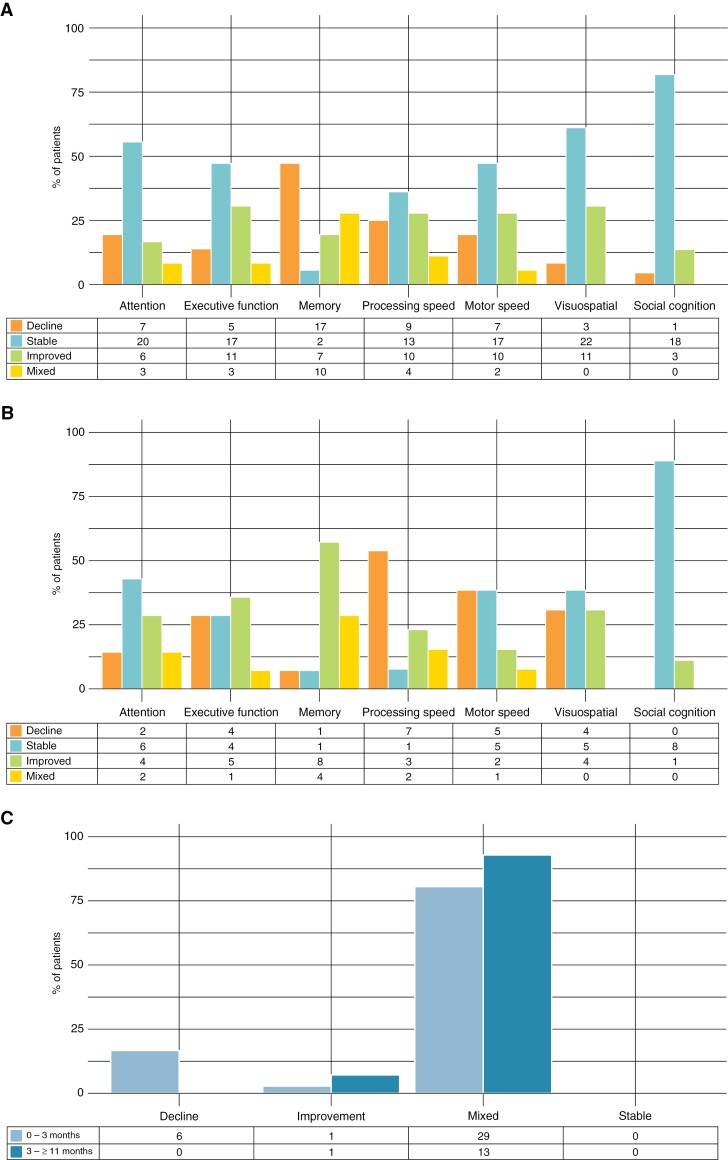
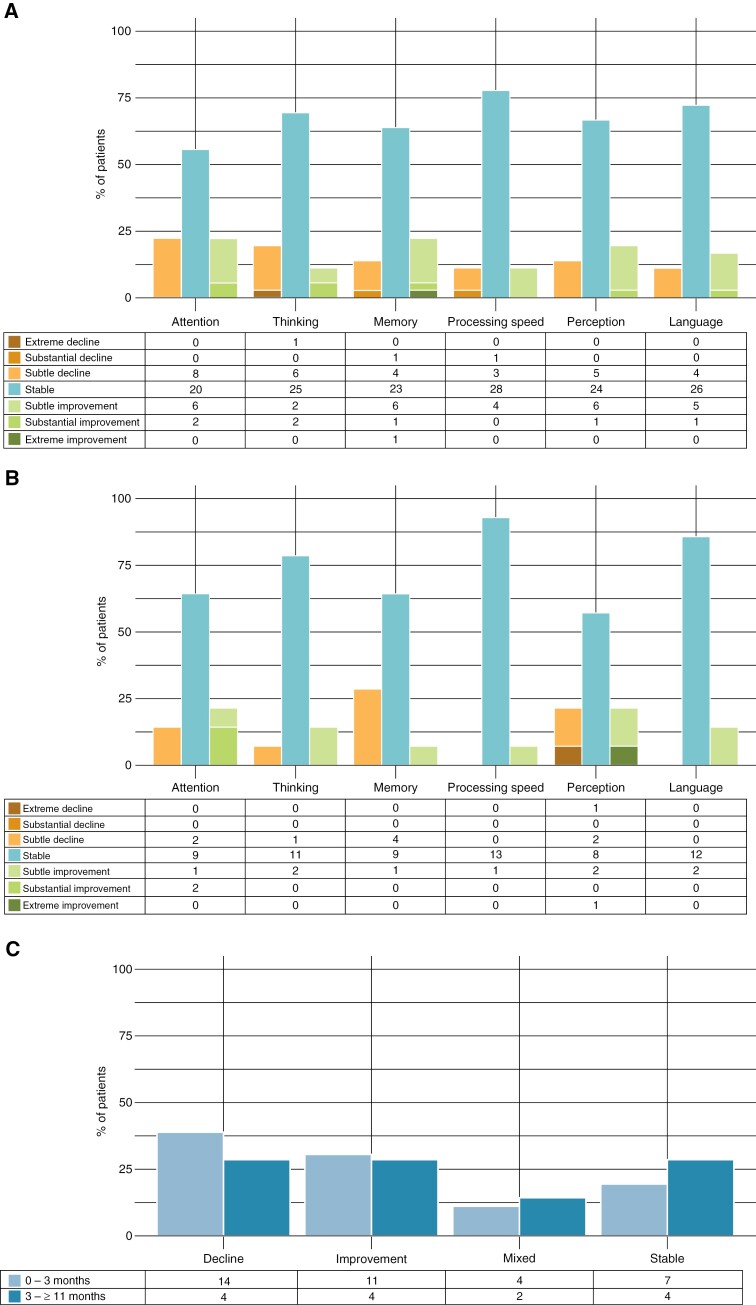
Thirty-six patients completed the 3-month follow-up, and 14 patients completed the ≥ 11-months follow-up. Depending on the domain, subjective cognitive decline was reported by 11-22% of patients. In total, 50% of patients reported subjective decline in at least one cognitive domain. Intracranial progression 3 months postradiotherapy was a risk-factor for self-reported deterioration ( = .031). Objective changes were observed across all domains, with a particular vulnerability for decline in memory at 3 months postradiotherapy. The majority of patients (81%) experienced both a deterioration as well as improvement (eg, mixed response) in objective cognitive functioning. Results were similar for the long-term follow-up (3 to ≥11 months). No risk factors for objective cognitive change 3 months postradiotherapy were identified.
Our study revealed that the majority of patients with BMs will show a mixed cognitive response following radiotherapy, reflecting the complex impact. This underscores the importance of patient-tailored NCAs 3 months postradiotherapy to guide optimal rehabilitation strategies.
脑转移瘤(BMs)发病率的上升以及生存率的提高凸显了研究治疗对个体影响的必要性。本研究的目的是评估脑转移瘤患者放疗后主观和客观认知表现的个体轨迹。
研究人群包括转诊接受放疗的成年脑转移瘤患者。采用半结构化访谈和全面神经认知评估(NCA)在放疗前、放疗后3个月和≥11个月评估主观和客观认知表现。使用可靠变化指数来识别个体的、具有临床意义的变化。
36例患者完成了3个月的随访,14例患者完成了≥11个月的随访。根据不同领域,11%-22%的患者报告有主观认知下降。总体而言,50%的患者报告至少在一个认知领域有主观下降。放疗后3个月颅内进展是自我报告病情恶化的一个危险因素(P=0.031)。在所有领域均观察到客观变化,放疗后3个月记忆力下降尤为明显。大多数患者(81%)在客观认知功能方面经历了恶化和改善(如混合反应)。长期随访(3至≥11个月)结果相似。未发现放疗后3个月客观认知变化的危险因素。
我们的研究表明,大多数脑转移瘤患者放疗后会出现混合认知反应,反映了其复杂的影响。这凸显了放疗后3个月进行针对患者的神经认知评估以指导最佳康复策略的重要性。