Dhaenens Britt A E, Heimann Günter, Bakker Annette, Nievo Marco, Ferner Rosalie E, Evans D Gareth, Wolkenstein Pierre, Leubner Jonas, Potratz Cornelia, Carton Charlotte, Iloeje Uchenna, Kirk George, Blakeley Jaishri O, Plotkin Scott, Fisher Michael J, Kim AeRang, Driever Pablo Hernáiz, Azizi Amedeo A, Widemann Brigitte C, Gross Andrea, Parke Tom, Legius Eric, Oostenbrink Rianne
Department of General Paediatrics, Erasmus MC-Sophia Children's Hospital, Rotterdam, The Netherlands.
ENCORE Expertise Centre for Neurodevelopmental Disorders, Erasmus MC, Rotterdam, The Netherlands.
Neurooncol Pract. 2024 Jan 4;11(4):395-403. doi: 10.1093/nop/npae001. eCollection 2024 Aug.
Neurofibromatosis type 1, -related schwannomatosis and non--related schwannomatosis (grouped under the abbreviation "NF") are rare hereditary tumor predisposition syndromes. Due to the low prevalence, variability in the range, and severity of manifestations, as well as limited treatment options, these conditions require innovative trial designs to accelerate the development of new treatments.
Within European Patient-Centric Clinical Trial Platforms (EU-PEARL), we designed 2 platform-basket trials in NF. The trials were designed by a team of multidisciplinary NF experts and trial methodology experts.
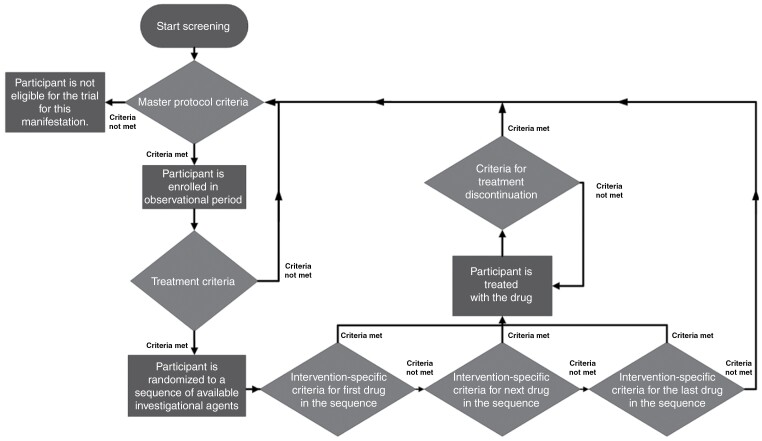
The trial will consist of an observational and a treatment period. The observational period will serve as a longitudinal natural history study. The platform trial design and randomization to a sequence of available interventions allow for the addition of interventions during the trial. If a drug does not meet the predetermined efficacy endpoint or reveals unacceptable toxicities, participants may stop treatment on that arm and re-enter the observational period, where they can be re-randomized to a different treatment arm if eligible. Intervention-specific eligibility criteria and endpoints are listed in intervention-specific-appendices, allowing the flexibility and adaptability needed for highly variable and rare conditions like NF.
These innovative platform-basket trials for NF may serve as a model for other rare diseases, as they will enhance the chance of identifying beneficial treatments through optimal learning from a small number of patients. The goal of these trials is to identify beneficial treatments for NF more rapidly and at a lower cost than traditional, single-agent clinical trials.
1型神经纤维瘤病、相关的神经鞘瘤病和非相关的神经鞘瘤病(简称为“NF”)是罕见的遗传性肿瘤易感性综合征。由于其患病率低、表现范围和严重程度存在差异,以及治疗选择有限,这些病症需要创新的试验设计来加速新治疗方法的开发。
在欧洲以患者为中心的临床试验平台(EU-PEARL)内,我们设计了两项针对NF的平台篮子试验。这些试验由多学科NF专家和试验方法专家团队设计。
该试验将包括一个观察期和一个治疗期。观察期将作为一项纵向自然史研究。平台试验设计和对一系列可用干预措施的随机分组允许在试验期间增加干预措施。如果一种药物未达到预定的疗效终点或显示出不可接受的毒性,参与者可以停止该组治疗并重新进入观察期,如果符合条件,他们可以重新随机分组到不同的治疗组。特定干预措施的入选标准和终点在特定干预措施附录中列出,这为像NF这样高度可变和罕见的病症提供了所需的灵活性和适应性。
这些针对NF的创新平台篮子试验可作为其他罕见病的模型,因为它们将通过从少数患者中进行最佳学习来提高识别有益治疗方法的机会。这些试验的目标是比传统的单药临床试验更快、更低成本地识别出对NF有益的治疗方法。