Walton Robert A, Liuzza Lindsey, Takawira Catherine, Leonardi Claudia, Lopez Mandi J
Laboratory for Equine and Comparative Orthopedic Research, Veterinary Clinical Sciences Department, School of Veterinary Medicine, Louisiana State University, Baton Rouge, Louisiana, U.S.A.
Department of Orthopaedics, Louisiana State University School of Medicine, New Orleans, Louisiana, U.S.A.
Arthrosc Sports Med Rehabil. 2024 Apr 9;6(3):100938. doi: 10.1016/j.asmr.2024.100938. eCollection 2024 Jun.
To compare tensile fatigue and strength measures of biocomposite and all-suture anchors in an ovine humerus-infraspinatus tendon model of rotator cuff repair.
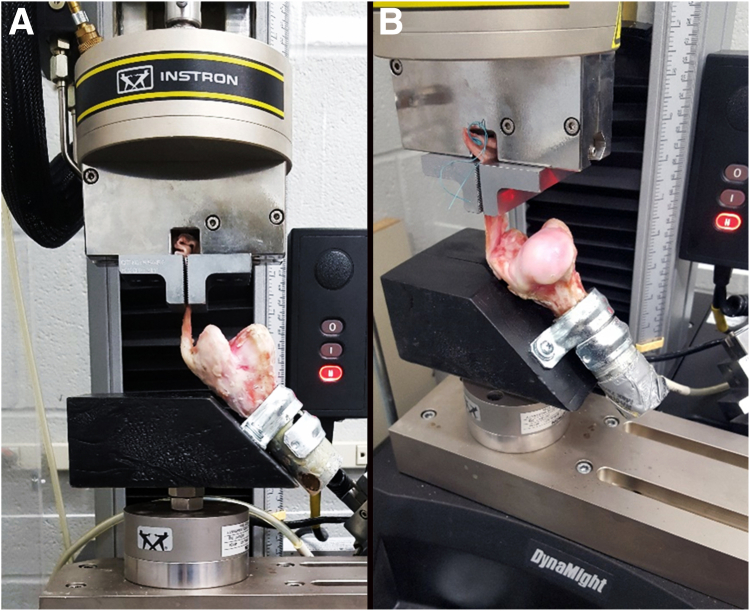
Infraspinatus tendons on adult ovine humeri were sharply transected at the insertion. One of each pair was assigned randomly for fixation with 2 biocomposite or all-suture anchors. Constructs were tested with 200 cycles of 20 to 70 N tensile load, and gap formation was measured at the incised tendon end every 50 cycles. They were subsequently tested to failure. Outcome measures including fatigue stiffness, hysteresis, creep, and gap formation and tensile stiffness, and yield and failure displacement, load, and energy were compared between anchors.
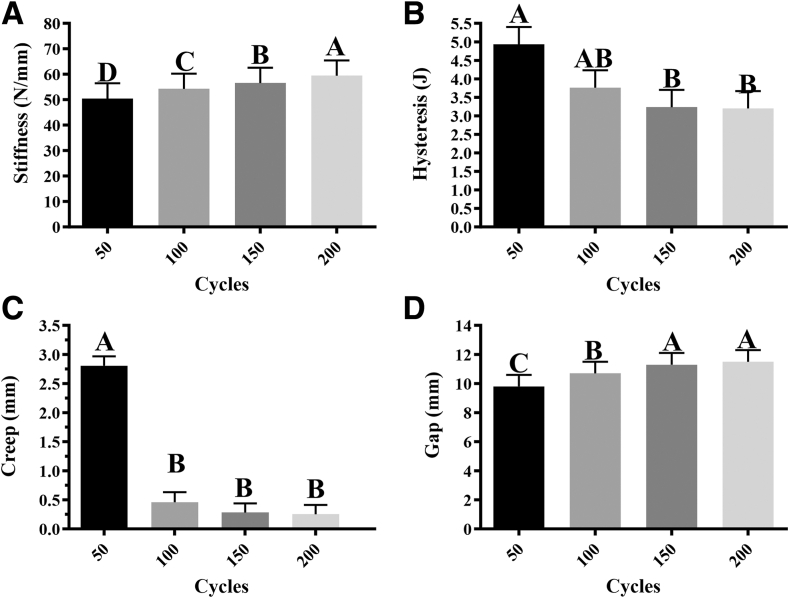
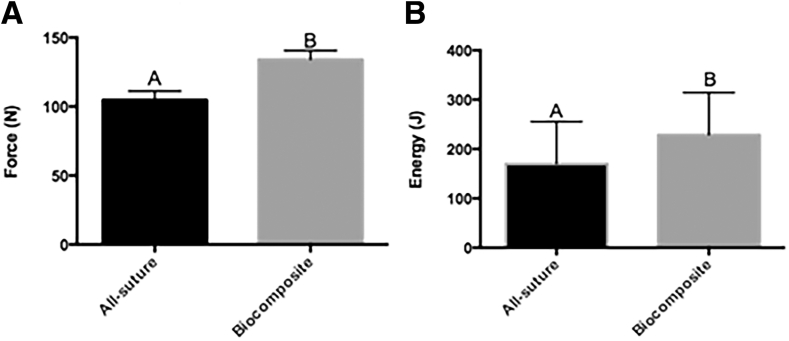
Biocomposite anchors had greater yield load (134.1 ± 6.5 N, < .01) and energy (228.6 ± 85.7 J, < .03) than all-suture anchors (104.7 ± 6.5 N, 169.8 ± 85.7 J). Fatigue properties were not different between anchors, but stiffness and gap formation increased and hysteresis and creep decreased significantly with increasing cycle number.
Although the yield displacement of both anchors was within the range of clinical failure, the tensile yield load and energy of ovine infraspinatus tendons secured to the humerus with 2 single-loaded all-suture anchors in a single row were significantly lower than those secured with 2 biocomposite anchors in the same configuration.
It is important to understand the biomechanical properties for selecting anchors for rotator cuff repair. A direct comparison of fatigue testing followed by failure strength of infraspinatus tendon fixation with all-suture and biocomposite anchors could help guide anchor selection and postoperative mobility recommendations.
在肩袖修复的羊肱骨-冈下肌腱模型中比较生物复合材料锚钉和全缝线锚钉的拉伸疲劳及强度指标。
将成年羊肱骨上的冈下肌腱在止点处锐性切断。每对肌腱中的一条随机分配用2个生物复合材料锚钉或全缝线锚钉进行固定。对构建物施加20至70 N的拉伸负荷,进行200次循环测试,每50次循环在切断的肌腱末端测量间隙形成情况。随后测试至失效。比较两种锚钉之间的疲劳刚度、滞后、蠕变、间隙形成以及拉伸刚度、屈服和失效位移、负荷及能量等结果指标。
生物复合材料锚钉的屈服负荷(134.1±6.5 N,P<0.01)和能量(228.6±85.7 J,P<0.03)高于全缝线锚钉(104.7±6.5 N,169.8±85.7 J)。两种锚钉的疲劳性能无差异,但随着循环次数增加,刚度和间隙形成增加,滞后和蠕变显著降低。
尽管两种锚钉的屈服位移均在临床失效范围内,但在单排中用2个单负荷全缝线锚钉固定于肱骨的羊冈下肌腱的拉伸屈服负荷和能量显著低于用相同构型的2个生物复合材料锚钉固定的情况。
了解生物力学性能对于选择肩袖修复的锚钉很重要。对全缝线和生物复合材料锚钉固定冈下肌腱的疲劳测试及随后的失效强度进行直接比较,有助于指导锚钉选择和术后活动建议。