School of Natural Sciences, Faculty of Science & Engineering, University of Manchester, United Kingdom.
School of Biological Sciences, Faculty of Biology, Medicine & Health, University of Manchester, United Kingdom.
PLoS Biol. 2024 Jul 15;22(7):e3002711. doi: 10.1371/journal.pbio.3002711. eCollection 2024 Jul.
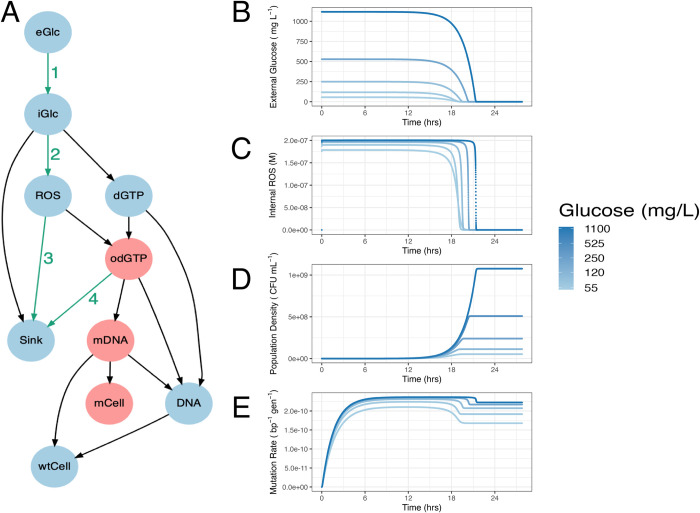
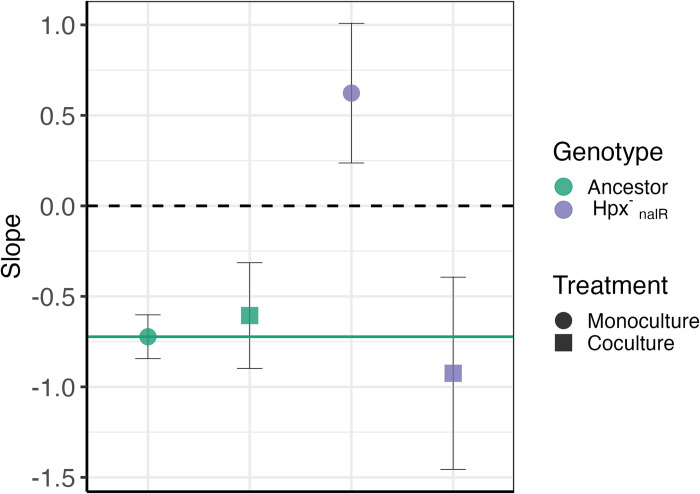
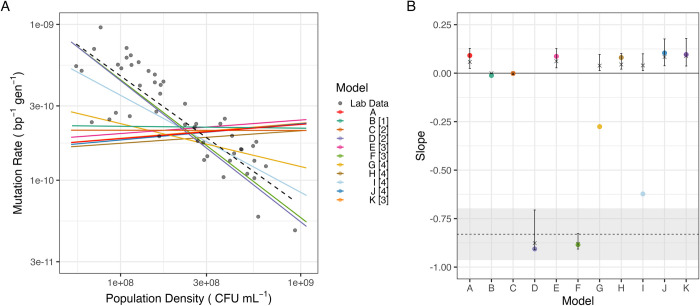
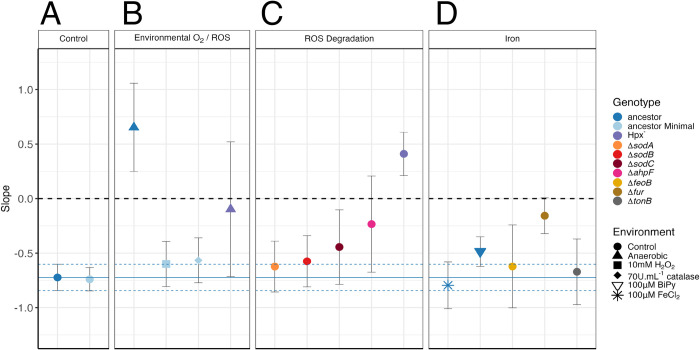
Mutagenesis is responsive to many environmental factors. Evolution therefore depends on the environment not only for selection but also in determining the variation available in a population. One such environmental dependency is the inverse relationship between mutation rates and population density in many microbial species. Here, we determine the mechanism responsible for this mutation rate plasticity. Using dynamical computational modelling and in culture mutation rate estimation, we show that the negative relationship between mutation rate and population density arises from the collective ability of microbial populations to control concentrations of hydrogen peroxide. We demonstrate a loss of this density-associated mutation rate plasticity (DAMP) when Escherichia coli populations are deficient in the degradation of hydrogen peroxide. We further show that the reduction in mutation rate in denser populations is restored in peroxide degradation-deficient cells by the presence of wild-type cells in a mixed population. Together, these model-guided experiments provide a mechanistic explanation for DAMP, applicable across all domains of life, and frames mutation rate as a dynamic trait shaped by microbial community composition.
突变是对许多环境因素的响应。因此,进化不仅取决于环境选择,还取决于种群中可用的变异。这种环境依赖性之一是许多微生物物种中突变率与种群密度之间的反比关系。在这里,我们确定了导致这种突变率可塑性的机制。通过动态计算建模和培养物突变率估计,我们表明,突变率与种群密度之间的负相关关系源于微生物种群控制过氧化氢浓度的集体能力。我们证明,当大肠杆菌种群缺乏过氧化氢的降解能力时,这种与密度相关的突变率可塑性(DAMP)就会丧失。我们进一步表明,在混合种群中存在野生型细胞时,可恢复在过氧化氢降解缺陷细胞中密集种群中降低的突变率。这些模型指导的实验共同为 DAMP 提供了一种机制解释,适用于所有生命领域,并将突变率作为一种由微生物群落组成塑造的动态特征。