One Health Research Group, Universidad de Las Americas, Quito, Ecuador.
School of Medicine, Ulster University, Londonderry, Northern Ireland, UK.
Nutr J. 2024 Jul 16;23(1):78. doi: 10.1186/s12937-024-00979-5.
The promotion of daily breakfast consumption and the importance of making appropriate breakfast choices have been underscored as significant public health messages. The aim of this study was to examine the relationship between breakfast frequency and life satisfaction in large and representative samples of school-going children and adolescents aged 10-17 years from 42 different countries.
This study used information from the 2017/2018 Health Behavior in School-aged Children study, comprising nationally representative samples of children and adolescents aged 10-17 years who were attending school. The total number of participants from the 42 countries included in the study was 155,451 (51.3% girls). The evaluation of breakfast consumption in this study involved a specific question: "How often do you typically have breakfast (more than a glass of milk or fruit juice)?". To measure life satisfaction, a subjective assessment scale was used in the form of a ladder, visually spanning from 0 to 10. On this scale, the topmost point (10) denotes the highest conceivable quality of life, whereas the bottom point (0) represents the worst imaginable quality of life.
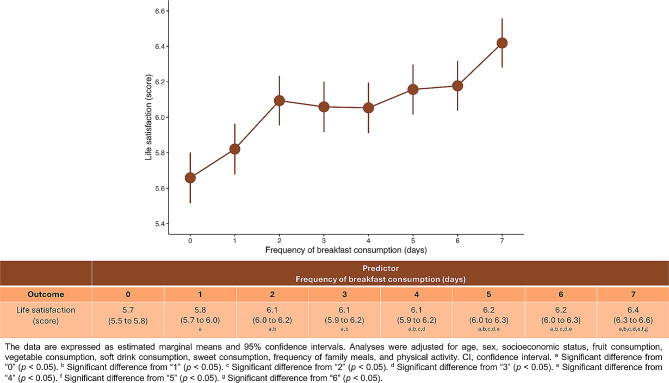
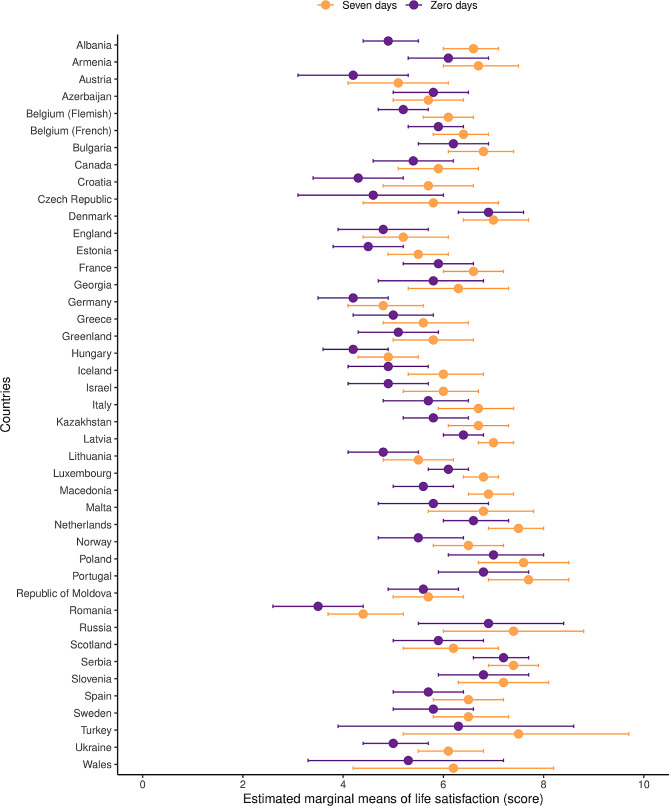
After adjusting for several covariates, the lowest estimated marginal mean of life satisfaction was identified in those participants who skipped breakfast (mean [M] = 5.6, 95% confidence interval [CI] 5.5 to 5.8). Conversely, the highest estimated marginal mean of life satisfaction was observed in those who had breakfast every day (M = 6.5, 95% CI 6.3 to 6.6). Overall, a nearly linear relationship between higher frequency of breakfast and greater life satisfaction in children and adolescents was identified (p-for-trend < 0.001). In addition, the highest estimated marginal mean of life satisfaction score was identified in those participants from Portugal who had breakfast every day (M = 7.7; 95% CI 6.9 to 8.5 points). Conversely, the lowest estimated marginal mean of life satisfaction was observed in those participants from Romania who no breakfast (M = 3.5; 95% CI 2.6 to 4.4 points).
There is a nearly linear relationship between higher frequency of breakfast and greater life satisfaction in children and adolescents. Considering the potential health advantages associated with breakfast during this critical age phase, these findings imply the necessity for additional global efforts to promote increased breakfast consumption among children and adolescents.
促进日常早餐消费和选择合适早餐的重要性已被强调为重要的公共卫生信息。本研究旨在检验早餐频率与 42 个不同国家/地区 10-17 岁在校儿童和青少年生活满意度之间的关系。
本研究使用了 2017/2018 年“学生健康行为”研究的数据,该研究包含来自 42 个国家/地区的代表性样本,年龄在 10-17 岁之间,正在上学。共有来自 42 个国家/地区的 155451 名参与者(51.3%为女生)。本研究通过一个具体问题评估早餐消费情况:“你通常多久吃一次早餐(超过一杯牛奶或果汁)?”。为了衡量生活满意度,采用了主观评估量表的形式,即梯子,从 0 到 10 不等。在这个量表上,最上面的点(10)表示最高的生活质量,而最下面的点(0)表示最差的生活质量。
调整了几个协变量后,发现不吃早餐的参与者的生活满意度最低(估计边际平均值 [M] = 5.6,95%置信区间 [CI] 5.5 至 5.8)。相反,每天吃早餐的参与者的生活满意度最高(M = 6.5,95%CI 6.3 至 6.6)。总体而言,在儿童和青少年中,早餐频率越高,生活满意度越高,呈近似线性关系(p 趋势<0.001)。此外,每天吃早餐的葡萄牙参与者的生活满意度最高(M = 7.7;95%CI 6.9 至 8.5 分)。相反,不吃早餐的罗马尼亚参与者的生活满意度最低(M = 3.5;95%CI 2.6 至 4.4 分)。
在儿童和青少年中,早餐频率与生活满意度之间呈近似线性关系。考虑到在这个关键年龄阶段早餐可能带来的健康益处,这些发现意味着需要在全球范围内进一步努力,促进儿童和青少年增加早餐的摄入。