Leonard Rachel, O'Connor Sean R, Hanratty Jennifer, Keenan Ciara, Chi Yuan, Ferguson Jenny, Axiaq Ariana, Volz Anna, Welsh Ceri, Campbell Kerry, Hawkins Victoria, Miller Sarah, Bradley Declan, Dempster Martin
School of Psychology Queen's University Belfast Belfast UK.
Centre for Evidence and Social Innovation Queen's University Belfast Belfast UK.
Campbell Syst Rev. 2024 Jul 15;20(3):e1421. doi: 10.1002/cl2.1421. eCollection 2024 Sep.
The COVID-19 pandemic, caused by the SARS-CoV-2 virus, has resulted in illness, deaths and societal disruption on a global scale. Societies have implemented various control measures to reduce transmission of the virus and mitigate its impact. Individual behavioural changes are crucial to the successful implementation of these measures. One commonly recommended measure to limit risk of infection is frequent handwashing. It is important to identify those factors that can predict the uptake and maintenance of handwashing.
We aimed to identify and synthesise the evidence on malleable psychological and psychosocial factors that determine uptake and adherence to handwashing aimed at reducing the risk of infection or transmission of COVID-19.
We searched various literature sources including electronic databases (Medline ALL, Child Development & Adolescent Studies, ERIC, PsycInfo, CINAHL and Web of Science), web searches, conference proceedings, government reports, other repositories of literature and grey literature. The search strategy was built around three concepts of interest including (1) context (terms relating to COVID-19), (2) behaviour of interest and (3) terms related to psychological and psychosocial determinants of COVID Health-Related Behaviours and adherence or compliance with handwashing, to capture malleable determines. Searches capture studies up until October 2021.
Eligibility criteria included observational studies (both retrospective and prospective) and experimental studies that measure and report malleable psychological and psychosocial determinants and handwashing at an individual level, amongst the general public. Screening was supported by the Cochrane Crowd. Titles and abstracts were screened against the eligibility criteria by three independent screeners. Following this, all potentially relevant studies were screened at full-text level by the research team. All conflicts between screeners were resolved by discussion between the core research team.
All data extraction was managed in EPPI-Reviewer software. All eligible studies, identified through full-text screening were extracted by one author. We extracted data on study information, population, determinant, behaviour and effects. A second author checked data extraction on 20% of all included papers. All conflicts were discussed by the two authors until consensus was reached.We assessed methodological quality of all included studies using an adapted version of the Joanna Briggs Institute Quality appraisal tool for cross-sectional studies.
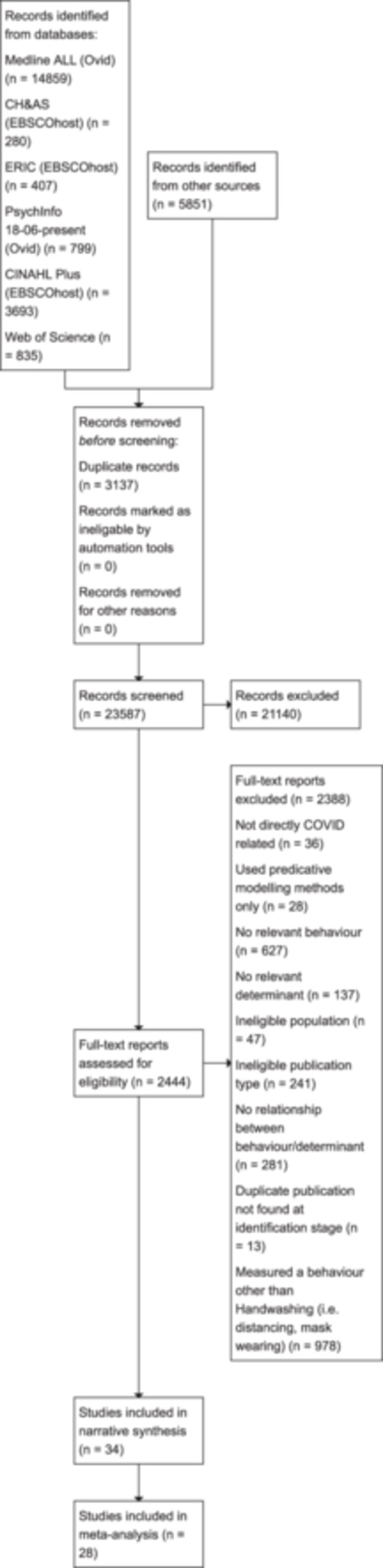
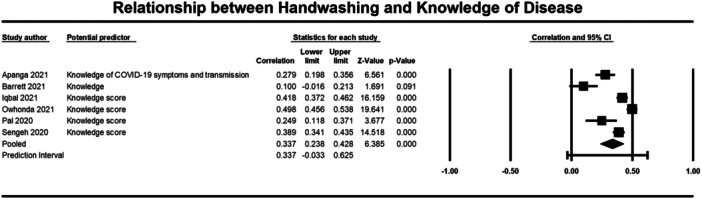
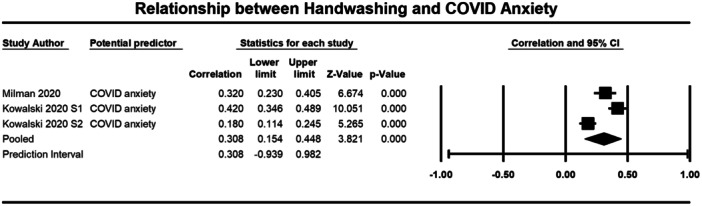
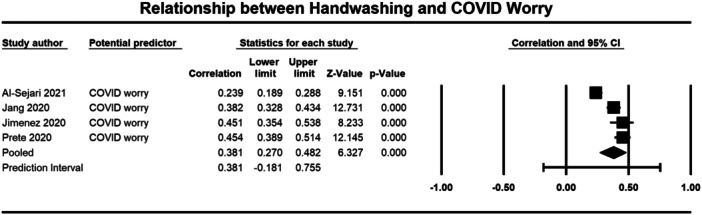
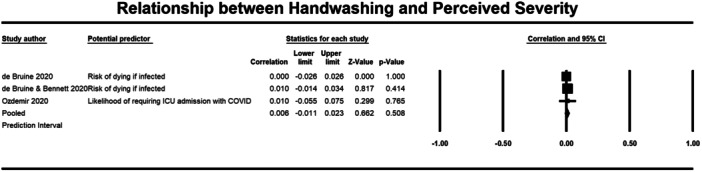
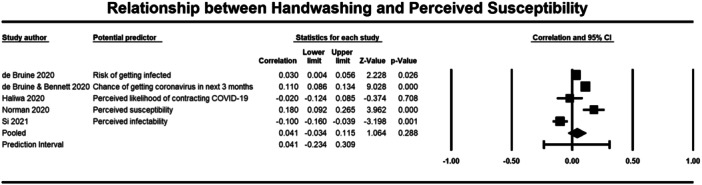
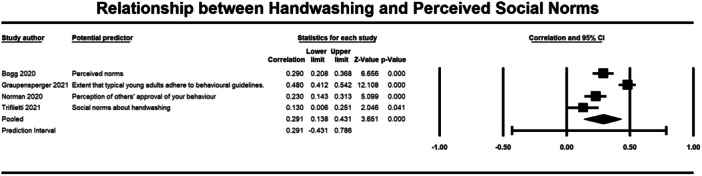
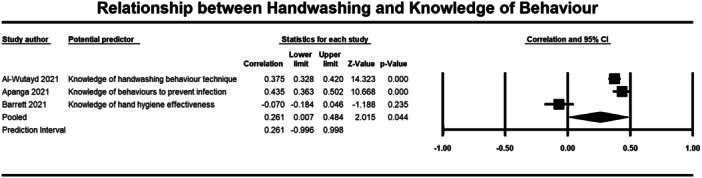
Our initial searches yielded 23,587 results, of which 56 studies were included in this review. The included studies were cross sectional in design, came from 22 countries and had a combined sample of 199,376 participants. The vast majority of studies had samples from the general public, with eight of the studies focusing on specific samples. All included studies considered people over the age of 18. The quality of the majority of the studies was good ( = 30 rated low risk of bias), with 8 rated high risk of bias, predominately due to lack of reporting of recruitment, sample characteristics and methodology. Thirty-four studies were included in the narrative synthesis and 28 in the meta-analysis.Findings indicated that emotions about COVID-19 (worry [0.381, confidence interval [CI] = 0.270-0.482, = 92%) and anxiety (0.308, CI = 0.154-0.448, = 91%]), knowledge of COVID-19 (0.323, CI = 0.223-0.417, = 94%), and perceived social norms (0.303, CI = 0.184-0.413, = 92%) were among the malleable determinants most associated with handwashing. Perceived severity (0.006, CI = -0.011-0.023) and susceptibility of COVID-19 (0.041, CI = -0.034 to 0.115) had little to no effect on handwashing behaviour.
AUTHORS' CONCLUSIONS: Understanding the effects of various malleable determinants on COVID-related handwashing can aid in the development and implementation of interventions and public health campaigns to promote handwashing behaviour in potential new waves of COVID-19 or other respiratory infections. Emotions about COVID, knowledge of COVID and perceived social norms warrant further consideration in future research and policy.
由严重急性呼吸综合征冠状病毒2(SARS-CoV-2)引起的2019冠状病毒病疫情已在全球范围内导致疾病、死亡和社会混乱。各国已实施各种控制措施以减少病毒传播并减轻其影响。个人行为改变对于这些措施的成功实施至关重要。一项普遍推荐的降低感染风险的措施是经常洗手。确定那些能够预测洗手行为的采纳和持续坚持的因素很重要。
我们旨在识别和综合关于可改变的心理和社会心理因素的证据,这些因素决定了为降低2019冠状病毒病感染或传播风险而进行的洗手行为的采纳和坚持。
我们搜索了各种文献来源,包括电子数据库(Medline ALL、儿童发展与青少年研究、教育资源信息中心数据库、心理学文摘数据库、护理学与健康领域数据库及科学引文索引数据库)、网络搜索、会议论文集、政府报告、其他文献库及灰色文献。搜索策略围绕三个感兴趣的概念构建,包括(1)背景(与2019冠状病毒病相关的术语)、(2)感兴趣的行为以及(3)与2019冠状病毒病健康相关行为的心理和社会心理决定因素以及洗手的坚持或依从性相关的术语,以获取可改变的决定因素。搜索涵盖截至2021年10月的研究。
纳入标准包括观察性研究(回顾性和前瞻性)以及在普通公众中测量和报告可改变的心理和社会心理决定因素及洗手情况的实验性研究。筛选由Cochrane众包平台提供支持。标题和摘要由三名独立筛选人员根据纳入标准进行筛选。在此之后,研究团队对所有潜在相关研究进行全文筛选。筛选人员之间的所有冲突均通过核心研究团队的讨论得以解决。
所有数据提取均在EPPI-Reviewer软件中进行管理。通过全文筛选确定的所有符合条件的研究由一名作者进行提取。我们提取了关于研究信息、人群、决定因素、行为和效果的数据。另一名作者对所有纳入论文的20%进行了数据提取检查。两位作者对所有冲突进行讨论,直至达成共识。我们使用乔安娜·布里格斯研究所横断面研究质量评估工具的改编版本评估所有纳入研究的方法学质量。
我们最初的搜索产生了23,587条结果,其中56项研究纳入了本综述。纳入的研究在设计上为横断面研究,来自22个国家,样本总量为199,376名参与者。绝大多数研究的样本来自普通公众,其中八项研究聚焦于特定样本。所有纳入研究均纳入了18岁以上人群。大多数研究的质量良好(30项被评为低偏倚风险),8项被评为高偏倚风险,主要原因是缺乏对招募、样本特征和方法学的报告。34项研究纳入了叙述性综合分析,28项纳入了荟萃分析。研究结果表明,对2019冠状病毒病的情绪(担忧[0.381,置信区间[CI]=0.270 - 0.482,=92%])和焦虑(0.308,CI = 0.154 - 0.448,=91%])、对2019冠状病毒病的了解(0.323,CI = 0.223 - 0.417,=94%])以及感知到的社会规范(0.303,CI = 0.184 - 0.413,=92%])是与洗手最相关的可改变决定因素。对2019冠状病毒病的感知严重性(0.006,CI = -0.011 - 0.023)和易感性(0.041,CI = -0.034至0.115)对洗手行为几乎没有影响。
了解各种可改变决定因素对与2019冠状病毒病相关的洗手行为的影响,有助于制定和实施干预措施及公共卫生宣传活动,以在2019冠状病毒病或其他呼吸道感染的潜在新一波疫情中促进洗手行为。对2019冠状病毒病的情绪、对2019冠状病毒病的了解以及感知到的社会规范在未来研究和政策中值得进一步考虑。