School of Competitive Sport, Shandong Sport University, Shandong, China.
Center for Health and Exercise Science Research, Hong Kong Baptist University, Hong Kong, China.
Ann Behav Med. 2022 Nov 5;56(11):1174-1187. doi: 10.1093/abm/kaac049.
Hand hygiene, facemask wearing, and physical distancing play a crucial role in the prevention of the COVID-19 pandemic. Identifying the key psychosocial determinants of these precautionary behaviors contributes to effective intervention and policymaking for COVID-19 and future pandemics.
This study aimed to systematically review and meta-analyze available evidence on psychosocial determinants of the general population's practice of three precautionary behaviors, based on the Risk, Attitudes, Norms, Abilities, and Self-regulation (RANAS) framework.
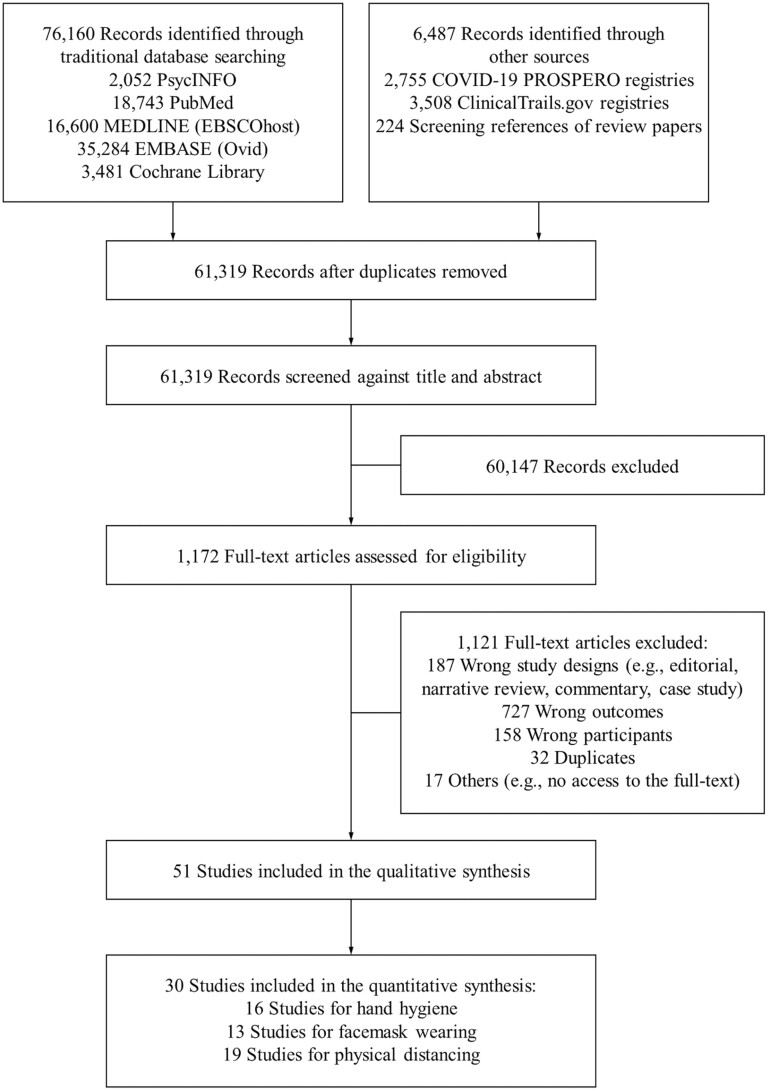
Literature was identified by searching seven databases and relevant review papers. Observational and experimental studies targeting the general population (≥18 years) published between January 2020 to September 2021 were included. Pooled effect sizes were calculated with the inverse-variance method using random-effects models.
A total of 51 studies (64 samples) were included in the qualitative synthesis, of which 30 studies (42 samples) were included in the meta-analysis. RANAS-based constructs including knowledge, pros attitudes, and perceived norms were identified as significant determinants of all three behaviors in the meta-analysis. Perceived susceptibility and cons attitudes showed no significant associations with any behaviors. Perceived severity, perceived control, self-efficacy, and behavioral intention were significantly associated with one or two behaviors. Country (western vs. eastern hemispheres) significantly moderated the effects of certain risk and ability factors.
More research is needed with respect to the intention-behavior relationship, self-regulatory and reflexive factors of precautionary behaviors, as well as the exploration of the potential moderating effect of sociodemographic factors.
手卫生、戴口罩和保持身体距离在 COVID-19 大流行的预防中起着至关重要的作用。确定这些预防措施行为的关键心理社会决定因素有助于为 COVID-19 和未来的大流行制定有效的干预和政策。
本研究旨在根据风险、态度、规范、能力和自我调节(RANAS)框架,系统地回顾和荟萃分析有关普通人群实施三种预防措施行为的心理社会决定因素的现有证据。
通过搜索七个数据库和相关综述文章来确定文献。纳入针对普通人群(≥18 岁)的观察性和实验性研究,发表时间为 2020 年 1 月至 2021 年 9 月。使用随机效应模型的逆方差法计算汇总效应大小。
共纳入 51 项研究(64 个样本)进行定性综合分析,其中 30 项研究(42 个样本)纳入荟萃分析。基于 RANAS 的结构包括知识、积极态度和感知规范,被确定为所有三种行为的重要决定因素。感知易感性和消极态度与任何行为均无显著关联。感知严重性、感知控制、自我效能感和行为意向与一种或两种行为显著相关。国家(西半球与东半球)显著调节了某些风险和能力因素的影响。
需要进一步研究预防行为的意图-行为关系、自我监管和反思因素,以及社会人口因素的潜在调节作用。