BHF Centre for Cardiovascular Science, University of Edinburgh, Edinburgh, UK.
Usher Institute, University of Edinburgh, Edinburgh, UK.
Age Ageing. 2024 Jul 2;53(7). doi: 10.1093/ageing/afae150.
Frailty is increasingly present in patients with acute myocardial infarction. The electronic Frailty Index (eFI) is a validated method of identifying vulnerable older patients in the community from routine primary care data. Our aim was to assess the relationship between the eFI and outcomes in older patients hospitalised with acute myocardial infarction.
Retrospective cohort study using the DataLoch Heart Disease Registry comprising consecutive patients aged 65 years or over hospitalised with a myocardial infarction between October 2013 and March 2021.
Patients were classified as fit, mild, moderate, or severely frail based on their eFI score. Cox-regression analysis was used to determine the association between frailty category and all-cause mortality.
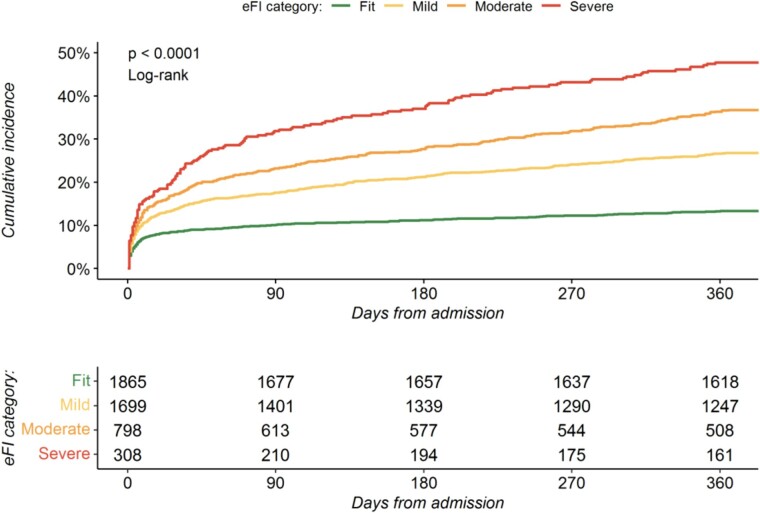
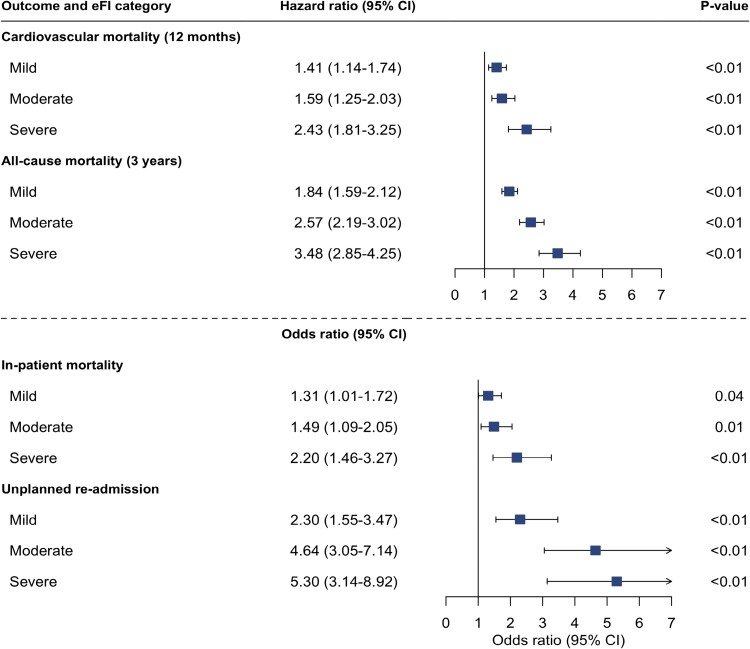
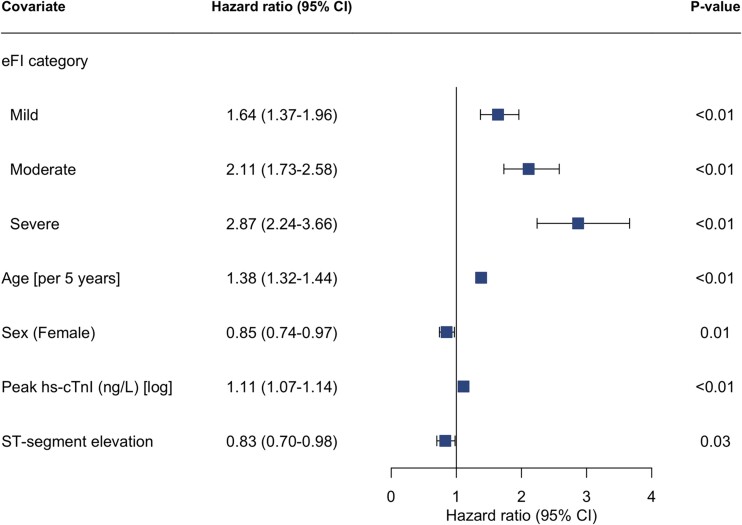
In 4670 patients (median age 77 years [71-84], 43% female), 1865 (40%) were classified as fit, with 1699 (36%), 798 (17%) and 308 (7%) classified as mild, moderate and severely frail, respectively. In total, 1142 patients died within 12 months of which 248 (13%) and 147 (48%) were classified as fit and severely frail, respectively. After adjustment, any degree of frailty was associated with an increased risk of all-cause death with the risk greatest in the severely frail (reference = fit, adjusted hazard ratio 2.87 [95% confidence intervals 2.24 to 3.66]).
The eFI identified patients at high risk of death following myocardial infarction. Automatic calculation within administrative data is feasible and could provide a low-cost method of identifying vulnerable older patients on hospital presentation.
衰弱在急性心肌梗死患者中越来越常见。电子衰弱指数(eFI)是一种从常规初级保健数据中识别社区中脆弱老年患者的经过验证的方法。我们的目的是评估 eFI 与老年急性心肌梗死住院患者结局之间的关系。
这是一项回顾性队列研究,使用 DataLoch 心脏病登记处,该登记处包含 2013 年 10 月至 2021 年 3 月期间因心肌梗死住院的年龄在 65 岁或以上的连续患者。
根据 eFI 评分将患者分为健康、轻度、中度或严重衰弱。Cox 回归分析用于确定衰弱类别与全因死亡率之间的关联。
在 4670 名患者(中位年龄 77 岁[71-84],43%为女性)中,1865 名(40%)被归类为健康,1699 名(36%)、798 名(17%)和 308 名(7%)分别归类为轻度、中度和严重衰弱。共有 1142 名患者在 12 个月内死亡,其中 248 名(13%)和 147 名(48%)分别归类为健康和严重衰弱。调整后,任何程度的衰弱与全因死亡风险增加相关,严重衰弱的风险最大(参考=健康,调整后的危险比 2.87 [95%置信区间 2.24 至 3.66])。
eFI 确定了心肌梗死后死亡风险高的患者。在行政数据中自动计算是可行的,可以为在医院就诊时识别脆弱的老年患者提供一种低成本的方法。