Giraudo Chiara, Cavallin Celeste, Pillon Marta, Carraro Elisa, Fichera Giulia, Cecchin Diego, Zucchetta Pietro
Unit of Advanced Clinical and Translational Imaging, Department of Cardiac, Thoracic, Vascular Sciences and Public Health-DCTV, University of Padova, Padova, Italy.
Hospital of Cittadella, Cittadella, Italy.
Eur Radiol. 2025 Jan;35(1):341-350. doi: 10.1007/s00330-024-10957-4. Epub 2024 Jul 16.
To use Dixon-MR images extracted from [F]FDG-PET/MR scans to perform an automatic, volumetric segmentation and quantification of body composition in pediatric patients with lymphoma.
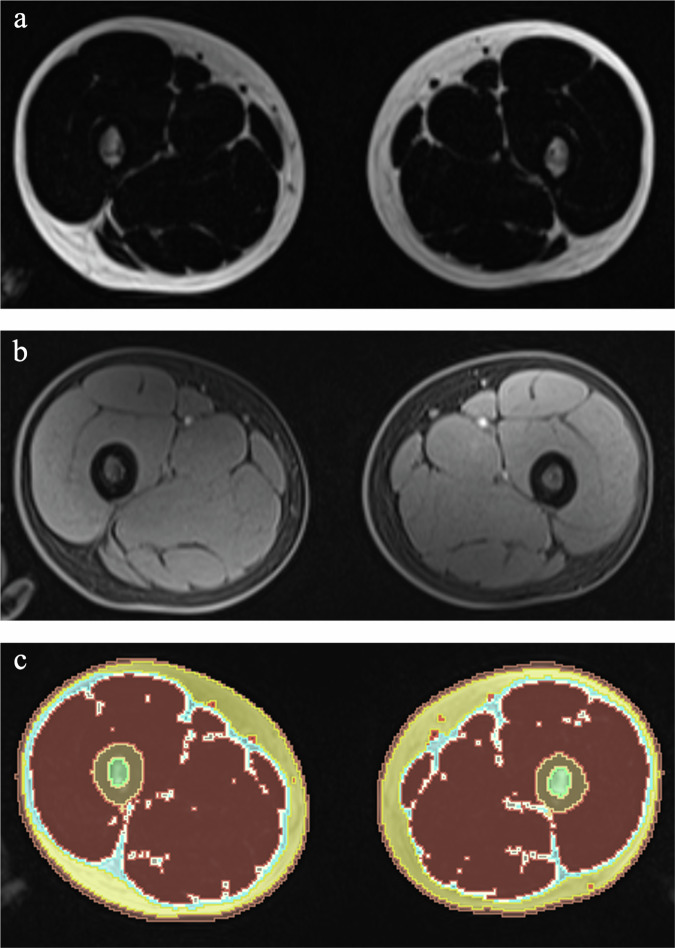
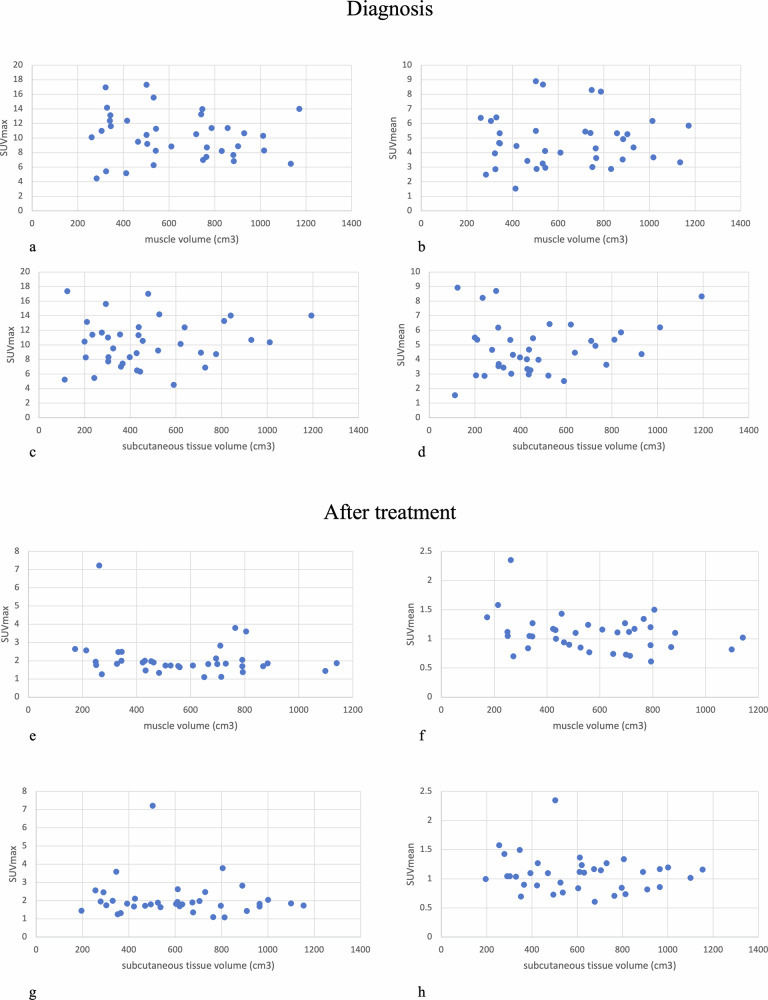
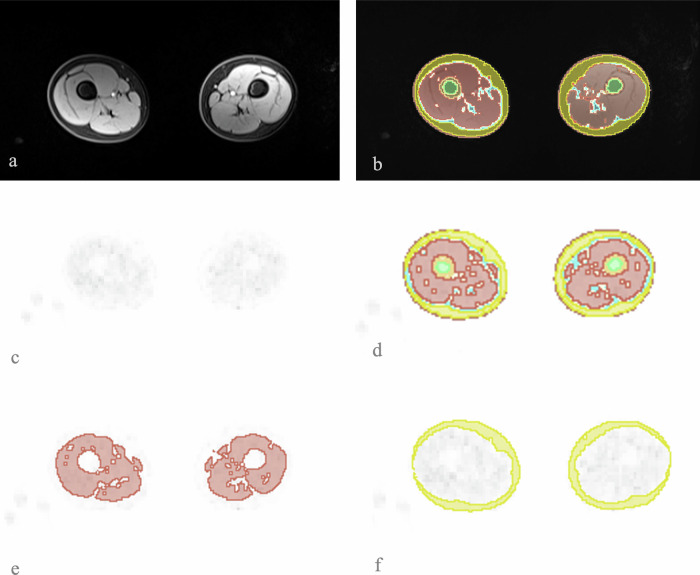
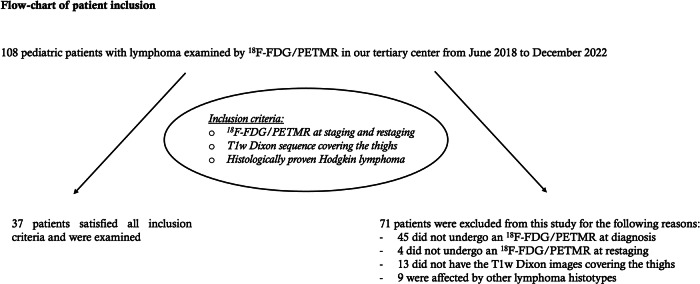
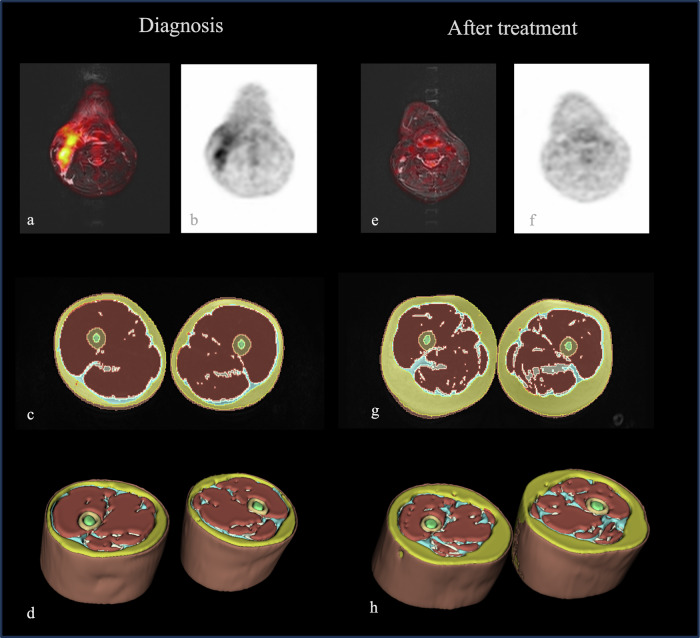
Pediatric patients with lymphoma examined by [F]FDG-PET/MR at diagnosis and restaging were included. At each time point, axial fat and water Dixon T1w images of the thighs were automatically segmented and muscle volume, subcutaneous, intramuscular, and intermuscular fat volume were quantified. The metabolic activity of the largest nodal lesion and of muscles and subcutaneous fat was recorded. The paired samples t-test and Spearman's correlation coefficient were applied to evaluate potential differences between the two time points and the relationship between metabolic and body composition metrics, respectively. By logistic regression analysis, the prognostic role of the investigated variables was assessed. The applied significance level was p < 0.05 for all analyses.
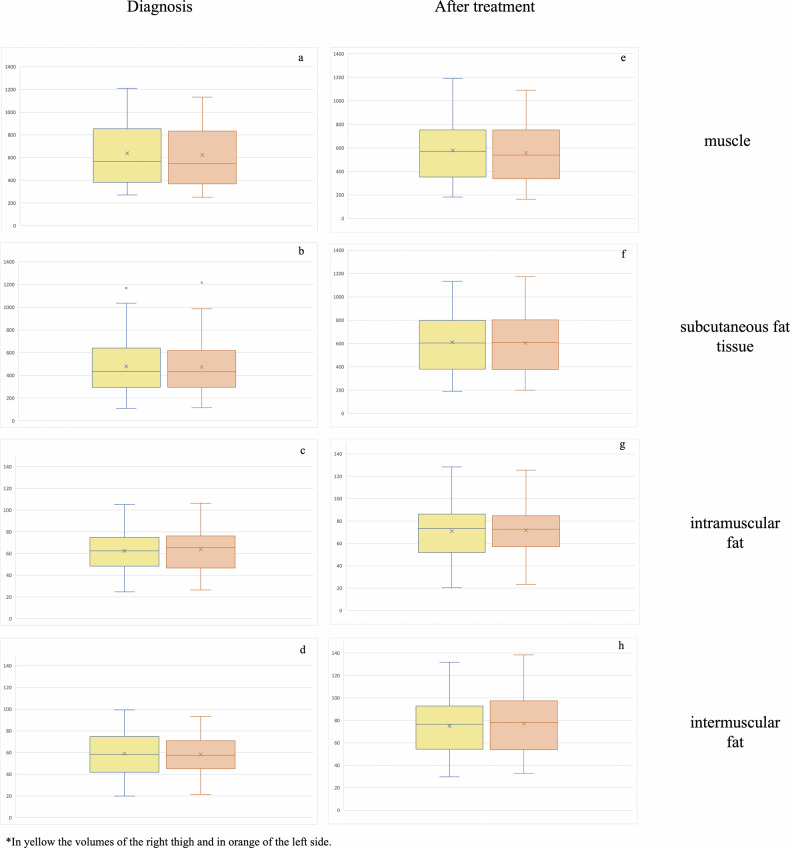
Thirty-seven patients (mean age ± SD 14 ± 3-years-old; 20 females) matched the inclusion criteria. After chemotherapy (interval between the two PET/MR scans, 56-80 days; median 65 days), muscle volume significantly decreased (629 ± 259 cm vs 567 ± 243 cm, p < 0.001) while subcutaneous, intramuscular and intermuscular fat increased (476 ± 255 cm vs 607 ± 254 cm, p < 0.001; 63 ± 20 cm vs 76 ± 26 cm, p < 0.001; 58 ± 19 cm vs 71 ± 23 cm, p < 0.001); the metabolic activity of the main nodal lesion, muscles, and subcutaneous fat significantly decreased (p < 0.05, each). None of the examined variables acted as predictors of the response to treatment (p = 0.283). A strong correlation between BMI and subcutaneous fat volume at diagnosis (r = 0.675, p < 0.001) and restaging (r = 0.600, p < 0.001) emerged.
The proposed method demonstrated that pediatric patients with lymphoma undergo muscle loss and an increase of subcutaneous fat during treatment.
The proposed automatic and volumetric MR-based assessment of body composition in children with lymphoma can be used to monitor the effect of chemotherapy and may guide tailored exercise programs during chemotherapy.
T1w Dixon images can be used for the automatic segmentation and quantification of body composition. Muscle and subcutaneous fat volume do not act as predictors of the response to treatment in children with lymphoma. Chemotherapy induces changes in body composition in children with lymphoma.
利用从[F]FDG-PET/MR扫描中提取的 Dixon-MR 图像,对淋巴瘤患儿的身体成分进行自动、体积分割和量化。
纳入在诊断和再分期时接受[F]FDG-PET/MR检查的淋巴瘤患儿。在每个时间点,自动分割大腿的轴向脂肪和水 Dixon T1w 图像,并量化肌肉体积、皮下、肌内和肌间脂肪体积。记录最大淋巴结病变以及肌肉和皮下脂肪的代谢活性。分别应用配对样本 t 检验和 Spearman 相关系数来评估两个时间点之间的潜在差异以及代谢和身体成分指标之间的关系。通过逻辑回归分析,评估所研究变量的预后作用。所有分析的应用显著性水平为 p < 0.05。
37 例患者(平均年龄±标准差 14±3 岁;20 名女性)符合纳入标准。化疗后(两次 PET/MR 扫描之间的间隔为 56 - 80 天;中位数 65 天),肌肉体积显著减少(629±259 cm³ 对 567±24³ cm³,p < 0.001),而皮下、肌内和肌间脂肪增加(476±255 cm³ 对 607±254 cm³,p < 0.001;63±20 cm³ 对 76±26 cm³,p < 0.001;58±19 cm³ 对 71±23 cm³,p < 0.001);主要淋巴结病变、肌肉和皮下脂肪的代谢活性显著降低(各 p < 0.05)。所检查的变量均未作为治疗反应的预测指标(p = 0.283)。在诊断时(r = 0.675,p < 0.001)和再分期时(r = 0.600,p < 0.001),BMI 与皮下脂肪体积之间出现强相关性。
所提出的方法表明,淋巴瘤患儿在治疗期间会出现肌肉量减少和皮下脂肪增加。
所提出的基于磁共振成像的儿童淋巴瘤身体成分自动体积评估方法可用于监测化疗效果,并可能指导化疗期间的个性化运动方案。
T1w Dixon 图像可用于身体成分的自动分割和量化。肌肉和皮下脂肪体积不是淋巴瘤患儿治疗反应的预测指标。化疗会导致淋巴瘤患儿身体成分发生变化。