Department of Cardiovascular and Metabolic Sciences, Lerner Research Institute, Cleveland Clinic, Cleveland, OH 44195.
Department of Chemistry, Cleveland State University, Cleveland, OH 44115.
Proc Natl Acad Sci U S A. 2024 Jul 23;121(30):e2303642121. doi: 10.1073/pnas.2303642121. Epub 2024 Jul 16.
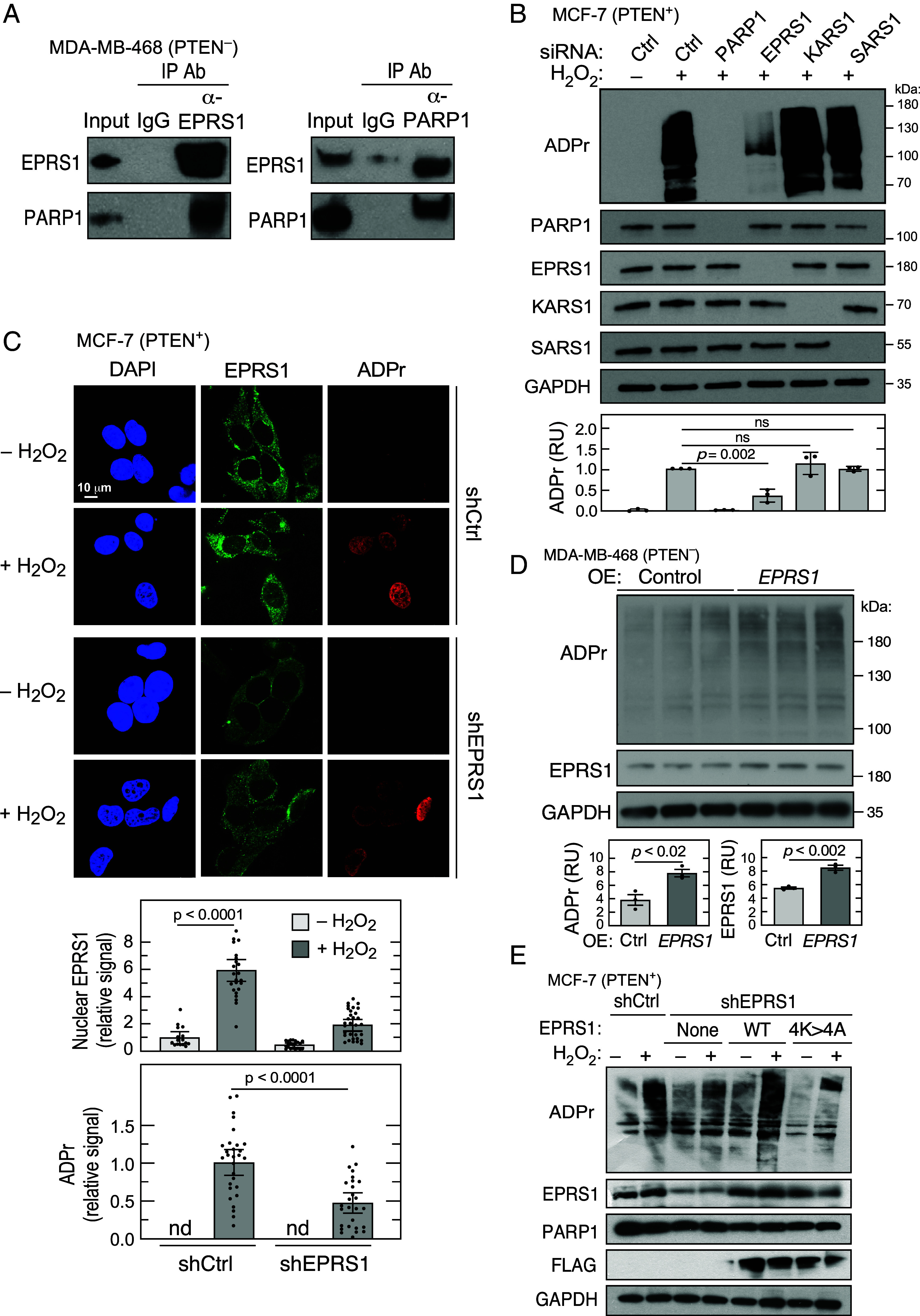
Glutamyl-prolyl-tRNA synthetase (EPRS1) is a bifunctional aminoacyl-tRNA-synthetase (aaRS) essential for decoding the genetic code. EPRS1 resides, with seven other aaRSs and three noncatalytic proteins, in the cytoplasmic multi-tRNA synthetase complex (MSC). Multiple MSC-resident aaRSs, including EPRS1, exhibit stimulus-dependent release from the MSC to perform noncanonical activities distinct from their primary function in protein synthesis. Here, we show EPRS1 is present in both cytoplasm and nucleus of breast cancer cells with constitutively low phosphatase and tensin homolog (PTEN) expression. EPRS1 is primarily cytosolic in PTEN-expressing cells, but chemical or genetic inhibition of PTEN, or chemical or stress-mediated activation of its target, AKT, induces EPRS1 nuclear localization. Likewise, preferential nuclear localization of EPRS1 was observed in invasive ductal carcinoma that were also P-Ser-AKT. EPRS1 nuclear transport requires a nuclear localization signal (NLS) within the linker region that joins the catalytic glutamyl-tRNA synthetase and prolyl-tRNA synthetase domains. Nuclear EPRS1 interacts with poly(ADP-ribose) polymerase 1 (PARP1), a DNA-damage sensor that directs poly(ADP-ribosyl)ation (PARylation) of proteins. EPRS1 is a critical regulator of PARP1 activity as shown by markedly reduced ADP-ribosylation in EPRS1 knockdown cells. Moreover, EPRS1 and PARP1 knockdown comparably alter the expression of multiple tumor-related genes, inhibit DNA-damage repair, reduce tumor cell survival, and diminish tumor sphere formation by breast cancer cells. EPRS1-mediated regulation of PARP1 activity provides a mechanistic link between PTEN loss in breast cancer cells, PARP1 activation, and cell survival and tumor growth. Targeting the noncanonical activity of EPRS1, without inhibiting canonical tRNA ligase activity, provides a therapeutic approach potentially supplementing existing PARP1 inhibitors.
谷氨酰-脯氨酰-tRNA 合成酶(EPRS1)是一种双功能氨酰-tRNA 合成酶(aaRS),对解码遗传密码至关重要。EPRS1 与其他七种 aaRS 和三种非催化蛋白一起存在于细胞质多 tRNA 合成酶复合物(MSC)中。包括 EPRS1 在内的多个 MSC 驻留的 aaRS 表现出对刺激的依赖性释放,从而进行与其在蛋白质合成中的主要功能不同的非典型活性。在这里,我们发现 EPRS1 存在于乳腺癌细胞的细胞质和细胞核中,这些细胞的磷酸酶和张力蛋白同源物(PTEN)表达水平持续较低。在表达 PTEN 的细胞中,EPRS1 主要存在于细胞质中,但化学或遗传抑制 PTEN,或化学或应激介导其靶标 AKT 的激活,诱导 EPRS1 核定位。同样,在也为 P-Ser-AKT 的浸润性导管癌中也观察到 EPRS1 的优先核定位。EPRS1 的核转运需要连接催化谷氨酰-tRNA 合成酶和脯氨酰-tRNA 合成酶结构域的连接区中的核定位信号(NLS)。核 EPRS1 与多聚(ADP-核糖)聚合酶 1(PARP1)相互作用,PARP1 是一种 DNA 损伤传感器,可指导蛋白质的多聚(ADP-核糖基)化(PARylation)。EPRS1 是 PARP1 活性的关键调节剂,如 EPRS1 敲低细胞中 ADP-ribosylation 明显减少所示。此外,EPRS1 和 PARP1 敲低均可改变多个与肿瘤相关基因的表达,抑制 DNA 损伤修复,降低肿瘤细胞存活,并减少乳腺癌细胞的肿瘤球体形成。EPRS1 介导的 PARP1 活性调节为乳腺癌细胞中 PTEN 缺失、PARP1 激活以及细胞存活和肿瘤生长之间提供了一种机制联系。针对 EPRS1 的非典型活性,而不抑制典型的 tRNA 连接酶活性,为提供了一种治疗方法,可能补充现有的 PARP1 抑制剂。