Department of Community and Public Health, Busitema University, Mbale, Uganda.
The Carter Center, Kampala, Uganda.
PLoS Negl Trop Dis. 2024 Jul 16;18(7):e0012270. doi: 10.1371/journal.pntd.0012270. eCollection 2024 Jul.
Globally, there are an estimated 20.9 million cases of onchocerciasis, with Africa bearing the greatest burden. The World Health Organization (WHO) has targeted the disease for elimination by 2030. As of August 2023, there were 15 foci in 37/48 (76%) districts and one city in Uganda that had reached the elimination phase. However, there is a paucity of data on community involvement in post-elimination surveillance (PES) activities. The communities in the post-elimination phase are expected to maintain surveillance, provide health education, refer cases for treatment, and participate in surveillance. However, it is not clear whether this is being done. In this study, we assessed the feasibility of community involvement in post-elimination surveillance activities in Bududa District, Eastern Uganda, to draw key generalisable lessons for similar settings.
This was a cross-sectional study employing rigorous mixed methods of data collection. We used a semi-structured questionnaire to collect quantitative data on randomly sampled study participants in two sub-countries in the district. Community involvement in post-elimination surveillance (PES) was our dependent variable, measured using Yes or No questions, and our independent variables were measured on different scales. Computations of proportions and associations were done using Stata 15 software. Conversely, qualitative data were collected via focus group discussions (FGDs) for community participants and key informant interviews (KIIs) for local leaders. For the qualitative component, we had 2 FGDs, each consisting of 8 gender-balanced participants per group and 8 KIIs. Qualitative data analyses were done using a robust thematic framework approach, ensuring the reliability and validity of our findings.
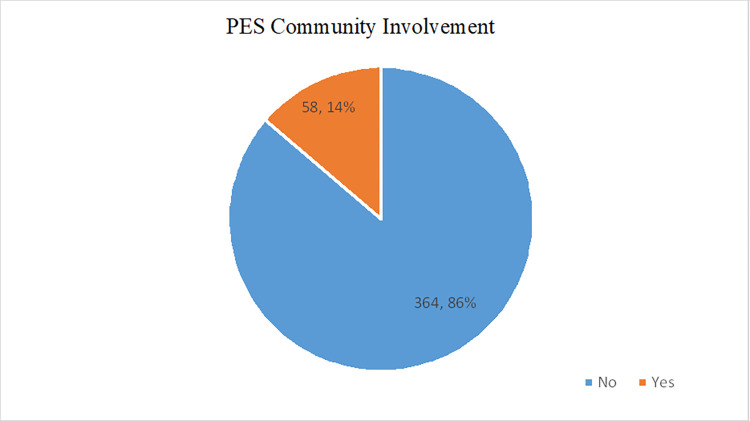
A total of 422 participants with a mean age of 51.4 years (SD = 15.8) participated in the study. Community involvement in post-elimination surveillance was low (14%). Factors associated with involvements were district support [Adjusted odd ratio AOR 14, 95 CI = (2.5, 81.7)], seeing black flies in the environment in a week preceding the survey [AOR 8, 95% CI = (1.5, 42.5)], in one month [AOR 3.8, 95% CI = (1.1, 13.2)], and being a community volunteer in the Ivermectin treatment program [AOR 4.3, 95% CI = (1.03, 17.9)]. Lack of funding, poor motivation, poor program sustainability planning, and a lack of drugs at health facilities were key challenges affecting community involvement in post-elimination surveillance.
Community involvement in onchocerciasis post-elimination surveillance activities in Bududa District in Eastern Uganda was low but could be improved by increased district support, funding, community motivation and sensitisation.
全球估计有 2090 万例盘尾丝虫病病例,其中非洲负担最重。世界卫生组织(世卫组织)已将该病作为 2030 年消除的目标。截至 2023 年 8 月,乌干达已有 15 个病灶,涉及 37/48 个区(76%)和一个城市已进入消除阶段。然而,关于社区参与消除后监测(PES)活动的数据很少。预计社区在消除后阶段将继续进行监测、提供健康教育、转诊治疗病例并参与监测。但是,尚不清楚是否正在这样做。在这项研究中,我们评估了在乌干达东部布杜达区社区参与消除后监测活动的可行性,以总结出在类似环境下的关键经验教训。
这是一项采用严格的混合方法收集数据的横断面研究。我们使用半结构式问卷,对该地区两个分区的随机抽样研究参与者收集定量数据。社区参与消除后监测(PES)是我们的因变量,使用是或否问题进行衡量,我们的自变量则以不同的尺度进行衡量。使用 Stata 15 软件计算比例和关联。相反,定性数据是通过社区参与者的焦点小组讨论(FGD)和当地领导人的关键信息访谈(KII)收集的。对于定性部分,我们进行了 2 次 FGD,每个小组由 8 名性别平衡的参与者组成,进行了 8 次 KII。使用稳健的主题框架方法进行定性数据分析,以确保研究结果的可靠性和有效性。
共有 422 名参与者,平均年龄为 51.4 岁(SD=15.8)。社区参与消除后监测的比例较低(14%)。与参与有关的因素包括地区支持[调整后的优势比(AOR)14,95%置信区间(CI)=(2.5,81.7)]、调查前一周在环境中看到黑蝇[AOR 8,95%CI=(1.5,42.5)]、一个月内[AOR 3.8,95%CI=(1.1,13.2)]和作为伊维菌素治疗计划的社区志愿者[AOR 4.3,95%CI=(1.03,17.9)]。缺乏资金、动机不足、方案可持续性规划不善以及卫生设施缺乏药物是影响社区参与消除后监测的主要挑战。
在乌干达东部布杜达区,社区参与盘尾丝虫病消除后监测活动的比例较低,但可以通过增加地区支持、资金、社区激励和宣传来提高。