Hanigan-Diebel Jennifer L, Costin Robert J, Myers Logan C, Vandermeer Christopher I, Willis Miles S, Takhar Kiran, Odinakachukwu Ogechukwu V, Carroll Matthias G, Schiffbauer Jarrod E, Lohse Samuel E
Chemistry Department, Central Washington University, 400 East University Way, Ellensburg, Washington 98926, United States.
Department of Physical and Environmental Sciences, Colorado Mesa University, 1100 North Ave, Grand Junction, Colorado 81501, United States.
Langmuir. 2024 Jul 16;40(30):15558-68. doi: 10.1021/acs.langmuir.4c01234.
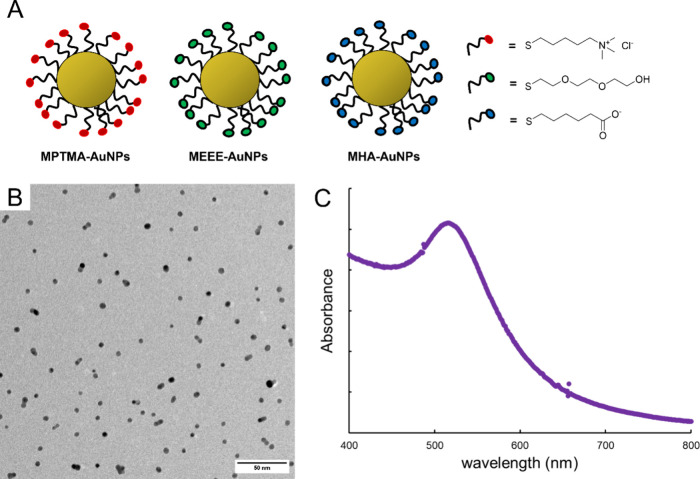
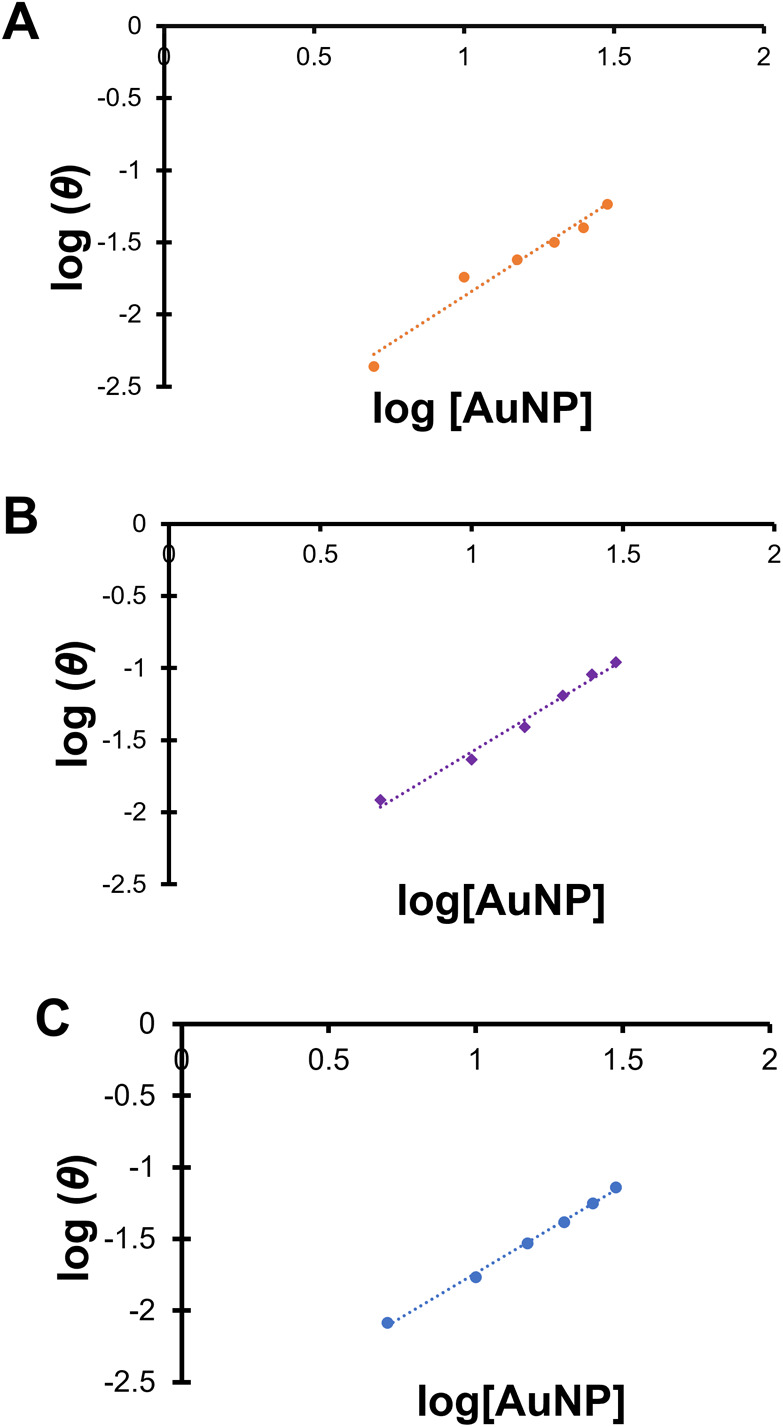
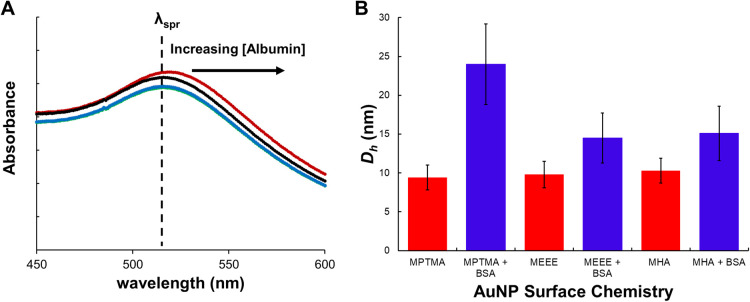
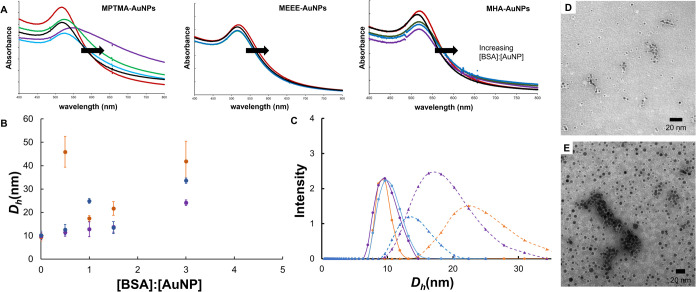
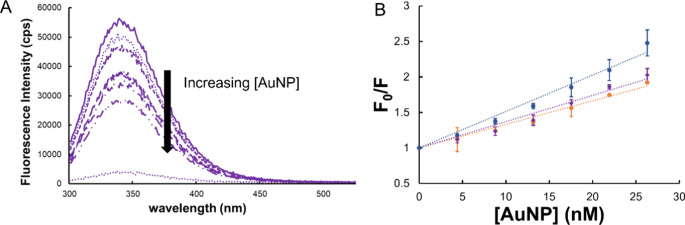
A detailed understanding of the binding of serum proteins to small ( <10 nm) nanoparticles (NPs) is essential for the mediation of protein corona formation in next generation nanotherapeutics. While a number of studies have investigated the details of protein adsorption on large functionalized NPs, small NPs (with a particle surface area comparable in size to the protein) have not received extensive study. This study determined the affinity constant () of BSA when binding to three different functionalized 5 nm gold nanoparticles (AuNPs). AuNPs were synthesized using three ω-functionalized thiols (mercaptoethoxy-ethoxy-ethanol (MEEE), mercaptohexanoic acid (MHA), and mercaptopentyltrimethylammonium chloride (MPTMA)), giving rise to particles with three different surface charges. The binding affinity of bovine serum albumin (BSA) to the different AuNP surfaces was investigated using UV-visible absorbance spectroscopy, dynamic light scattering (DLS), and fluorescence quenching titrations. Fluorescence titrations indicated that the affinity of BSA was actually highest for small AuNPs with a negative surface charge (MHA-AuNPs). Interestingly, the positively charged MPTMA-AuNPs showed the lowest for BSA, indicating that electrostatic interactions are likely not the primary driving force in binding of BSA to these small AuNPs. values at 25 °C for MHA, MEEE, and MPTMA-AuNPs were 5.2 ± 0.2 × 10, 3.7 ± 0.2 × 10, and 3.3 ± 0.16 × 10 M in water, respectively. Fluorescence quenching titrations performed in 100 mM NaCl resulted in lower values for the charged AuNPs, while the value for the MEEE-AuNPs remained unchanged. Measurement of the hydrodynamic diameter () by dynamic light scattering (DLS) suggests that adsorption of 1-2 BSA molecules is sufficient to saturate the AuNP surface. DLS and negative-stain TEM images indicate that, despite the lower observed values, the binding of MPTMA-AuNPs to BSA likely induces significant protein misfolding and may lead to extensive BSA aggregation at specific BSA:AuNP molar ratios.
深入了解血清蛋白与小尺寸(<10 nm)纳米颗粒(NP)的结合对于下一代纳米治疗中蛋白质冠层形成的介导至关重要。虽然已有多项研究探讨了蛋白质在大型功能化NP上吸附的细节,但小尺寸NP(其颗粒表面积与蛋白质大小相当)尚未得到广泛研究。本研究测定了牛血清白蛋白(BSA)与三种不同功能化的5 nm金纳米颗粒(AuNP)结合时的亲和常数()。使用三种ω-功能化硫醇(巯基乙氧基-乙氧基-乙醇(MEEE)、巯基己酸(MHA)和巯基戊基三甲基氯化铵(MPTMA))合成AuNP,得到具有三种不同表面电荷的颗粒。使用紫外-可见吸收光谱、动态光散射(DLS)和荧光猝灭滴定法研究了牛血清白蛋白(BSA)与不同AuNP表面的结合亲和力。荧光滴定表明,BSA对表面带负电荷的小AuNP(MHA-AuNP)的亲和力实际上最高。有趣的是,带正电荷的MPTMA-AuNP对BSA的显示出最低的,这表明静电相互作用可能不是BSA与这些小AuNP结合的主要驱动力。在水中,MHA、MEEE和MPTMA-AuNP在25℃时的 值分别为5.2±0.2×10、3.7±0.2×10和3.3±0.16×10 M。在100 mM NaCl中进行的荧光猝灭滴定导致带电AuNP的 值降低,而MEEE-AuNP的 值保持不变。通过动态光散射(DLS)测量流体动力学直径()表明,吸附1-2个BSA分子足以使AuNP表面饱和。DLS和负染色透射电镜图像表明,尽管观察到的 值较低,但MPTMA-AuNP与BSA的结合可能会导致显著的蛋白质错误折叠,并可能在特定的BSA:AuNP摩尔比下导致大量BSA聚集。