Harvard Medical School, Boston, MA, USA.
Department of Radiology, The Third Affiliated Hospital of Zhengzhou University, Zhengzhou, China.
Sci Rep. 2024 Jul 16;14(1):16455. doi: 10.1038/s41598-024-67517-5.
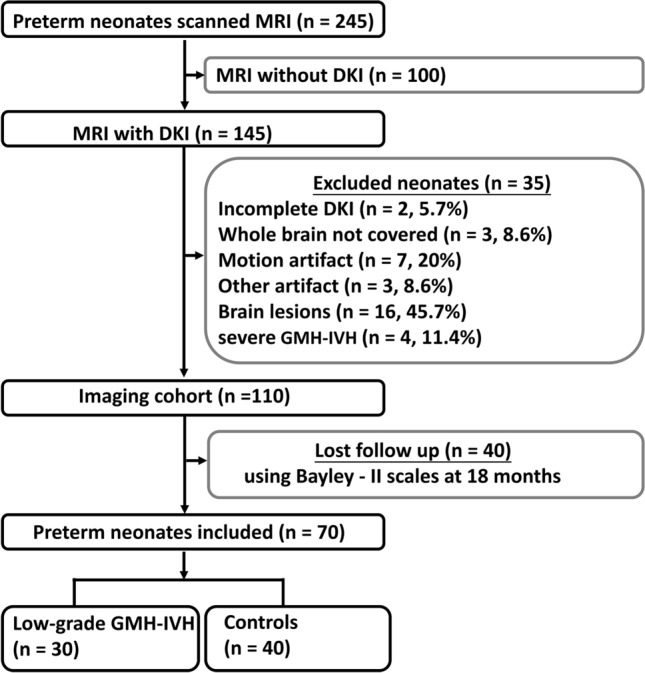
Diffusion Kurtosis Imaging (DKI)-derived metrics are recognized as indicators of maturation in neonates with low-grade germinal matrix and intraventricular hemorrhage (GMH-IVH). However, it is not yet known if these factors are associated with neurodevelopmental outcomes. The objective of this study was to acquire DKI-derived metrics in neonates with low-grade GMH-IVH, and to demonstrate their association with later neurodevelopmental outcomes. In this prospective study, neonates with low-grade GMH-IVH and control neonates were recruited, and DKI were performed between January 2020 and March 2021. These neonates underwent the Bayley Scales of Infant Development test at 18 months of age. Mean kurtosis (MK), radial kurtosis (RK) and gray matter values were measured. Spearman correlation analyses were conducted for the measured values and neurodevelopmental outcome scores. Forty controls (18 males, average gestational age (GA) 30 weeks ± 1.3, corrected GA at MRI scan 38 weeks ± 1) and thirty neonates with low-grade GMH-IVH (13 males, average GA 30 weeks ± 1.5, corrected GA at MRI scan 38 weeks ± 1). Neonates with low-grade GMH-IVH exhibited lower MK and RK values in the PLIC and the thalamus (P < 0.05). The MK value in the thalamus was associated with Mental Development Index (MDI) (r = 0.810, 95% CI 0.695-0.13; P < 0.001) and Psychomotor Development Index (PDI) (r = 0.852, 95% CI 0.722-0.912; P < 0.001) scores. RK value in the caudate nucleus significantly and positively correlated with MDI (r = 0.496, 95% CI 0.657-0.933; P < 0.001) and PDI (r = 0.545, 95% CI 0.712-0.942; P < 0.001) scores. The area under the curve (AUC) were used to assess diagnostic performance of MK and RK in thalamus (AUC = 0.866, 0.787) and caudate nucleus (AUC = 0.833, 0.671) for predicting neurodevelopmental outcomes. As quantitative neuroimaging markers, MK in thalamus and RK in caudate nucleus may help predict neurodevelopmental outcomes in neonates with low-grade GMH-IVH.
弥散峰度成像(DKI)衍生的指标被认为是伴有低级别脑室内出血和脑室内出血(GMH-IVH)新生儿成熟的指标。然而,目前尚不清楚这些因素是否与神经发育结局有关。本研究的目的是获取伴有低级别 GMH-IVH 的新生儿的 DKI 衍生指标,并证明其与后期神经发育结局相关。本前瞻性研究纳入了伴有低级别 GMH-IVH 的新生儿和对照组新生儿,并于 2020 年 1 月至 2021 年 3 月进行 DKI。这些新生儿在 18 个月时进行贝利婴幼儿发展量表测试。测量平均峰度(MK)、径向峰度(RK)和灰质值。对测量值和神经发育结局评分进行 Spearman 相关分析。纳入 40 名对照组新生儿(男 18 名,平均胎龄(GA)30 周±1.3,MRI 扫描校正 GA 38 周±1)和 30 名伴有低级别 GMH-IVH 的新生儿(男 13 名,GA 平均 30 周±1.5,MRI 扫描校正 GA 38 周±1)。伴有低级别 GMH-IVH 的新生儿在PLIC 和丘脑的 MK 和 RK 值较低(P<0.05)。丘脑的 MK 值与精神发育指数(MDI)(r=0.810,95%CI 0.695-0.13;P<0.001)和运动发育指数(PDI)(r=0.852,95%CI 0.722-0.912;P<0.001)相关。尾状核的 RK 值与 MDI(r=0.496,95%CI 0.657-0.933;P<0.001)和 PDI(r=0.545,95%CI 0.712-0.942;P<0.001)呈显著正相关。MK 和 RK 在丘脑(AUC=0.866,0.787)和尾状核(AUC=0.833,0.671)中的曲线下面积(AUC)用于评估对神经发育结局的预测诊断性能。作为定量神经影像学标志物,丘脑的 MK 和尾状核的 RK 可能有助于预测伴有低级别 GMH-IVH 的新生儿的神经发育结局。