Panagiotakopoulos Thrasyvoulos, Chorti Angeliki, Pliakos Ioannis, Ioannidis Aris, Boudina Maria, Papavramidis Theodossis
1st Propedeutic Department of Surgery, AHEPA University Hospital of Thessaloniki, School of Medicine, Aristotle University, Thessaloniki, Greece.
Minimally Invasive Endocrine Surgery Department, EUROMEDICA-Kyanous Stavros, Thessaloniki, Greece.
Gland Surg. 2024 Jun 30;13(6):1097-1107. doi: 10.21037/gs-24-52. Epub 2024 Jun 20.
Thyroid cancer is the second most common malignancy during pregnancy, especially the well-differentiated thyroid cancer (well-DTC). Therefore, complex medical and social dilemmas arise, dealing with which requires deep knowledge of the nature and characteristics of the disease and pregnancy as a whole. The purpose of this review is to present the diagnostic and therapeutic strategies of thyroid cancer during pregnancy and the postpartum period.
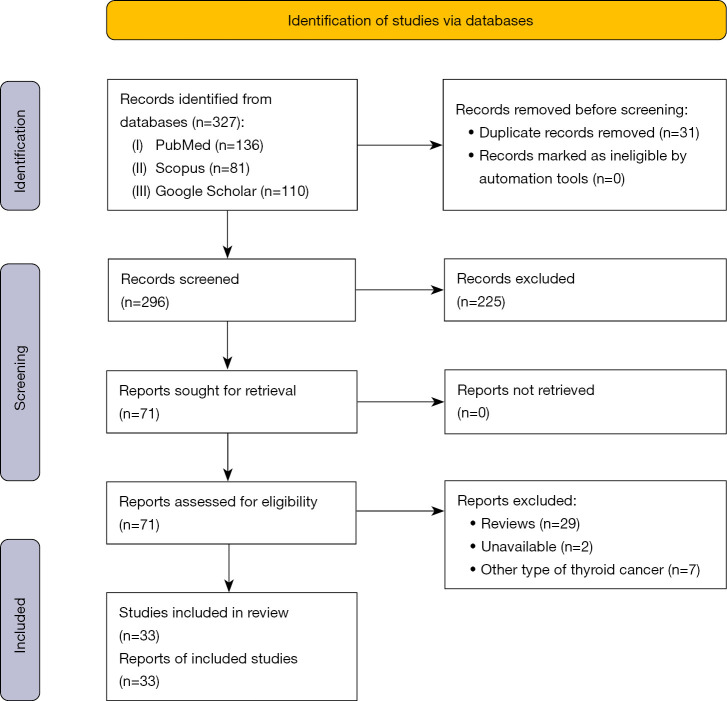
Extended review of the literature [2011-2023] was performed. Two hundred ninety-six articles were found, from which 225 were excluded due to irrelevant subjects. Seventy-one articles were assessed for eligibility, from which 33 articles were cohort studies and case reports and were included in the review.
From the 33 included studies, 18 were retrospective cohort studies, 1 was cohort study, 2 were case control studies, 1 was meta-analysis and 11 were case reports. The primary endpoints of these studies refer to the progression and recurrence of DTC during pregnancy, the prevalence of thyroid cancer in pregnancy and the most appropriate time for surgical intervention.
The majority of the studies agree that well-differentiated tumors with mild clinical and imaging characteristics do not require immediate surgical treatment, but mere monitoring. Surgery can be delayed after childbirth. In contrast, tumors with aggressive behavior as well as non-differentiated ones, require immediate surgery because delay under these circumstances can dramatically reduce survival rates. Finally, a history of thyroid cancer does not seem to affect future deliveries, on condition that no residual disease exists at the onset of pregnancy.
甲状腺癌是孕期第二常见的恶性肿瘤,尤其是分化型甲状腺癌(分化良好的甲状腺癌,well-DTC)。因此,出现了复杂的医学和社会困境,应对这些困境需要对该疾病以及整个孕期的性质和特征有深入了解。本综述的目的是介绍孕期及产后甲状腺癌的诊断和治疗策略。
对2011年至2023年的文献进行了广泛回顾。共找到296篇文章,其中225篇因主题不相关而被排除。对71篇文章进行了资格评估,其中33篇为队列研究和病例报告,并被纳入综述。
在纳入的33项研究中,18项为回顾性队列研究,1项为队列研究,2项为病例对照研究,1项为荟萃分析,11项为病例报告。这些研究的主要终点涉及孕期分化型甲状腺癌的进展和复发、孕期甲状腺癌的患病率以及手术干预的最佳时机。
大多数研究一致认为,具有轻度临床和影像学特征的分化良好的肿瘤不需要立即进行手术治疗,只需进行监测。手术可在产后推迟进行。相比之下,具有侵袭性行为的肿瘤以及未分化肿瘤需要立即手术,因为在这种情况下延迟手术会显著降低生存率。最后,甲状腺癌病史似乎不会影响未来分娩,前提是在怀孕开始时不存在残留疾病。