Pescador Jimenez Marcia, Wagner Maude, Laden Francine, Hart Jaime E, Grodstein Francine, James Peter
Department of Epidemiology, Boston University School of Public Health, Boston, Massachusetts, USA.
Department of Internal Medicine, Rush Medical College and Rush Alzheimer's Disease Center, Chicago, Illinois, USA.
Environ Health Perspect. 2024 Jul;132(7):77003. doi: 10.1289/EHP13588. Epub 2024 Jul 17.
Midlife residential exposure to greenspace may slow cognitive decline by increasing opportunities for physical activity and social connection, restoring attention, or reducing stress or adverse environmental exposures. However, prospective studies on the association between greenness and cognitive decline are sparse.
We investigated the prospective association between greenness at midlife and cognitive decline later in life. We explored effect measure modification by apolipoprotein E (APOE)-ɛ4 carrier status, neighborhood socioeconomic status (NSES), and rural/urban regions.
The Nurses' Health Study () started in 1976 with married female nurses, 30-55 years of age, located across 11 US states. We examined 16,962 nurses who were enrolled in a substudy starting in 1995-2001 (mean ) through 2008. We assessed average summer residential greenness in a buffer using Landsat Normalized Difference Vegetation Index data from 1986-1994. Starting in 1995-2001, participants underwent up to four repeated measures of five cognitive tests. A global composite score was calculated as the average of all -scores for each task to evaluate overall cognition. We used linear mixed models to evaluate the association of average greenness exposure at midlife with cognitive decline in later life, adjusted for age, education, NSES, and depression.
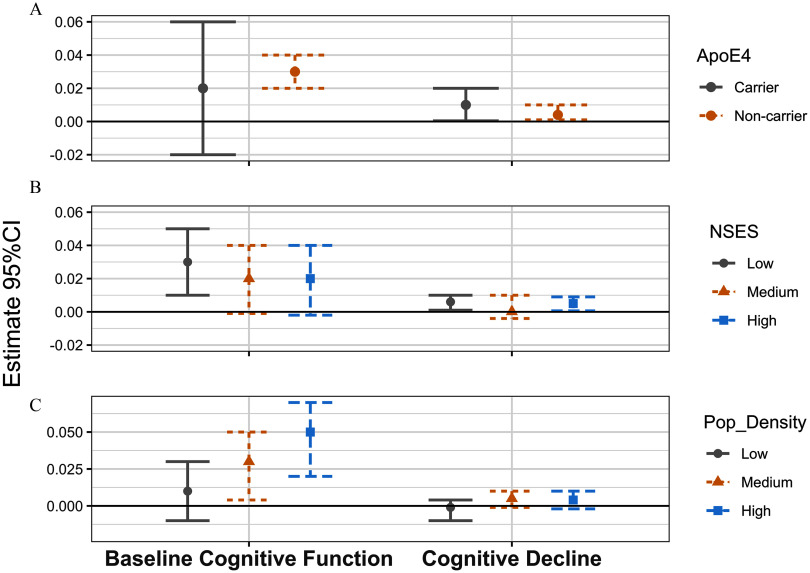
In adjusted models, higher midlife greenness exposure [per interquartile range (IQR): 0.18] was associated with a 0.004-unit (95% CI: 0.001, 0.006) slower annual rate of cognitive decline. For comparison, we found that 1 year of age is related to a mean annual difference for global cognition in the full sample; thus, higher midlife greenness appeared equivalent to slowing cognitive decline by months. In analysis exploring gene-environment interactions, we found that among APOE-ɛ4 carriers, an IQR increase in greenness was associated with a rate of decline that was slower by 0.01 units of global composite score (95% CI: 0.0004, 0.02). This association was attenuated among APOE-ɛ4 noncarriers. We did not observe associations between greenness and baseline or annual rate of cognitive decline of verbal memory.
Higher midlife greenness exposure is associated with slower cognitive decline later in life. Future research is necessary to confirm these findings. https://doi.org/10.1289/EHP13588.
中年时期居住在绿地附近可能通过增加身体活动和社交联系的机会、恢复注意力、减轻压力或减少不良环境暴露来减缓认知衰退。然而,关于绿地与认知衰退之间关联的前瞻性研究较少。
我们调查了中年时期的绿地状况与晚年认知衰退之间的前瞻性关联。我们探讨了载脂蛋白E(APOE)-ε4携带者状态、邻里社会经济地位(NSES)和农村/城市地区对效应量修正的影响。
护士健康研究始于1976年,研究对象为美国11个州的30至55岁已婚女性护士。我们对1995 - 2001年(平均年龄)至2008年参与一项子研究的16962名护士进行了调查。我们使用1986 - 1994年的陆地卫星归一化植被指数数据评估了半径1公里缓冲区内夏季的平均居住绿地面积。从1995 - 2001年开始,参与者对五项认知测试进行了多达四次的重复测量。计算一个综合总得分,作为每个任务所有得分的平均值,以评估整体认知。我们使用线性混合模型评估中年时期平均绿地暴露与晚年认知衰退之间的关联,并对年龄、教育程度、NSES和抑郁进行了调整。
在调整后的模型中,中年时期更高的绿地暴露[每四分位数间距(IQR):0.18]与每年认知衰退速度减慢0.004个单位(95%置信区间:0.001,0.006)相关。作为比较,我们发现年龄每增加1岁与全样本中整体认知的平均年差异为相关;因此,中年时期更高的绿地暴露似乎相当于将认知衰退减缓了个月。在探索基因 - 环境相互作用的分析中,我们发现,在APOE - ε4携带者中,绿地面积增加一个IQR与整体综合得分下降速度减慢0.01个单位相关(95%置信区间:0.0004,0.02)。这种关联在APOE - ε4非携带者中减弱。我们未观察到绿地与言语记忆的基线或年度认知衰退率之间存在关联。
中年时期更高的绿地暴露与晚年认知衰退速度减慢相关。未来有必要进行研究以证实这些发现。https://doi.org/10.1289/EHP13588 。