Rosen Aviana O, Hidalgo Maria Dolores, Mistler Colleen B, Balluerka Nekane, Gorostiaga Arantxa, Gómez-Benito Juana, Holmes Ashley L, Huedo-Medina Tania B
Department of Allied Health Sciences, University of Connecticut, Storrs, Connecticut, United States of America.
Department of Basic Psychology and Methodology, University of Murcia, Murcia, Spain.
PLOS Glob Public Health. 2024 Jul 17;4(7):e0003389. doi: 10.1371/journal.pgph.0003389. eCollection 2024.
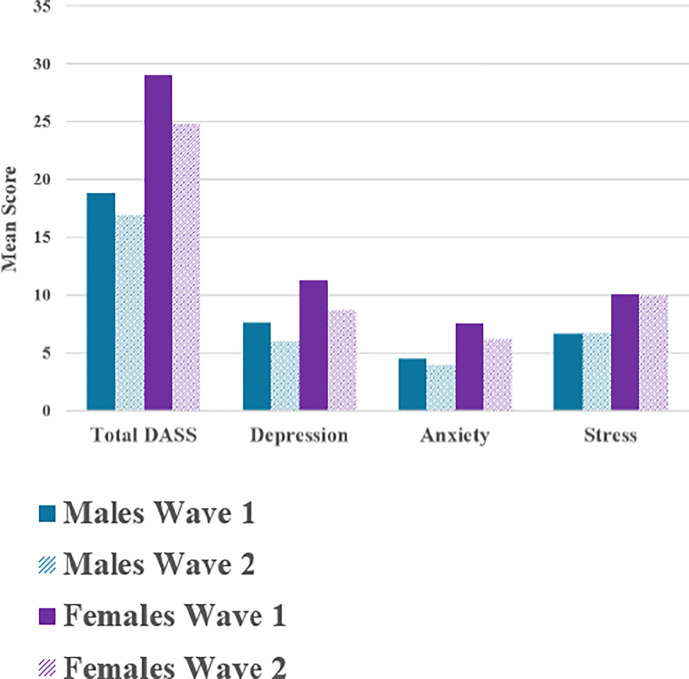
The COVID-19 pandemic had a detrimental effect on mental health since its start in 2020 and current data on mental health is limited. This study provides recent longitudinal data on psychological distress among a country-wide sample of adults. We recruited and surveyed 1,956 adults in Spain in April 2021 and August 2022 on sociodemographic- and pandemic-related psychological distress using the General Distress 21-item version of the Depression, Anxiety, and Stress Scale (DASS). Paired sampled t-tests assessed DASS scores by sex from April 2021 to August 2022; and one-way ANOVAs assessed DASS scores across sociodemographic characteristics. Results showed that psychological distress slightly improved across the total sample from April 2021 to August 2022; though females, young adults, students, and individuals with lower income experienced more psychological distress. Increases in severe stress scores were found particularly among men. Our data provides an overview of the psychological distress of Spanish adults 2.5 years into the pandemic and provides novel evidence that though life has resumed a sense of normalcy after the COVID-19 pandemic, the mental health of key populations (e.g., females, young adults, students, low-income) is still suffering and further intervention and resources are needed.
自2020年开始以来,新冠疫情对心理健康产生了不利影响,而目前关于心理健康的数据有限。本研究提供了全国范围内成年人样本近期的心理困扰纵向数据。2021年4月和2022年8月,我们在西班牙招募并调查了1956名成年人,使用抑郁、焦虑和压力量表(DASS)的21项一般困扰版本,询问了与社会人口统计学和疫情相关的心理困扰情况。配对样本t检验评估了2021年4月至2022年8月按性别划分的DASS分数;单因素方差分析评估了不同社会人口统计学特征下的DASS分数。结果显示,从2021年4月到2022年8月,整个样本的心理困扰略有改善;不过女性、年轻人、学生以及低收入者经历了更多的心理困扰。严重压力分数的增加尤其在男性中被发现。我们的数据概述了疫情爆发2.5年后西班牙成年人的心理困扰情况,并提供了新的证据,即尽管新冠疫情后生活已恢复正常感,但关键人群(如女性、年轻人、学生、低收入者)的心理健康仍在遭受影响,需要进一步的干预和资源。