King Lloyd D W, Pulido David, Barrett Jordan R, Davies Hannah, Quinkert Doris, Lias Amelia M, Silk Sarah E, Pattinson David J, Diouf Ababacar, Williams Barnabas G, McHugh Kirsty, Rodrigues Ana, Rigby Cassandra A, Strazza Veronica, Suurbaar Jonathan, Rees-Spear Chloe, Dabbs Rebecca A, Ishizuka Andrew S, Zhou Yu, Gupta Gaurav, Jin Jing, Li Yuanyuan, Carnrot Cecilia, Minassian Angela M, Campeotto Ivan, Fleishman Sarel J, Noe Amy R, MacGill Randall S, King C Richter, Birkett Ashley J, Soisson Lorraine A, Long Carole A, Miura Kazutoyo, Ashfield Rebecca, Skinner Katherine, Howarth Mark R, Biswas Sumi, Draper Simon J
Department of Biochemistry, University of Oxford, Dorothy Crowfoot Hodgkin Building, OX1 3QU Oxford, UK; Kavli Institute for Nanoscience Discovery, Dorothy Crowfoot Hodgkin Building, University of Oxford, OX1 3QU Oxford, UK; The Jenner Institute, University of Oxford, Old Road Campus Research Building, OX3 7DQ Oxford, UK.
The Jenner Institute, University of Oxford, Old Road Campus Research Building, OX3 7DQ Oxford, UK.
Cell Rep Med. 2024 Jul 16;5(7):101654. doi: 10.1016/j.xcrm.2024.101654.
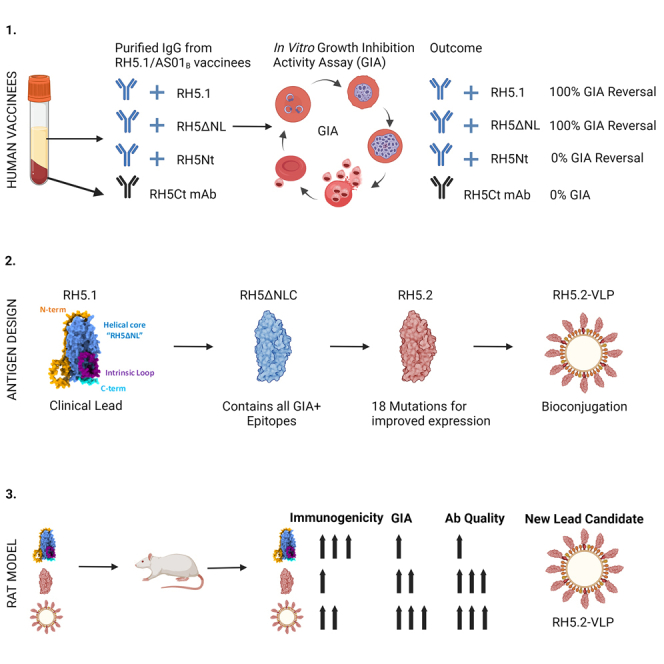
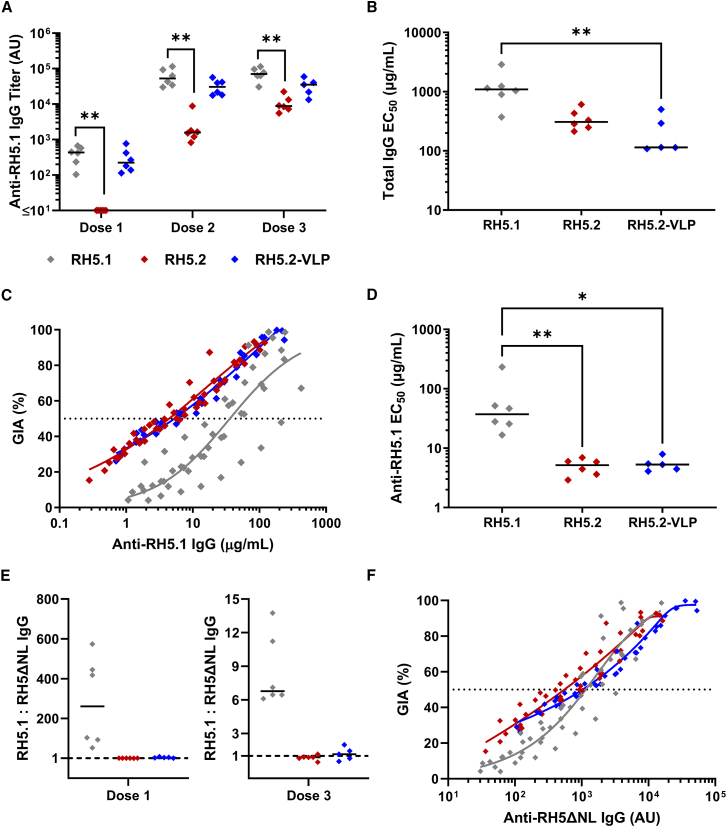
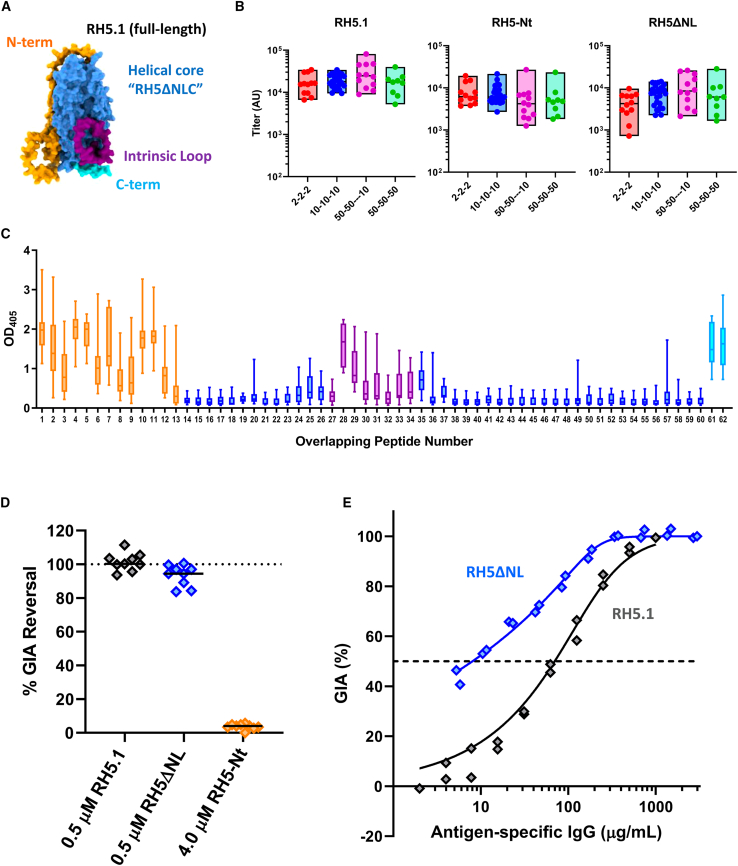
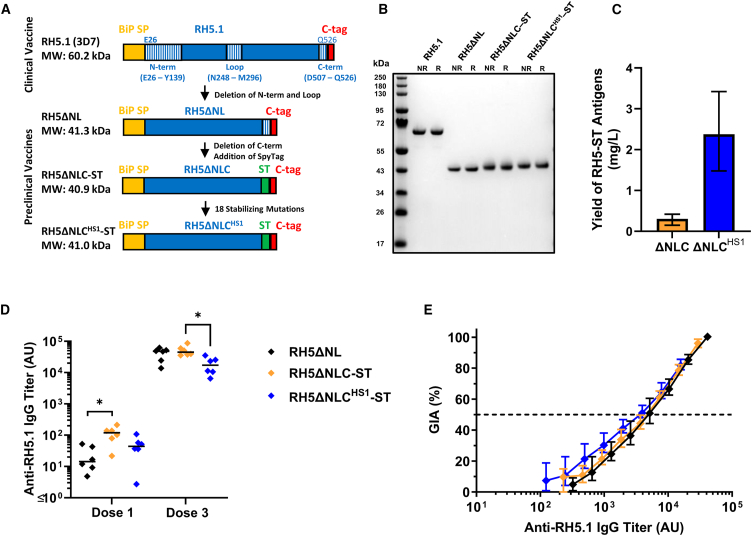
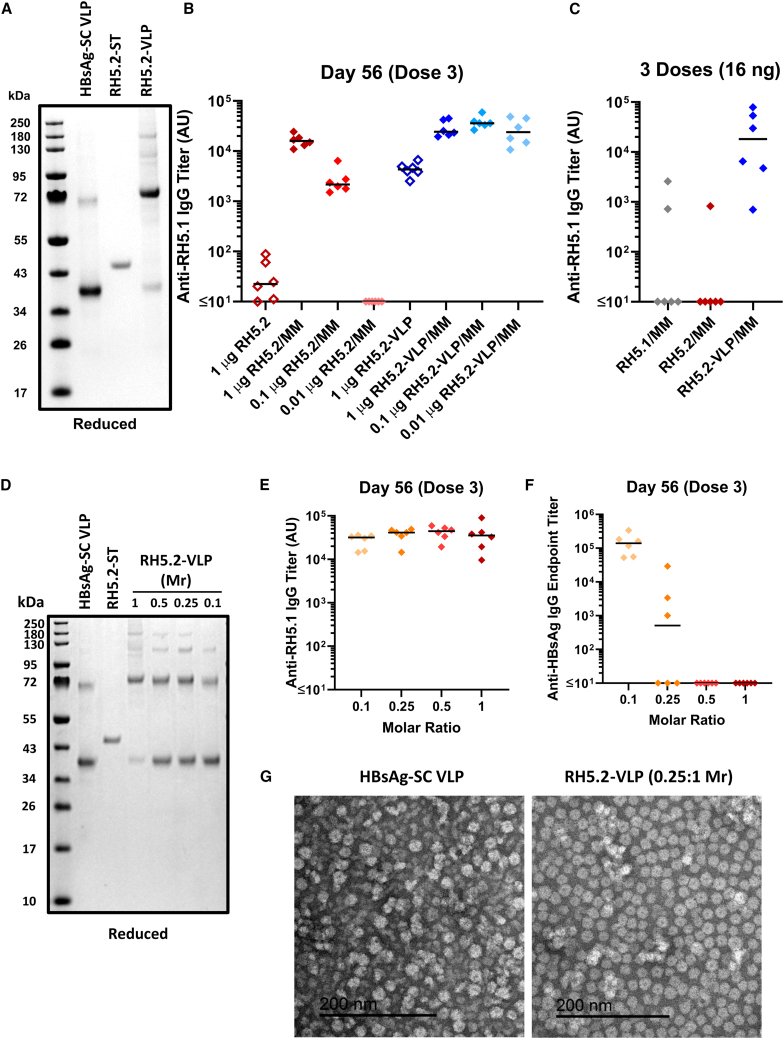
Plasmodium falciparum reticulocyte-binding protein homolog 5 (RH5) is a leading blood-stage malaria vaccine antigen target, currently in a phase 2b clinical trial as a full-length soluble protein/adjuvant vaccine candidate called RH5.1/Matrix-M. We identify that disordered regions of the full-length RH5 molecule induce non-growth inhibitory antibodies in human vaccinees and that a re-engineered and stabilized immunogen (including just the alpha-helical core of RH5) induces a qualitatively superior growth inhibitory antibody response in rats vaccinated with this protein formulated in Matrix-M adjuvant. In parallel, bioconjugation of this immunogen, termed "RH5.2," to hepatitis B surface antigen virus-like particles (VLPs) using the "plug-and-display" SpyTag-SpyCatcher platform technology also enables superior quantitative antibody immunogenicity over soluble protein/adjuvant in vaccinated mice and rats. These studies identify a blood-stage malaria vaccine candidate that may improve upon the current leading soluble protein vaccine candidate RH5.1/Matrix-M. The RH5.2-VLP/Matrix-M vaccine candidate is now under evaluation in phase 1a/b clinical trials.
恶性疟原虫网织红细胞结合蛋白同源物5(RH5)是主要的血液期疟疾疫苗抗原靶点,目前作为一种名为RH5.1/Matrix-M的全长可溶性蛋白/佐剂疫苗候选物正处于2b期临床试验阶段。我们发现,全长RH5分子的无序区域在人类疫苗接种者中诱导产生非生长抑制性抗体,而一种经过重新设计和稳定化的免疫原(仅包括RH5的α-螺旋核心)在用Matrix-M佐剂配制的该蛋白免疫的大鼠中诱导出质量上更优的生长抑制性抗体反应。同时,使用“即插即用”的SpyTag-SpyCatcher平台技术将这种称为“RH5.2”的免疫原与乙型肝炎表面抗原病毒样颗粒(VLP)进行生物偶联,在接种疫苗的小鼠和大鼠中也能实现比可溶性蛋白/佐剂更高的定量抗体免疫原性。这些研究确定了一种血液期疟疾疫苗候选物,其可能优于当前领先的可溶性蛋白疫苗候选物RH5.1/Matrix-M。RH5.2-VLP/Matrix-M疫苗候选物目前正在1a/b期临床试验中进行评估。