Huang Xiao Xian, Kone Bognan Valentin, Koffi Yao Didier, Koffi Aboa Paul, Camara Poplikla Blanche Euphraise, Dje Laurence, Kouma Brahima, Akpa M Amari Jules Cesar, N'dri N'goran Raphaël, Barogui Mahoutondji Yves Thierry, Asiedu Kingsley Bampoe
World Health Organization, Genève, Suisse.
Centre Suisse de Recherches Scientifiques en Côte d'Ivoire, Côte d'Ivoire.
Int J Infect Dis. 2024 Oct;147:107177. doi: 10.1016/j.ijid.2024.107177. Epub 2024 Jul 15.
The World Health Organization advocates integrating neglected tropical diseases (NTDs) into common delivery platforms to combat them in resource-constrained settings. However, limited literature exists on the benefits of integration. This study examines the feasibility and impact of adding skin screening to a mass drug administration (MDA) campaign in Côte d'Ivoire.
In June 2023, the Ministry of Health and Public Hygiene of Côte d'Ivoire piloted screening for skin-related NTDs alongside a national MDA campaign targeting soil-transmitted helminthiases and schistosomiasis. Two districts, Fresco and Koro, were selected for the pilot. The study applied both quantitative and qualitative assessments. The quantitative aspect focused on campaign costs and outputs, using an ingredient approach for costing. The qualitative evaluation employed an empirical phenomenological approach to analyze the campaign's operational feasibility and appreciation by stakeholders.
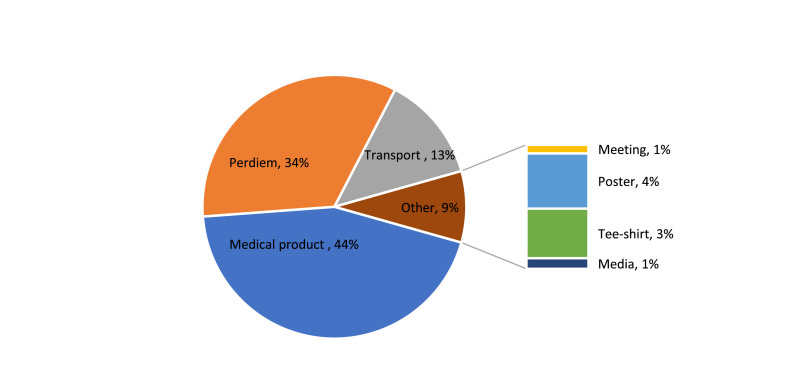
MDA activities cost $0·66 per treated child and skin screening $0·62 per screened person, including medical products. The MDA campaign exceeded coverage targets in both districts, whereas skin screening coverage varied by locality and age group. Both the service delivery team and the beneficiaries expressed appreciation for the integrated campaign. However, opportunities for improvement were identified.
Integrating MDA and skin NTD screening proved operationally feasible in this context but had not recorded cost-saving effects. The performance of the MDA campaign was not negatively affected by additional skin screening activities, but effective integration requires thorough joint planning, strengthened training, and proper supervision.
世界卫生组织倡导将被忽视的热带病纳入常规服务平台,以便在资源有限的环境中防治这些疾病。然而,关于整合的益处的文献有限。本研究考察了在科特迪瓦的大规模药物驱虫运动(MDA)中增加皮肤筛查的可行性和影响。
2023年6月,科特迪瓦卫生与公共卫生部在一项针对土壤传播蠕虫病和血吸虫病的全国MDA运动中,试点筛查与皮肤相关的被忽视热带病。选择了两个地区Fresco和Koro进行试点。该研究采用了定量和定性评估。定量方面侧重于运动成本和产出,采用成分法进行成本核算。定性评估采用实证现象学方法分析运动的操作可行性和利益相关者的评价。
MDA活动为每名接受治疗的儿童花费0.66美元,皮肤筛查为每名接受筛查的人花费0.62美元,包括医疗产品。MDA运动在两个地区都超过了覆盖目标,而皮肤筛查覆盖范围因地区和年龄组而异。服务提供团队和受益者都对综合运动表示赞赏。然而,也发现了改进的机会。
在这种情况下,将MDA和皮肤被忽视热带病筛查整合起来在操作上是可行的,但没有记录到节省成本的效果。额外的皮肤筛查活动没有对MDA运动的表现产生负面影响,但有效的整合需要全面的联合规划、加强培训和适当的监督。