The First Affiliated Hospital of Soochow University, No. 188 Shizi Street, Suzhou, 215006, China.
School of Nursing, Suzhou Medical College of Soochow University, Suzhou, 215006, China.
Eur J Med Res. 2024 Jul 19;29(1):376. doi: 10.1186/s40001-024-01943-z.
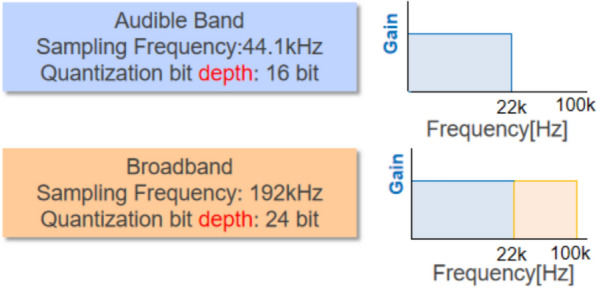
Although broadband music with inaudible high-frequency components may benefit human well-being, this research area is largely unexplored and lacks sufficient studies on the topic. This study aimed to investigate and compare the effects of broadband and audible band music on relaxation states and cognitive function in young adults.
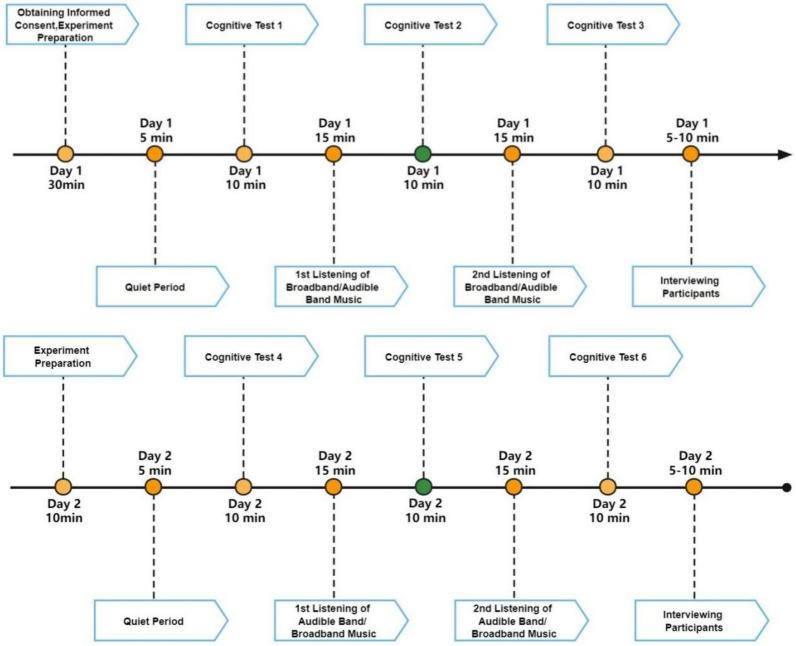
A single-blind randomized controlled trial was conducted in a professional soundproof laboratory from December 22, 2022, to January 18, 2023 with 32 participants randomly assigned to two groups, "Day 1 broadband + Day 2 audible band" (n = 16) and "Day 1 audible band + Day 2 broadband" (n = 16), listening to either broadband or audible band music (the same music piece played on the piano and harp) for two sessions of 15 min each on two consecutive days. Cognitive function was measured using CNS Vital Signs at pre-listening, after the 1st session, and after the 2nd session, while heart rate was monitored throughout the experiment. Visual Analog Scale was also administered for self-reported arousal, stress, thinking ability, and attention following each listening session.
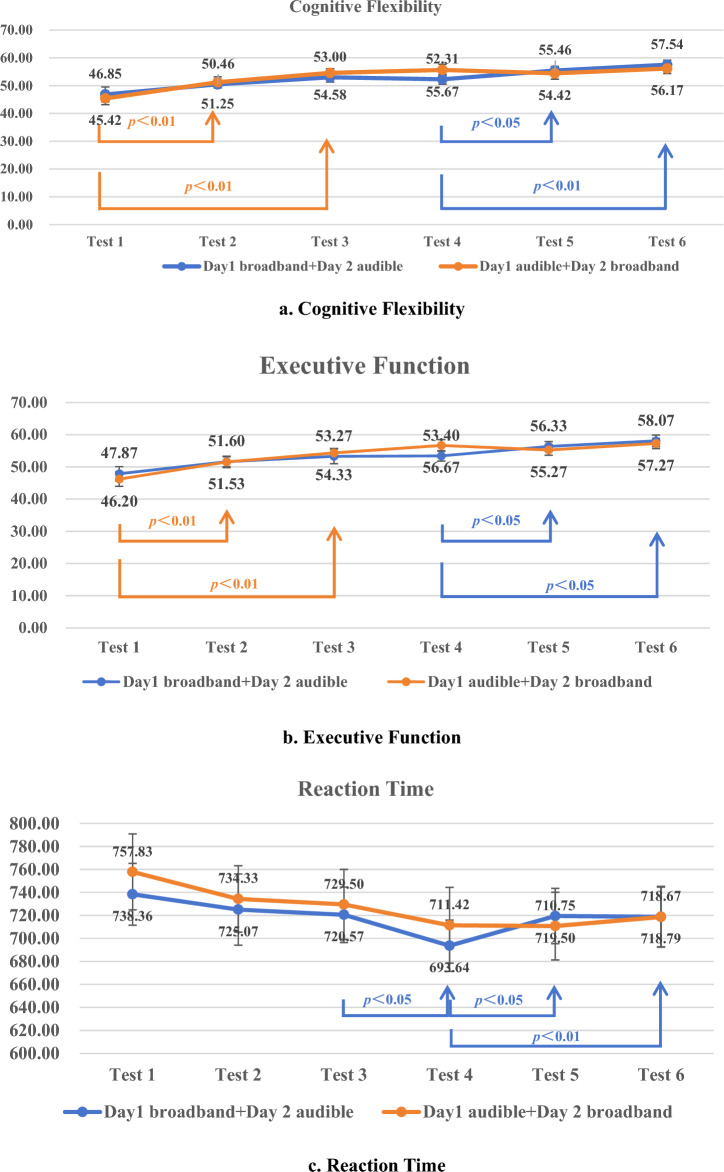
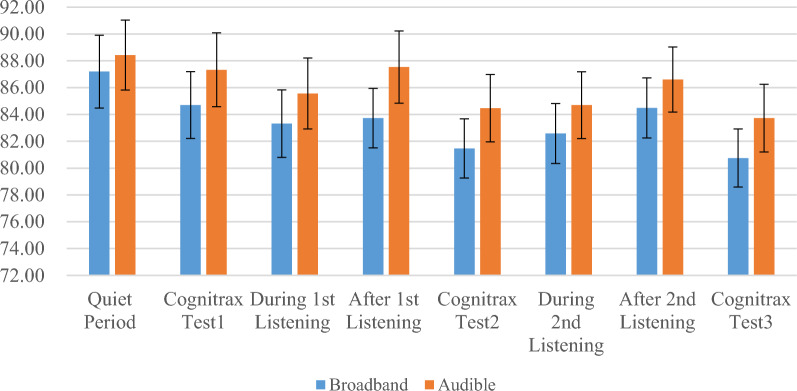
No significant differences were found in heart rate, cognitive flexibility, and executive function between the broadband listening group and the audible band-listening group (p > 0.05). However, the broadband group exhibited significant differences in mean heart rate at several time points, as well as a significant improvement in VAS stress level during the 2nd listening session compared to the 1st (p < 0.05). On the other hand, significant improvements in cognitive flexibility and executive function were observed in the audible band group across different time points (p < 0.05).
Comparative analysis showed that broadband and audible band music influenced cognitive function differently. Short-term audible band music listening significantly improved cognitive flexibility and executive function, while short-term broadband music listening significantly reduced reaction time in cognitive tests. Additionally, broadband music consistently resulted in lower mean heart rates compared to audible band music at all time points, suggesting that it may be more effective in promoting relaxation and reducing stress, although these differences were not statistically significant. Since the cognitive enhancing effects of broadband music may be counteracted by the drowsy effect of the selected relaxing music, using different types of music may be necessary to confirm its effects in future studies.
虽然具有不可听高频成分的宽带音乐可能有益于人类健康,但该研究领域在很大程度上尚未得到探索,并且缺乏关于该主题的充分研究。本研究旨在调查和比较宽带和可听频带音乐对年轻成年人放松状态和认知功能的影响。
2022 年 12 月 22 日至 2023 年 1 月 18 日,在专业隔音实验室中进行了一项单盲随机对照试验,共有 32 名参与者随机分配到两组,“第 1 天宽带+第 2 天可听频带”(n=16)和“第 1 天可听频带+第 2 天宽带”(n=16),连续两天各听两次 15 分钟的宽带或可听频带音乐(在钢琴和竖琴上演奏相同的乐曲)。在预听、第 1 次会议后和第 2 次会议后使用 CNS Vital Signs 测量认知功能,同时在整个实验过程中监测心率。每次聆听后,还使用视觉模拟量表(VAS)评估唤醒度、压力、思维能力和注意力的自我报告。
在心率、认知灵活性和执行功能方面,宽带聆听组和可听频带聆听组之间没有发现显著差异(p>0.05)。然而,宽带组在几个时间点的平均心率以及在第 2 次聆听期间 VAS 压力水平的显著改善方面与第 1 次聆听相比存在显著差异(p<0.05)。另一方面,可听频带组在不同时间点的认知灵活性和执行功能均有显著改善(p<0.05)。
对比分析表明,宽带和可听频带音乐对认知功能的影响不同。短期可听频带音乐聆听显著改善了认知灵活性和执行功能,而短期宽带音乐聆听显著缩短了认知测试中的反应时间。此外,与可听频带音乐相比,宽带音乐在所有时间点的平均心率均较低,这表明它在促进放松和减轻压力方面可能更有效,尽管这些差异没有统计学意义。由于宽带音乐的认知增强作用可能会被所选放松音乐的昏昏欲睡效果抵消,因此在未来的研究中可能需要使用不同类型的音乐来确认其效果。