Department of Psychological & Brain Sciences, University of California, Santa Barbara, California, USA.
Institute for Collaborative Biotechnologies, University of California, Santa Barbara, California, USA.
Hum Brain Mapp. 2024 Aug 1;45(11):e26785. doi: 10.1002/hbm.26785.
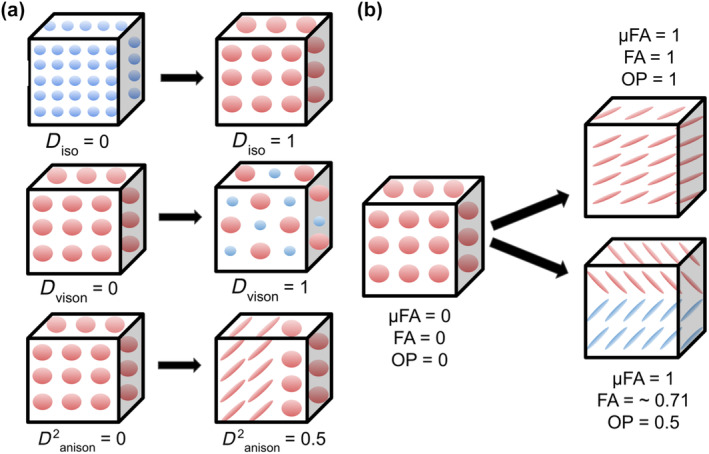
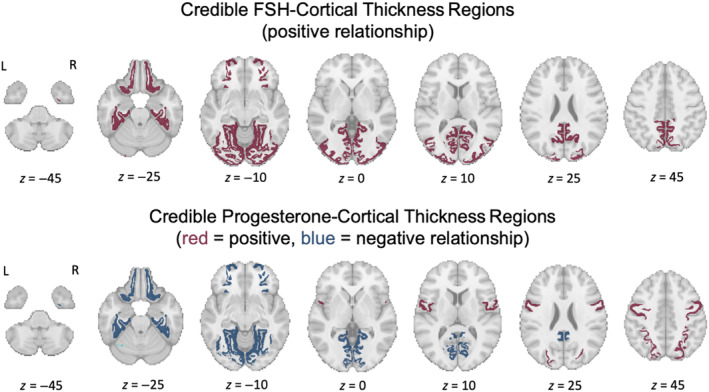
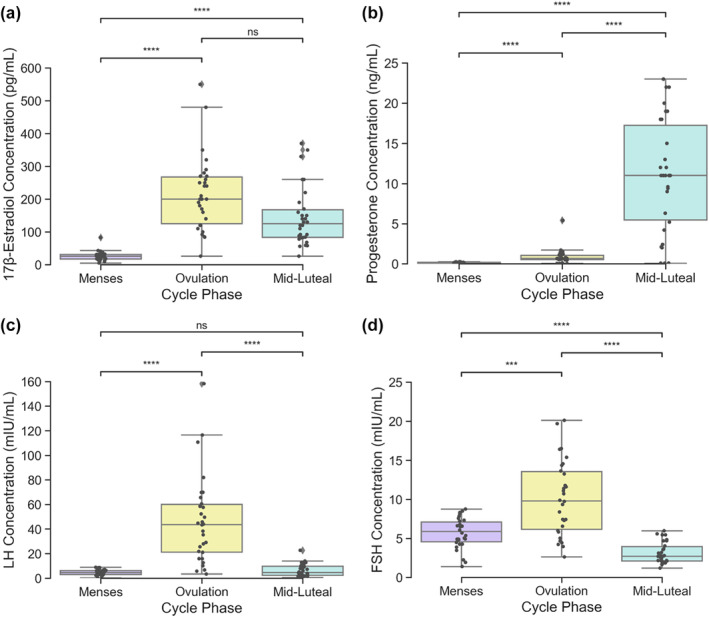
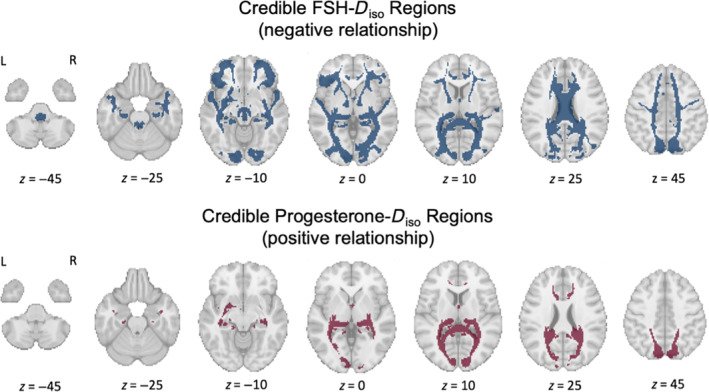
Cyclic fluctuations in hypothalamic-pituitary-gonadal axis (HPG-axis) hormones exert powerful behavioral, structural, and functional effects through actions on the mammalian central nervous system. Yet, very little is known about how these fluctuations alter the structural nodes and information highways of the human brain. In a study of 30 naturally cycling women, we employed multidimensional diffusion and T-weighted imaging during three estimated menstrual cycle phases (menses, ovulation, and mid-luteal) to investigate whether HPG-axis hormone concentrations co-fluctuate with alterations in white matter (WM) microstructure, cortical thickness (CT), and brain volume. Across the whole brain, 17β-estradiol and luteinizing hormone (LH) concentrations were directly proportional to diffusion anisotropy (μFA; 17β-estradiol: β = 0.145, highest density interval (HDI) = [0.211, 0.4]; LH: β = 0.111, HDI = [0.157, 0.364]), while follicle-stimulating hormone (FSH) was directly proportional to CT (β = 0 .162, HDI = [0.115, 0.678]). Within several individual regions, FSH and progesterone demonstrated opposing relationships with mean diffusivity (D) and CT. These regions mainly reside within the temporal and occipital lobes, with functional implications for the limbic and visual systems. Finally, progesterone was associated with increased tissue (β = 0.66, HDI = [0.607, 15.845]) and decreased cerebrospinal fluid (CSF; β = -0.749, HDI = [-11.604, -0.903]) volumes, with total brain volume remaining unchanged. These results are the first to report simultaneous brain-wide changes in human WM microstructure and CT coinciding with menstrual cycle-driven hormone rhythms. Effects were observed in both classically known HPG-axis receptor-dense regions (medial temporal lobe, prefrontal cortex) and in other regions located across frontal, occipital, temporal, and parietal lobes. Our results suggest that HPG-axis hormone fluctuations may have significant structural impacts across the entire brain.
下丘脑-垂体-性腺轴 (HPG 轴) 激素的周期性波动通过对哺乳动物中枢神经系统的作用,产生强大的行为、结构和功能影响。然而,人们对这些波动如何改变人类大脑的结构节点和信息高速公路知之甚少。在一项对 30 名自然周期女性的研究中,我们在估计的三个月经周期阶段(月经期、排卵期和黄体中期)使用多维扩散和 T 加权成像来研究 HPG 轴激素浓度是否与白质 (WM) 微观结构、皮质厚度 (CT) 和脑体积的变化同时发生变化。在整个大脑中,17β-雌二醇和黄体生成素 (LH) 浓度与扩散各向异性 (μFA;17β-雌二醇:β=0.145,最高密度区间 (HDI)=[0.211,0.4];LH:β=0.111,HDI=[0.157,0.364]) 成正比,而卵泡刺激素 (FSH) 与 CT 成正比 (β=0.162,HDI=[0.115,0.678])。在几个单独的区域内,FSH 和孕酮与平均扩散率 (D) 和 CT 呈相反的关系。这些区域主要位于颞叶和枕叶,对边缘系统和视觉系统有功能影响。最后,孕酮与组织增加 (β=0.66,HDI=[0.607,15.845]) 和脑脊液 (CSF;β=-0.749,HDI=[-11.604,-0.903]) 减少有关,总脑容量保持不变。这些结果是首次报道人类 WM 微观结构和 CT 同时发生变化与月经周期驱动的激素节律相吻合。在经典的 HPG 轴受体密集区域(内侧颞叶、前额叶皮层)和位于额叶、枕叶、颞叶和顶叶的其他区域都观察到了这些影响。我们的研究结果表明,HPG 轴激素波动可能对整个大脑具有显著的结构影响。