Enzyme and Protein Chemistry, Department of Biotechnology and Biomedicine, Technical University of Denmark, Lyngby, Denmark; Norwegian Biopolymer Laboratory (NOBIPOL), Department of Biotechnology and Food Science, NTNU Norwegian University of Science and Technology, Trondheim, Norway.
Enzyme and Protein Chemistry, Department of Biotechnology and Biomedicine, Technical University of Denmark, Lyngby, Denmark.
J Biol Chem. 2024 Sep;300(9):107596. doi: 10.1016/j.jbc.2024.107596. Epub 2024 Jul 19.
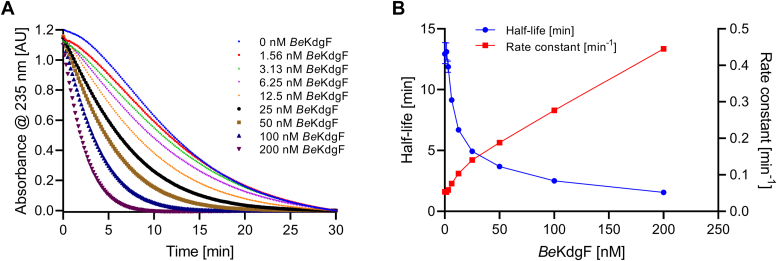
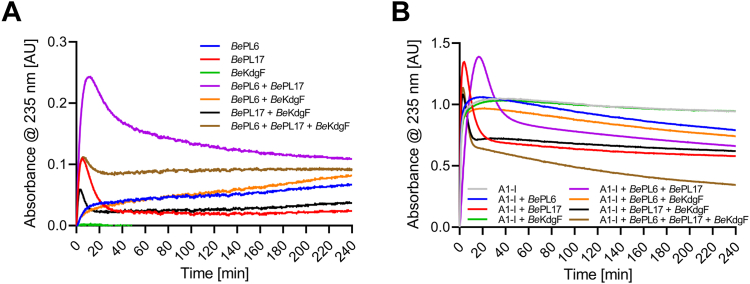
Alginate is a polysaccharide consumed by humans in edible seaweed and different foods where it is applied as a texturizing hydrocolloid or in encapsulations of drugs and probiotics. While gut bacteria are found to utilize and ferment alginate to health-beneficial short-chain fatty acids, knowledge on the details of the molecular reactions is sparse. Alginates are composed of mannuronic acid (M) and its C-5 epimer guluronic acid (G). An alginate-related polysaccharide utilization locus (PUL) has been identified in the gut bacterium Bacteroides eggerthii DSM 20697. The PUL encodes two polysaccharide lyases (PLs) from the PL6 (BePL6) and PL17 (BePL17) families as well as a KdgF-like metalloprotein (BeKdgF) known to catalyze ring-opening of 4,5-unsaturated monouronates yielding 4-deoxy-l-erythro-5-hexoseulose uronate (DEH). B. eggerthii DSM 20697 does not grow on alginate, but readily proliferates with a lag phase of a few hours in the presence of an endo-acting alginate lyase A1-I from the marine bacterium Sphingomonas sp. A1. The B. eggerthii lyases are both exo-acting and while BePL6 is strictly G-block specific, BePL17 prefers M-blocks. BeKdgF retained 10-27% activity in the presence of 0.1-1 mM EDTA. X-ray crystallography was used to investigate the three-dimensional structure of BeKdgF, based on which a catalytic mechanism was proposed to involve Asp102, acting as acid/base having pK of 5.9 as determined by NMR pH titration. BePL6 and BePL17 cooperate in alginate degradation with BeKdgF linearizing producing 4,5-unsaturated monouronates. Their efficiency of alginate degradation was much enhanced by the addition of the A1-I alginate lyase.
海藻酸盐是一种多糖,人类可从食用海藻和各种食物中摄取,这些食物中应用了海藻酸盐作为质构化水胶体,或用于包裹药物和益生菌。虽然肠道细菌被发现可以利用和发酵海藻酸盐,生成有益健康的短链脂肪酸,但关于其分子反应细节的知识还很匮乏。海藻酸盐由甘露糖醛酸 (M) 和其 C-5 差向异构体古罗糖醛酸 (G) 组成。在肠道细菌 Bacteroides eggerthii DSM 20697 中已经鉴定出与海藻酸盐相关的多糖利用基因座 (PUL)。该 PUL 编码两种来自 PL6 (BePL6) 和 PL17 (BePL17) 家族的多糖裂解酶 (PL) 以及一种 KdgF 样金属蛋白酶 (BeKdgF),已知该酶能够催化 4,5-不饱和单糖醛酸的开环反应,生成 4-脱氧-L-赤式-5-己酮糖醛酸 (DEH)。Bacteroides eggerthii DSM 20697 不能在海藻酸盐上生长,但在海洋细菌 Sphingomonas sp. A1 的内切作用的海藻酸盐裂解酶 A1-I 的存在下,生长迅速,经历几个小时的延迟期。B. eggerthii 的裂解酶均为外切作用,虽然 BePL6 严格特异性作用于 G 块,但 BePL17 更倾向于 M 块。BeKdgF 在 0.1-1 mM EDTA 存在下保留 10-27%的活性。X 射线晶体学用于研究 BeKdgF 的三维结构,基于此提出了一种催化机制,涉及作为酸/碱的 Asp102,其 pK 值为 5.9,通过 NMR pH 滴定法确定。BePL6 和 BePL17 与 BeKdgF 合作线性化产生 4,5-不饱和单糖醛酸,共同降解海藻酸盐。添加 A1-I 海藻酸盐裂解酶大大提高了它们降解海藻酸盐的效率。