Asan Institute for Life Sciences, Asan Medical Center, University of Ulsan College of Medicine, Seoul, South Korea.
Department of Biochemistry and Molecular Biology, AMIST, Asan Medical Center, University of Ulsan College of Medicine, Seoul, South Korea.
J Cell Mol Med. 2024 Jul;28(14):e18533. doi: 10.1111/jcmm.18533.
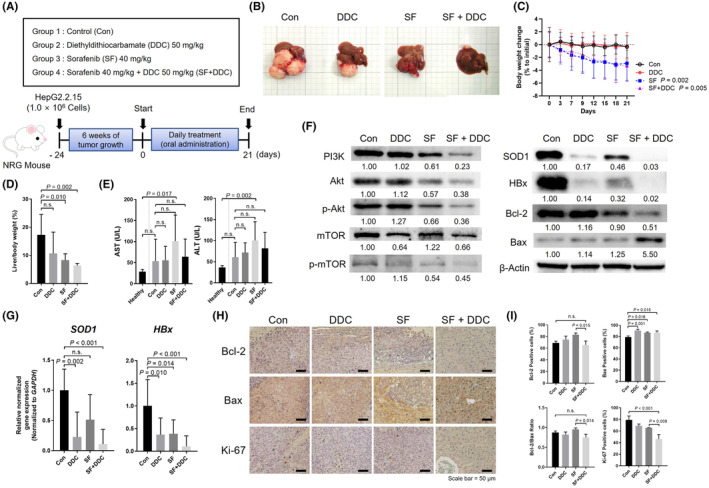
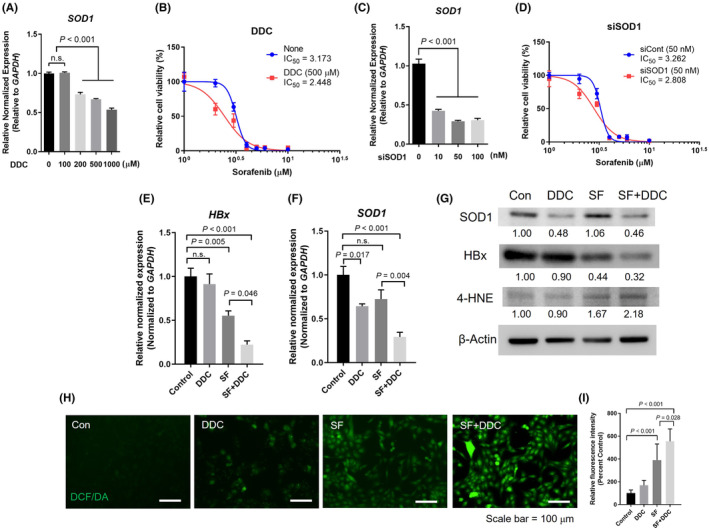
Hepatitis B Virus (HBV) infection significantly elevates the risk of hepatocellular carcinoma (HCC), with the HBV X protein (HBx) playing a crucial role in cancer progression. Sorafenib, the primary therapy for advanced HCC, shows limited effectiveness in HBV-infected patients due to HBx-related resistance. Numerous studies have explored combination therapies to overcome this resistance. Sodium diethyldithiocarbamate (DDC), known for its anticancer effects and its inhibition of superoxide dismutase 1 (SOD1), is hypothesized to counteract sorafenib (SF) resistance in HBV-positive HCCs. Our research demonstrates that combining DDC with SF significantly reduces HBx and SOD1 expressions in HBV-positive HCC cells and human tissues. This combination therapy disrupts the PI3K/Akt/mTOR signalling pathway and promotes apoptosis by increasing reactive oxygen species (ROS) levels. These cellular changes lead to reduced tumour viability and enhanced sensitivity to SF, as evidenced by the synergistic suppression of tumour growth in xenograft models. Additionally, DDC-mediated suppression of SOD1 further enhances SF sensitivity in HBV-positive HCC cells and xenografted animals, thereby inhibiting cancer progression more effectively. These findings suggest that the DDC-SF combination could serve as a promising strategy for overcoming SF resistance in HBV-related HCC, potentially optimizing therapy outcomes.
乙型肝炎病毒(HBV)感染显著增加肝细胞癌(HCC)的风险,HBV X 蛋白(HBx)在癌症进展中起着关键作用。索拉非尼是治疗晚期 HCC 的主要药物,但由于 HBx 相关耐药性,其在 HBV 感染患者中的疗效有限。许多研究探索了联合治疗以克服这种耐药性。二乙二硫代氨基甲酸钠(DDC)因其抗癌作用及其对超氧化物歧化酶 1(SOD1)的抑制作用而被认为可以抵抗 HBV 阳性 HCC 中的索拉非尼(SF)耐药性。我们的研究表明,DDC 与 SF 联合使用可显著降低 HBV 阳性 HCC 细胞和人组织中的 HBx 和 SOD1 表达。这种联合治疗通过增加活性氧(ROS)水平破坏 PI3K/Akt/mTOR 信号通路并促进细胞凋亡。这些细胞变化导致肿瘤活力降低和对 SF 的敏感性增强,在异种移植模型中协同抑制肿瘤生长得到证实。此外,DDC 介导的 SOD1 抑制可进一步增强 HBV 阳性 HCC 细胞和异种移植动物对 SF 的敏感性,从而更有效地抑制癌症进展。这些发现表明,DDC-SF 联合可能是克服 HBV 相关 HCC 中 SF 耐药性的一种有前途的策略,可能优化治疗效果。