Tang Xiao-Wei, Jiang Jiao, Huang Shu, Shi Xiao-Min, Xu Huan, Xu Jia, Peng Jie-Yu, Zhang Wei, Shi Lei, Zhong Xiao-Lin, Kang Min, Lü Mu-Han
Department of Gastroenterology, the Affiliated Hospital of Southwest Medical University, Luzhou, China.
Nuclear Medicine and Molecular Imaging Key Laboratory of Sichuan Province, The Affiliated Hospital of Southwest Medical University, Luzhou, China.
Front Pediatr. 2024 Jul 5;12:1357093. doi: 10.3389/fped.2024.1357093. eCollection 2024.
Childhood and adolescent cancer represent a significant health burden in the United States. Current and precise epidemiological data are crucial to develop effective cancer control plans and ultimately reduce the burden of childhood and adolescent cancer.
We analyzed data obtained from cancer registries in the National Cancer Institute's Surveillance, Epidemiology, and End Results Program. Age-standardized incidence and death rates, assessed using joinpoint analysis, were quantified as annual percentage changes (APC) and average percentage changes (AAPC).
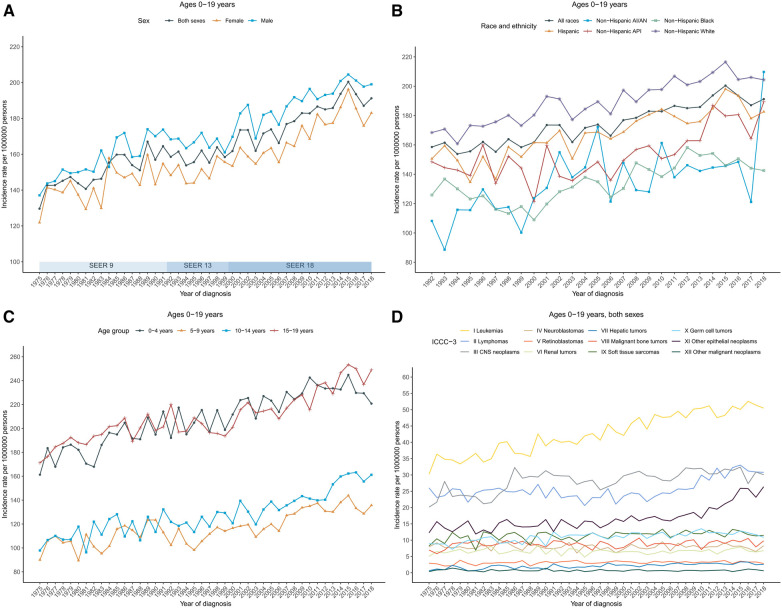
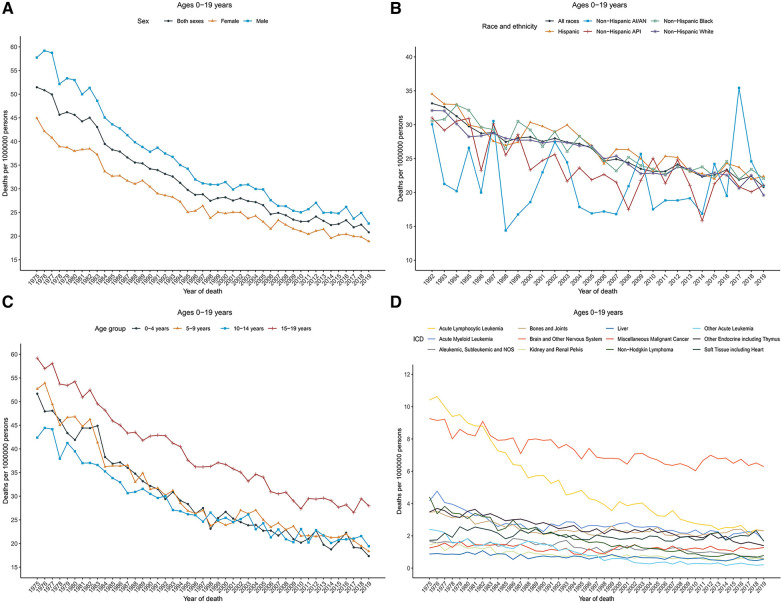
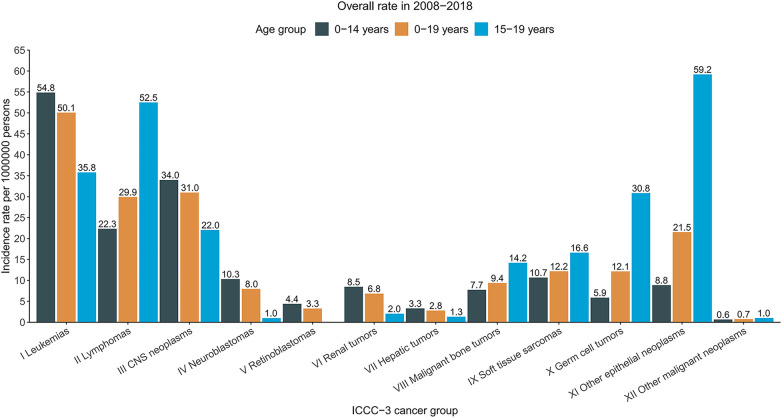
The overall cancer incidence rate in 2008-2018 was 187.9 per 1,000,000 persons. Cancer incidence rates demonstrated a sustained upward trend, with an APC of 0.8 from 1975 to 2018. Incidence rates during 2008-2018 remained stable among non-Hispanic Black children but increased among other racial and ethnic groups. Leukemias, central nervous system tumors, and lymphomas were the most common cancer groups for patients aged 0-19 years. Cancer death rates decreased among children [AAPC, -1.3 (95% CI, -1.5 to -1.1)] during 2009-2019, while were stable among adolescents during that period.
In this study, we analyzed cancer incidence and mortality rates and trends in children aged 0-19 years in the United States. Our findings revealed an overall increase in cancer incidence rates among children and adolescents, accompanied by a decline in cancer mortality rates over time. These rates and trends varied by age, sex, and particularly race and ethnicity, highlighting the significance of comprehending and addressing disparities and ultimately reducing the disease burden of childhood and adolescent cancer.
儿童和青少年癌症是美国一项重大的健康负担。当前准确的流行病学数据对于制定有效的癌症控制计划并最终减轻儿童和青少年癌症负担至关重要。
我们分析了从美国国立癌症研究所监测、流行病学和最终结果计划中的癌症登记处获得的数据。使用连接点分析评估的年龄标准化发病率和死亡率被量化为年度百分比变化(APC)和平均百分比变化(AAPC)。
2008 - 2018年总体癌症发病率为每100万人187.9例。癌症发病率呈持续上升趋势,1975年至2018年的APC为0.8。2008 - 2018年期间,非西班牙裔黑人儿童的发病率保持稳定,但其他种族和族裔群体的发病率有所上升。白血病、中枢神经系统肿瘤和淋巴瘤是0 - 19岁患者中最常见的癌症类型。2009 - 2019年期间儿童癌症死亡率下降[AAPC,-1.3(95%CI,-1.5至-1.1)],而在此期间青少年癌症死亡率保持稳定。
在本研究中,我们分析了美国0 - 19岁儿童的癌症发病率、死亡率及趋势。我们的研究结果显示儿童和青少年癌症发病率总体上升,同时癌症死亡率随时间下降。这些发病率和趋势因年龄、性别,尤其是种族和族裔而异,凸显了理解和解决差异并最终减轻儿童和青少年癌症疾病负担的重要性。