Department of General, Visceral and Transplant Surgery, University of Heidelberg, Im Neuenheimer Feld 110, 69120, Heidelberg, Germany.
Department of Pediatric Surgery, University of Heidelberg, Im Neuenheimer Feld 110, 69120, Heidelberg, Germany.
Cancer Commun (Lond). 2019 Oct 24;39(1):62. doi: 10.1186/s40880-019-0411-7.
Hepatoblastoma is a rare disease that nevertheless accounts for the majority of liver malignancies in children. Due to limited epidemiological data, therapy for hepatoblastoma tends to be individualized. This study aimed to evaluate incidence trends of hepatoblastoma and to develop a nomogram to predict the survival of children with newly diagnosed hepatoblastoma on a population-based level.
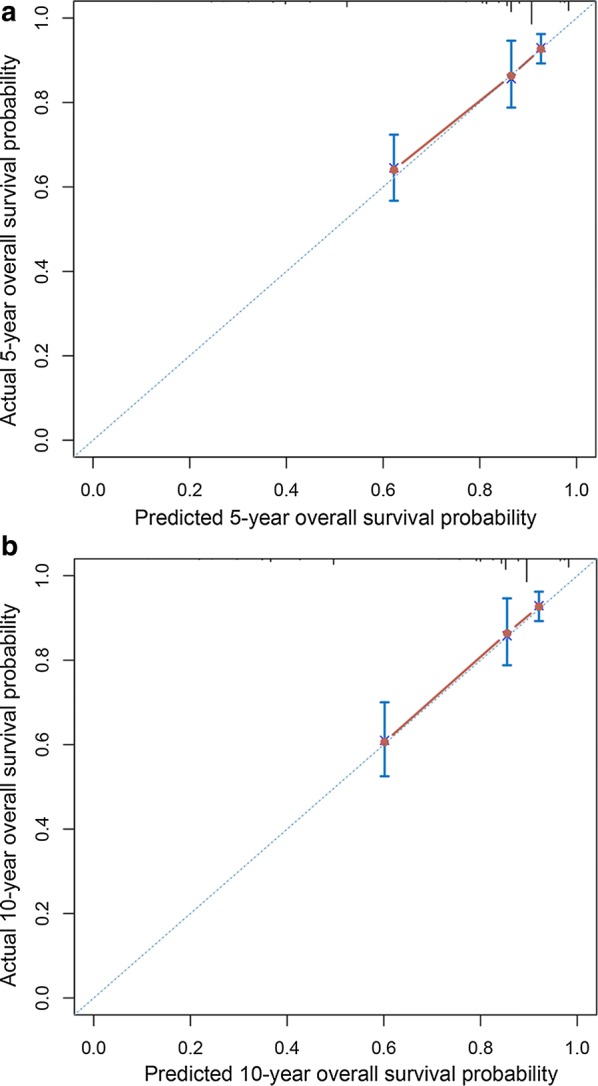
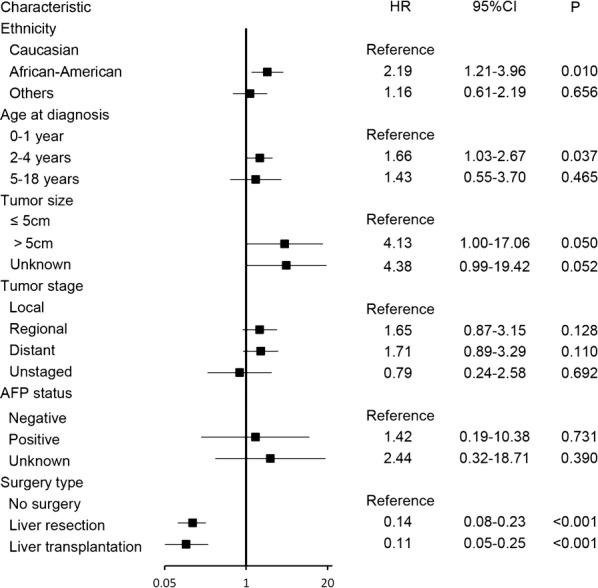
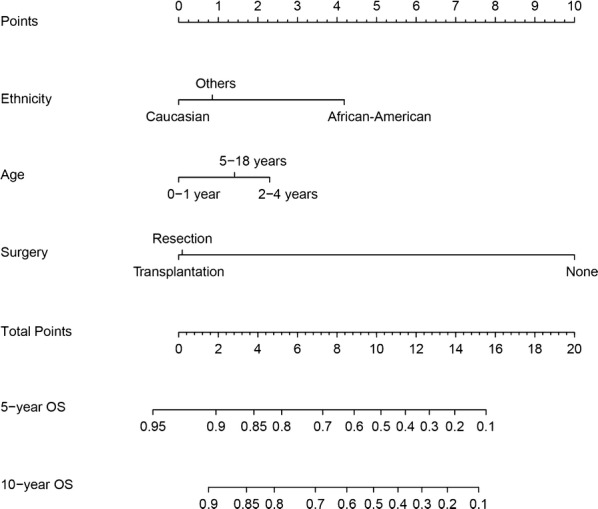
Individuals up to 18 years of age with hepatoblastoma recorded in 18 registries of the Surveillance, Epidemiology, and End Results (SEER) database between 2004 and 2015 were examined. Joinpoint regression analyses were applied to assess incidence trends in annual percentage change (APC). Multivariable Cox regression was used to identify factors associated with overall survival (OS). A nomogram was constructed to predict OS in individual cases based on independent predictors. Concordance index (C-index) and calibration curves were used to evaluate predictive performance.
Between 2004 and 2015, hepatoblastoma incidence increased significantly (APC, 2.2%; 95% confidence interval [CI] 0.5% to 3.8%, P < 0.05). In particular, this increase was observed among 2- to 4-year-old patients, males, and African-Americans. The 5- and 10-year OS rates were 81.5% and 81.0%, respectively. Age of 2 to 4 years, African-American ethnicity, and no surgery were independent predictors for short OS. Distant disease at presentation was found not to be an independent factor of survival. The nomogram had a C-index of 0.79 (95% CI 0.74-0.84) with appropriate calibration curve fitting.
We constructed a nomogram that integrates common factors associated with survival for hepatoblastoma patients. It provides accurate prognostic prediction for children with hepatoblastoma.
肝母细胞瘤是一种罕见的疾病,但它仍是儿童肝脏恶性肿瘤的主要类型。由于有限的流行病学数据,肝母细胞瘤的治疗往往是个体化的。本研究旨在评估肝母细胞瘤的发病率趋势,并建立一个列线图来预测基于人群的新诊断肝母细胞瘤患儿的生存情况。
在 2004 年至 2015 年间,我们对 18 个监测、流行病学和最终结果(SEER)数据库登记处记录的年龄在 18 岁以下的肝母细胞瘤患者进行了检查。应用 Joinpoint 回归分析评估年度百分比变化(APC)的发病率趋势。多变量 Cox 回归用于确定与总生存(OS)相关的因素。根据独立预测因素,构建列线图预测个体病例的 OS。使用一致性指数(C 指数)和校准曲线评估预测性能。
2004 年至 2015 年间,肝母细胞瘤的发病率显著增加(APC,2.2%;95%置信区间[CI],0.5%至 3.8%,P<0.05)。特别是在 2 至 4 岁的患者、男性和非裔美国人中观察到这种增加。5 年和 10 年 OS 率分别为 81.5%和 81.0%。2 至 4 岁、非裔美国人种族和未手术是 OS 短的独立预测因素。初诊时的远处疾病未被发现是生存的独立因素。该列线图的 C 指数为 0.79(95%CI,0.74-0.84),校准曲线拟合良好。
我们构建了一个列线图,该图综合了与肝母细胞瘤患者生存相关的常见因素。它为肝母细胞瘤患儿提供了准确的预后预测。