Cao Mumin, Sheng Renwang, Sun Yimin, Cao Ying, Wang Hao, Zhang Ming, Pu Yunmeng, Gao Yucheng, Zhang Yuanwei, Lu Panpan, Teng Gaojun, Wang Qianqian, Rui Yunfeng
Department of Orthopaedics, Zhongda Hospital, School of Medicine, Southeast University, Nanjing, Jiangsu, People's Republic of China.
School of Medicine, Southeast University, Nanjing, 210009, People's Republic of China.
Nanomicro Lett. 2024 Jul 22;16(1):251. doi: 10.1007/s40820-024-01464-8.
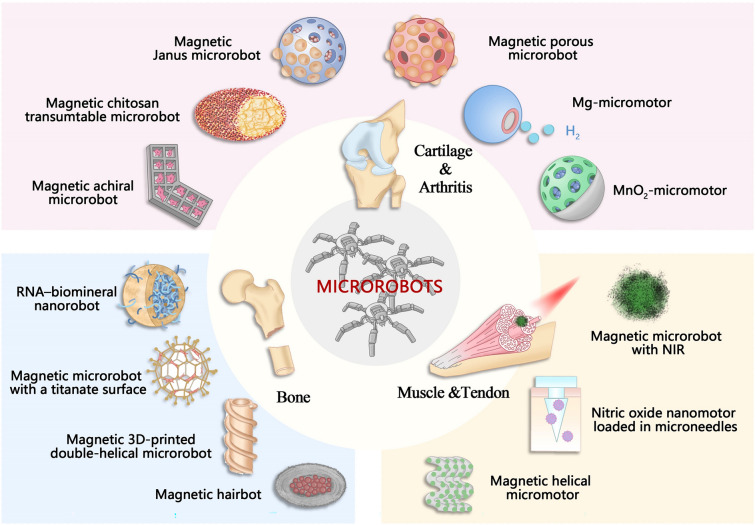
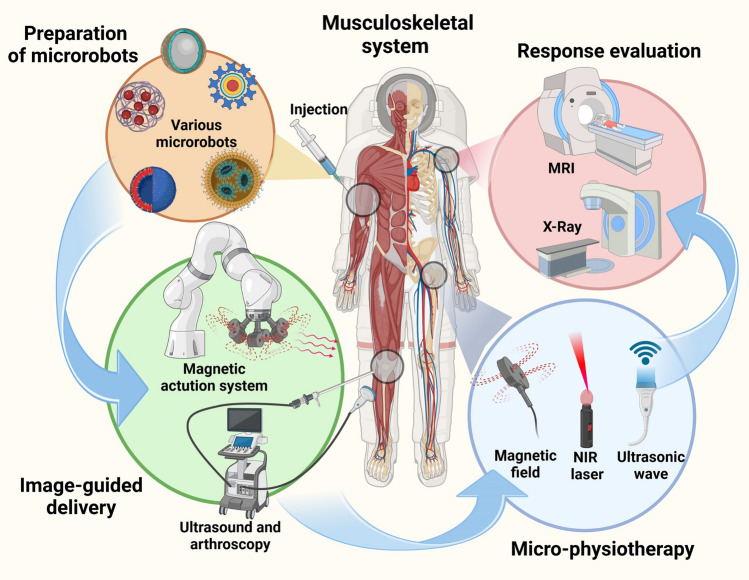
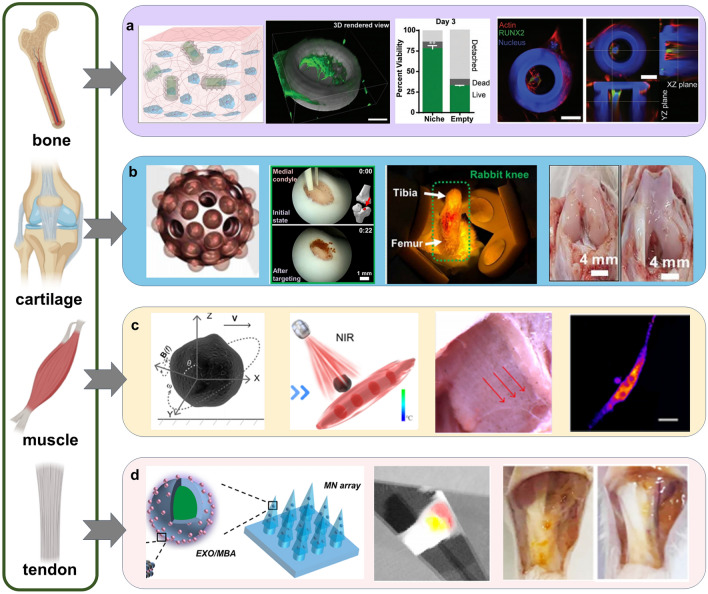
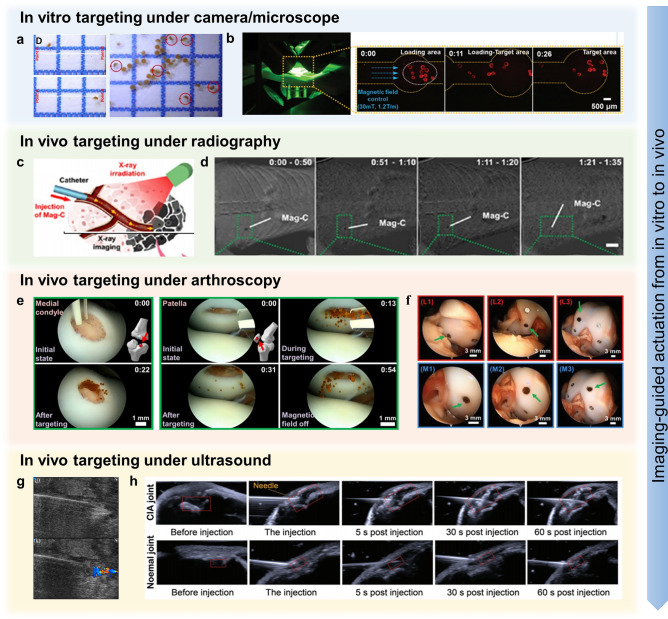
Disorders of the musculoskeletal system are the major contributors to the global burden of disease and current treatments show limited efficacy. Patients often suffer chronic pain and might eventually have to undergo end-stage surgery. Therefore, future treatments should focus on early detection and intervention of regional lesions. Microrobots have been gradually used in organisms due to their advantages of intelligent, precise and minimally invasive targeted delivery. Through the combination of control and imaging systems, microrobots with good biosafety can be delivered to the desired area for treatment. In the musculoskeletal system, microrobots are mainly utilized to transport stem cells/drugs or to remove hazardous substances from the body. Compared to traditional biomaterial and tissue engineering strategies, active motion improves the efficiency and penetration of local targeting of cells/drugs. This review discusses the frontier applications of microrobotic systems in different tissues of the musculoskeletal system. We summarize the challenges and barriers that hinder clinical translation by evaluating the characteristics of different microrobots and finally point out the future direction of microrobots in the musculoskeletal system.
肌肉骨骼系统疾病是全球疾病负担的主要成因,而目前的治疗方法疗效有限。患者常遭受慢性疼痛,最终可能不得不接受终末期手术。因此,未来的治疗应侧重于区域病变的早期检测和干预。微型机器人因其智能、精确和微创靶向递送的优势,已逐渐应用于生物体中。通过控制和成像系统的结合,可以将具有良好生物安全性的微型机器人输送到所需区域进行治疗。在肌肉骨骼系统中,微型机器人主要用于运输干细胞/药物或从体内清除有害物质。与传统生物材料和组织工程策略相比,主动运动提高了细胞/药物局部靶向的效率和穿透性。本文综述了微型机器人系统在肌肉骨骼系统不同组织中的前沿应用。我们通过评估不同微型机器人的特性,总结了阻碍临床转化的挑战和障碍,并最终指出了微型机器人在肌肉骨骼系统中的未来发展方向。