O'Hara Bethany A, Lukacher Avraham S, Garabian Kaitlin, Kaiserman Jacob, MacLure Evan, Ishikawa Hiroshi, Schroten Horst, Haley Sheila A, Atwood Walter J
Department of Cell Biology, Biochemistry, and Molecular Biology, The Warren Alpert Medical School, Brown University, Providence, Rhode Island, United States of America.
University of Tsukuba, Tsukuba City, Japan.
PLoS Pathog. 2024 Jul 22;20(7):e1012335. doi: 10.1371/journal.ppat.1012335. eCollection 2024 Jul.
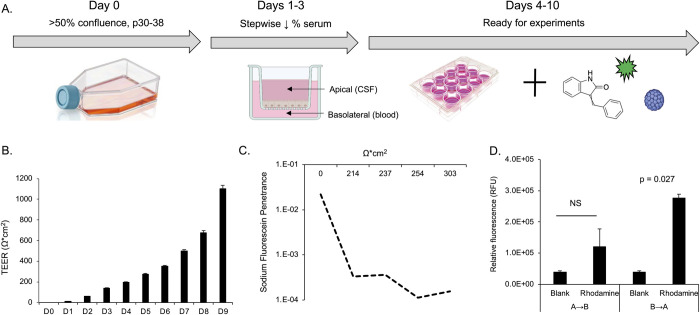
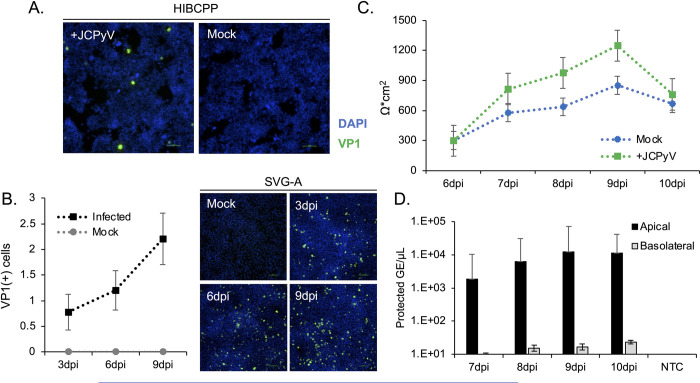
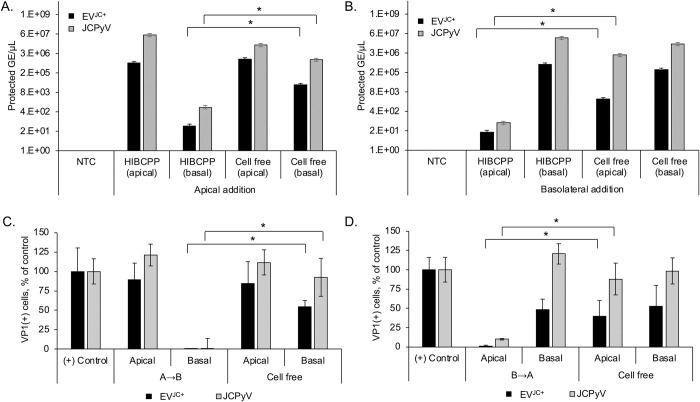
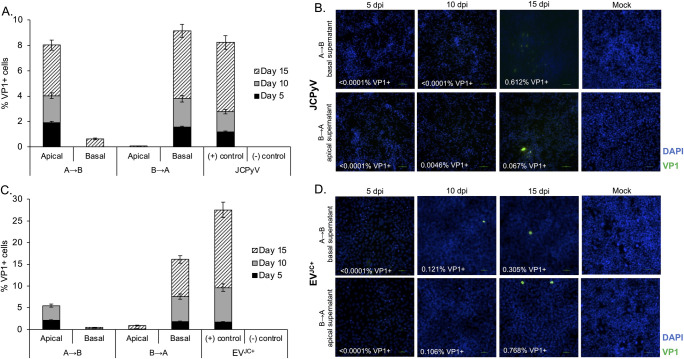
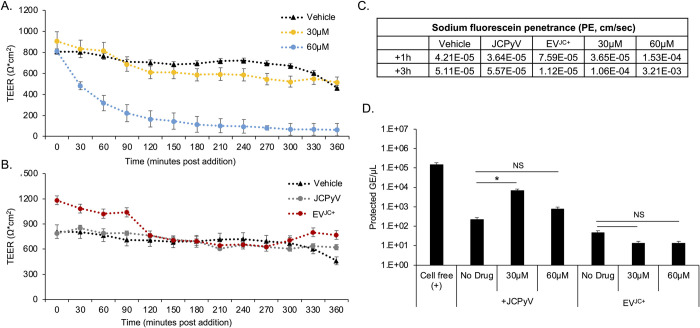
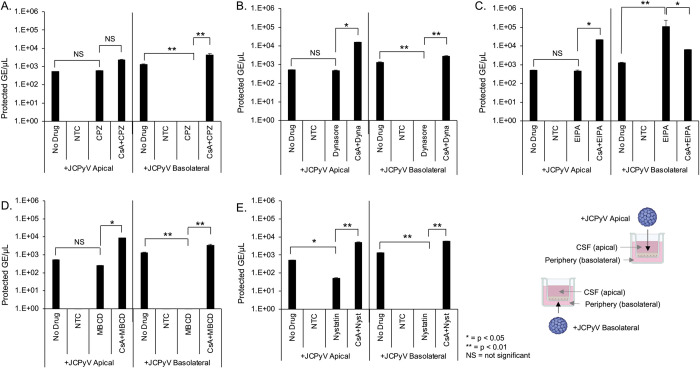
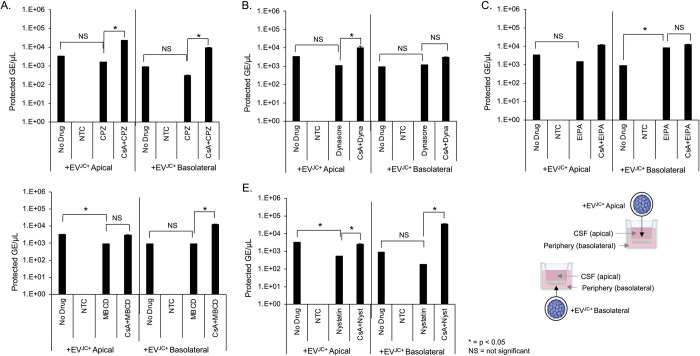
The human polyomavirus JCPyV is an opportunistic pathogen that infects greater than 60% of the world's population. The virus establishes a persistent and asymptomatic infection in the urogenital system but can cause a fatal demyelinating disease in immunosuppressed or immunomodulated patients following invasion of the CNS. The mechanisms responsible for JCPyV invasion into CNS tissues are not known but direct invasion from the blood to the cerebral spinal fluid via the choroid plexus has been hypothesized. To study the potential of the choroid plexus as a site of neuroinvasion, we used an adult human choroid plexus epithelial cell line to model the blood-cerebrospinal fluid (B-CSF) barrier in a transwell system. We found that these cells formed a highly restrictive barrier to virus penetration either as free virus or as virus associated with extracellular vesicles (EVJC+). The restriction was not absolute and small amounts of virus or EVJC+ penetrated and were able to establish foci of infection in primary astrocytes. Disruption of the barrier with capsaicin did not increase virus or EVJC+ penetration leading us to hypothesize that virus and EVJC+ were highly cell-associated and crossed the barrier by an active process. An inhibitor of macropinocytosis increased virus penetration from the basolateral (blood side) to the apical side (CSF side). In contrast, inhibitors of clathrin and raft dependent transcytosis reduced virus transport from the basolateral to the apical side of the barrier. None of the drugs inhibited apical to basolateral transport suggesting directionality. Pretreatment with cyclosporin A, an inhibitor of P-gp, MRP2 and BCRP multidrug resistance transporters, restored viral penetration in cells treated with raft and clathrin dependent transcytosis inhibitors. Because choroid plexus epithelial cells are known to be susceptible to JCPyV infection both in vitro and in vivo we also examined the release of infectious virus from the barrier. We found that virus was preferentially released from the cells into the apical (CSF) chamber. These data show clearly that there are two mechanisms of penetration, direct transcytosis which is capable of seeding the CSF with small amounts of virus, and infection followed by directional release of infectious virions into the CSF compartment.
人类多瘤病毒JCPyV是一种机会性病原体,全球超过60%的人口受到感染。该病毒在泌尿生殖系统中建立持续的无症状感染,但在侵入中枢神经系统后,可在免疫抑制或免疫调节的患者中引起致命的脱髓鞘疾病。JCPyV侵入中枢神经系统组织的机制尚不清楚,但有人推测病毒可通过脉络丛从血液直接侵入脑脊液。为了研究脉络丛作为神经侵袭部位的可能性,我们使用成人人类脉络丛上皮细胞系在Transwell系统中模拟血脑屏障。我们发现,这些细胞对游离病毒或与细胞外囊泡相关的病毒(EVJC+)形成了高度限制性的病毒穿透屏障。这种限制并非绝对,少量病毒或EVJC+能够穿透并在原代星形胶质细胞中建立感染灶。用辣椒素破坏屏障并没有增加病毒或EVJC+的穿透,这使我们推测病毒和EVJC+与细胞高度相关,并通过一个活跃的过程穿过屏障。一种巨胞饮作用抑制剂增加了病毒从基底外侧(血液侧)向顶端侧(脑脊液侧)的穿透。相反,网格蛋白和脂筏依赖性转胞吞作用抑制剂减少了病毒从屏障基底外侧向顶端侧的转运。没有一种药物抑制从顶端到基底外侧的转运,表明存在方向性。用环孢素A(一种P-糖蛋白、多药耐药相关蛋白2和乳腺癌耐药蛋白多药耐药转运体的抑制剂)预处理,可恢复在用脂筏和网格蛋白依赖性转胞吞作用抑制剂处理的细胞中的病毒穿透。由于已知脉络丛上皮细胞在体外和体内均易受JCPyV感染,我们还研究了感染性病毒从屏障中的释放。我们发现病毒优先从细胞释放到顶端(脑脊液)腔室。这些数据清楚地表明,存在两种穿透机制,即能够将少量病毒接种到脑脊液中的直接转胞吞作用,以及随后将感染性病毒粒子定向释放到脑脊液隔室中的感染。