da Silva Marcos Augusto R, Gil Jéssica C, Torres Juliana A, S T Silva Gelson T, Filho José Balena Gabriel, Victória Henrique Fernandes Vieira, Krambrock Klaus, Teixeira Ivo F, Ribeiro Caue
Nanotechnology National Laboratory for Agriculture (LNNA), Embrapa Instrumentation, São Carlos 13561-206, Brazil.
Department of Chemistry, Federal University of São Carlos (UFSCar), 13565-905 São Carlos, São Paulo, Brazil.
ACS Appl Mater Interfaces. 2024 Aug 14;16(32):41973-41985. doi: 10.1021/acsami.4c02862. Epub 2024 Jul 23.
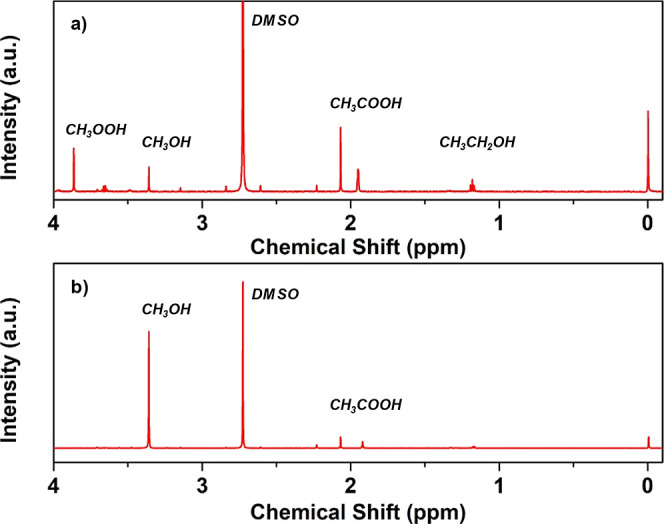
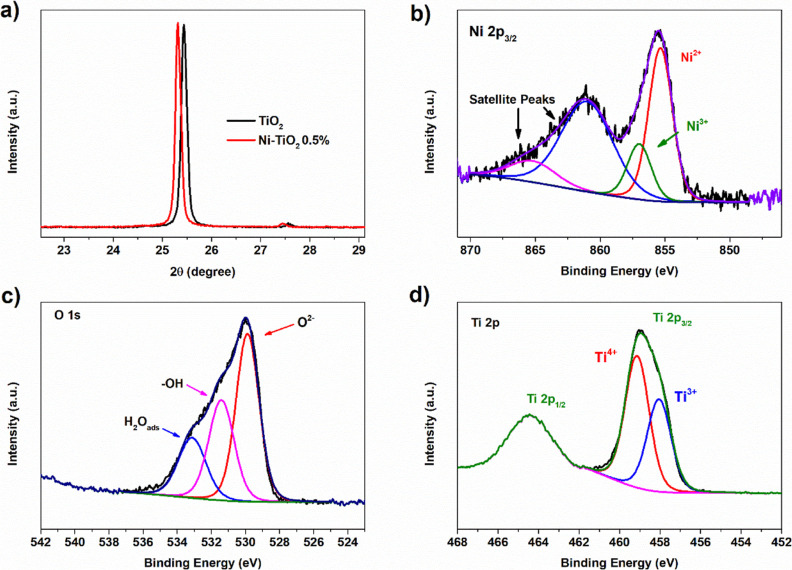
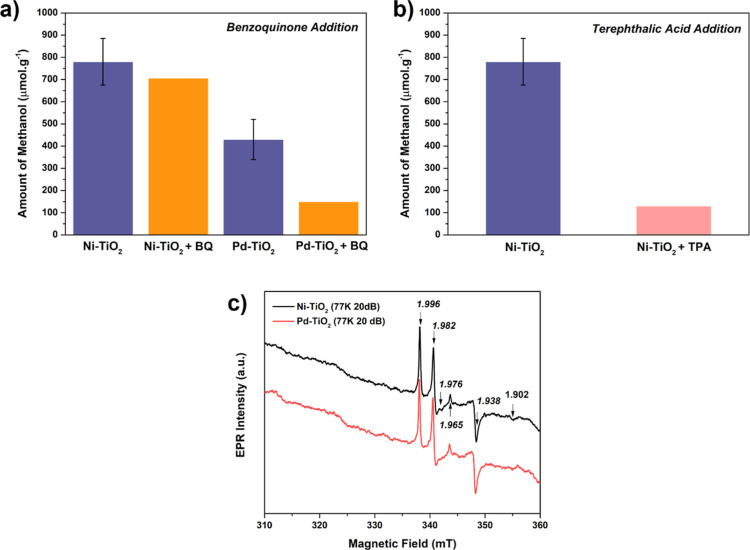
Methane conversion to valuable chemicals is a highly challenging and desirable reaction. Photocatalysis is a clean pathway to drive this chemical reaction, avoiding the high temperature and pressure of the syngas process. Titanium dioxide, being the most used photocatalyst, presents challenges in controlling the oxidation process, which is believed to depend on the metal sites on its surface that function as heterojunctions. Herein, we supported different metals on TiO and evaluated their activity in methane photooxidation reactions. We showed that Ni-TiO is the best photocatalyst for selective methane conversion, producing impressively high amounts of methanol (1.600 μmol·g) using HO as an oxidant, with minimal CO evolution. This performance is attributed to the high efficiency of nickel species to produce hydroxyl radicals and enhance HO utilization as well as to induce carrier traps (Ti and SETOVs sites) on TiO, which are crucial for C-H activation. This study sheds light on the role of catalyst structure in the proper control of CH photoconversion.
将甲烷转化为有价值的化学品是一个极具挑战性且令人期待的反应。光催化是驱动这一化学反应的清洁途径,可避免合成气工艺所需的高温高压。二氧化钛作为最常用的光催化剂,在控制氧化过程方面存在挑战,据信该过程取决于其表面作为异质结起作用的金属位点。在此,我们在TiO上负载了不同的金属,并评估了它们在甲烷光氧化反应中的活性。我们表明,Ni-TiO是选择性甲烷转化的最佳光催化剂,以H₂O₂作为氧化剂时,能产生高达1.600 μmol·g的甲醇,且CO生成量极少。这种性能归因于镍物种产生羟基自由基和提高H₂O₂利用率的高效率,以及在TiO上诱导载流子陷阱(Ti和SETOVs位点),这对于C-H活化至关重要。这项研究揭示了催化剂结构在适当控制CH光转化中的作用。