Department of Radiation Oncology, Corewell Health William Beaumont University Hospital, Royal Oak, Michigan, USA.
William Beaumont School of Medicine, Oakland University, Rochester, Michigan, USA.
J Appl Clin Med Phys. 2024 Sep;25(9):e14472. doi: 10.1002/acm2.14472. Epub 2024 Jul 23.
This study examines how MRI distortions affect frame-based SRS treatments and assesses the need for clinical distortion corrections.
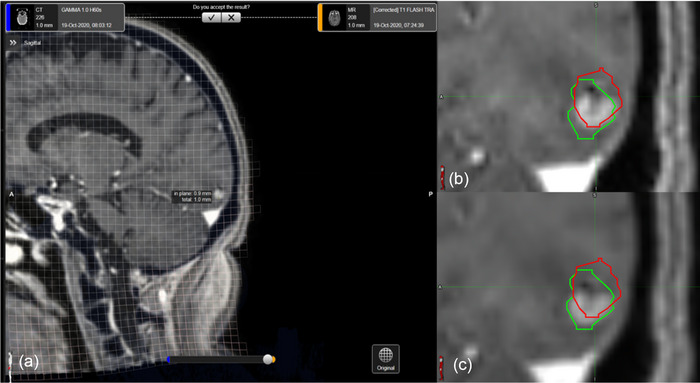
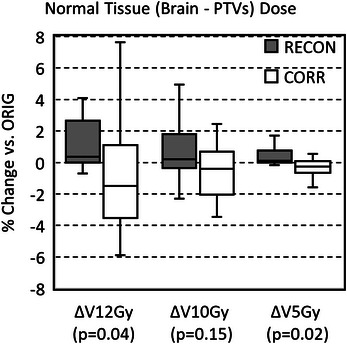
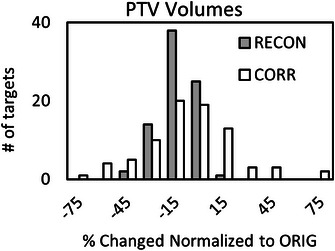
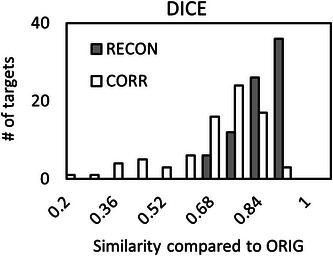
The study included 18 patients with 80 total brain targets treated using frame-based radiosurgery. Distortion within patients' MRIs were corrected using Cranial Distortion Correction (CDC) software, which utilizes the patient's CT to alter planning MRIs to reduce inherent intra-cranial distortion. Distortion was evaluated by comparing the original planning target volumes (PTV) to targets contoured on corrected MRIs (PTV). To provide an internal control, targets were also re-contoured on uncorrected (PTV) MRIs. Additional analysis was done to assess if 1 mm expansions to PTV targets would compensate for patient-specific distortions. Changes in target volumes, DICE and JACCARD similarity coefficients, minimum PTV dose (D), dose to 95% of the PTV (D95%), and normal tissue receiving 12 Gy (V), 10 Gy (V), and 5 Gy (V) were calculated and evaluated. Student's t-tests were used to determine if changes in PTV were significantly different than intra-contouring variability quantified by PTV.
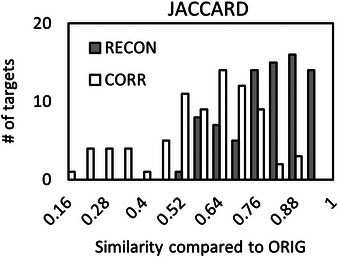
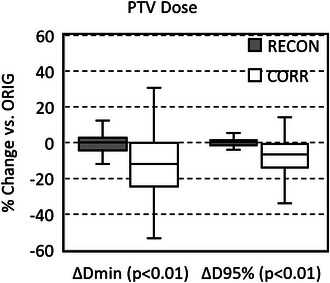
PTV and PTV relative changes in volume were 6.19% ± 10.95% and 1.48% ± 32.92%. PTV and PTV similarity coefficients were 0.90 ± 0.08 and 0.73 ± 0.16 for DICE and 0.82 ± 0.12 and 0.60 ± 0.18 for JACCARD. PTV and PTV changes in D were -0.88% ± 8.77% and -12.9 ± 17.3%. PTV and PTV changes in D95% were -0.34% ± 5.89 and -8.68% ± 13.21%. The 1 mm expanded PTV targets did not entirely cover 14 of the 80 PTV targets. Normal tissue changes (V, V, V) calculated with PTV were (-0.09% ± 7.39%, -0.38% ± 5.67%, -0.08% ± 2.04%) and PTV were (-2.14% ± 7.34%, -1.42% ± 5.45%, -0.61% ± 1.93%). Except for V, all PTV changes were significantly different (p < 0.05) than PTV.
MRIs used for SRS target delineation exhibit notable geometric distortions that may compromise optimal dosimetric accuracy. A uniform 1 mm expansion may result in geometric misses; however, the CDC algorithm provides a feasible solution for rectifying distortions, thereby enhancing treatment precision.
本研究旨在探讨 MRI 变形如何影响基于框架的 SRS 治疗,并评估临床变形校正的必要性。
该研究纳入了 18 名 80 个全脑靶区接受基于框架放射外科治疗的患者。利用 Cranial Distortion Correction(CDC)软件对患者 MRI 中的变形进行校正,该软件利用患者的 CT 来改变计划 MRI,以减少固有颅内变形。通过比较原始计划靶区(PTV)与校正 MRI 上勾画的靶区(PTV)来评估变形。为了提供内部对照,还在未校正的 MRI 上对靶区进行了重新勾画(PTV)。还进行了额外的分析,以评估 1mm 的 PTV 靶区扩展是否可以补偿患者特异性变形。计算并评估了靶区体积、DICE 和 JACCARD 相似系数、最小 PTV 剂量(D)、95%的 PTV 剂量(D95%)、12Gy(V)、10Gy(V)和 5Gy(V)接受的正常组织的变化。使用学生 t 检验来确定 PTV 的变化是否与通过 PTV 量化的内部勾画变异性有显著差异。
PTV 和 PTV 体积的相对变化分别为 6.19%±10.95%和 1.48%±32.92%。DICE 和 JACCARD 的 PTV 和 PTV 相似系数分别为 0.90±0.08 和 0.73±0.16,0.82±0.12 和 0.60±0.18。PTV 和 PTV 中 D 的变化分别为-0.88%±8.77%和-12.9±17.3%。PTV 和 PTV 中 D95%的变化分别为-0.34%±5.89%和-8.68%±13.21%。1mm 扩展的 PTV 靶区未能完全覆盖 80 个 PTV 靶区中的 14 个。使用 PTV 计算的正常组织变化(V、V、V)分别为(-0.09%±7.39%,-0.38%±5.67%,-0.08%±2.04%)和 PTV 为(-2.14%±7.34%,-1.42%±5.45%,-0.61%±1.93%)。除了 V 之外,所有 PTV 变化均与 PTV 有显著差异(p<0.05)。
用于 SRS 靶区勾画的 MRI 存在明显的几何变形,可能会影响最佳剂量准确性。统一的 1mm 扩展可能会导致几何遗漏;然而,CDC 算法提供了一种可行的解决方案,可以纠正变形,从而提高治疗精度。