Emerg Infect Dis. 2024 Aug;30(8):1599-1608. doi: 10.3201/eid3008.240529.
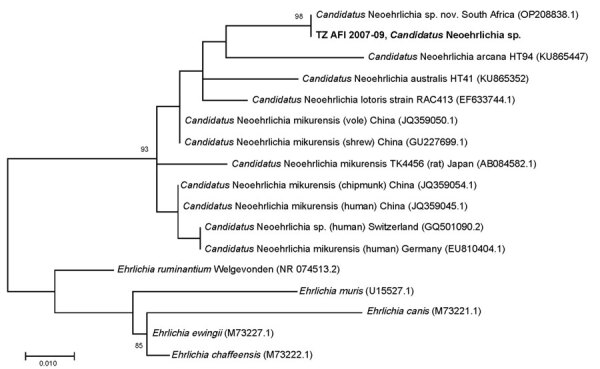
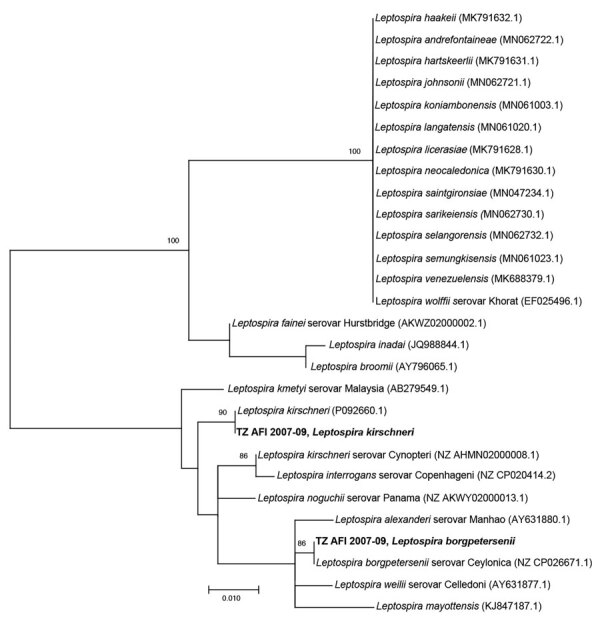
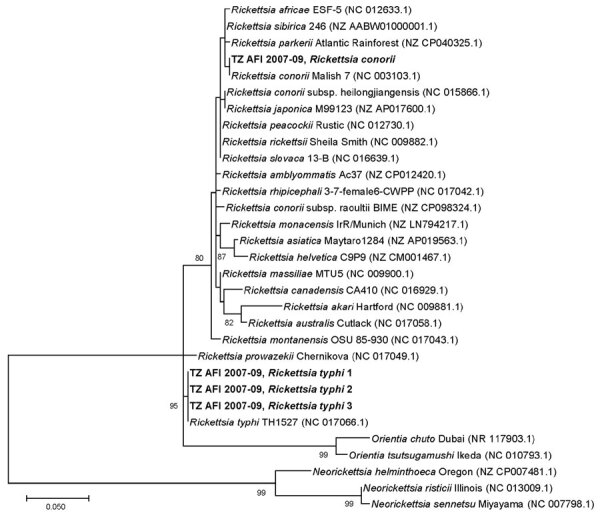
Bacterial zoonoses are established causes of severe febrile illness in East Africa. Within a fever etiology study, we applied a high-throughput 16S rRNA metagenomic assay validated for detecting bacterial zoonotic pathogens. We enrolled febrile patients admitted to 2 referral hospitals in Moshi, Tanzania, during September 2007-April 2009. Among 788 participants, median age was 20 (interquartile range 2-38) years. We performed PCR amplification of V1-V2 variable region 16S rRNA on cell pellet DNA, then metagenomic deep-sequencing and pathogenic taxonomic identification. We detected bacterial zoonotic pathogens in 10 (1.3%) samples: 3 with Rickettsia typhi, 1 R. conorii, 2 Bartonella quintana, 2 pathogenic Leptospira spp., and 1 Coxiella burnetii. One other sample had reads matching a Neoerhlichia spp. previously identified in a patient from South Africa. Our findings indicate that targeted 16S metagenomics can identify bacterial zoonotic pathogens causing severe febrile illness in humans, including potential novel agents.
细菌性人畜共患病是东非严重发热疾病的既定病因。在一项发热病因研究中,我们应用了一种经过验证的高通量 16S rRNA 宏基因组检测方法,用于检测细菌性人畜共患病病原体。我们在 2007 年 9 月至 2009 年 4 月期间招募了坦桑尼亚莫希的 2 家转诊医院的发热患者。在 788 名参与者中,中位年龄为 20 岁(四分位距 2-38 岁)。我们对细胞沉淀 DNA 进行了 V1-V2 可变区 16S rRNA 的 PCR 扩增,然后进行了宏基因组深度测序和病原分类鉴定。我们在 10 份(1.3%)样本中检测到了细菌性人畜共患病病原体:3 份为伤寒立克次体,1 份为恙虫病东方体,2 份为贝纳柯克斯体,2 份为致病性钩端螺旋体,1 份为柯克斯体。另一份样本的读数与先前在南非患者中发现的 Neoerhlichia 属的一种相匹配。我们的发现表明,靶向 16S 宏基因组学可以鉴定出引起人类严重发热疾病的细菌性人畜共患病病原体,包括潜在的新型病原体。