Swain Suryakanta, Sahoo Gourishankar, Nayak Bibekananda
Department of Physics and Astronomical Science, Central University of Himachal Pradesh, Dharamshala, 176215, India.
P.G. Department of Physics, Fakir Mohan University, Balasore, 756019, India.
Sci Rep. 2024 Jul 23;14(1):16928. doi: 10.1038/s41598-024-68000-x.
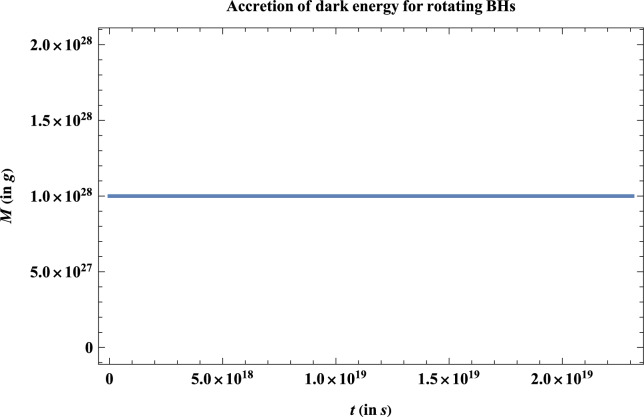
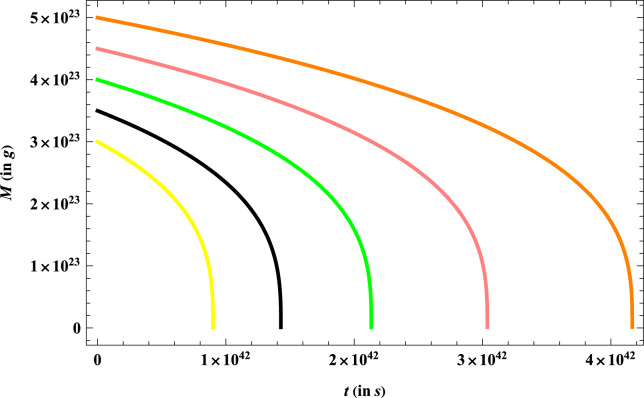
In this work, we aim to discuss about the evolution of rotating black holes (RBHs) within the context of loop quantum cosmology. Here, the main part of our research work focuses on the impacts of angular momentum based rotating parameter and accretion efficiency on the lifetime of RBHs. Our study reveals that accretion of dark energy would not significantly affect the evolution of RBHs, however higher value of rotating parameter could slightly delay the evaporation times of RBHs. Our analysis also depicts that the maximum value of rotating parameter for evolution of any RBH is , where is the formation mass of RBH. Moreover, from our calculation we found that the maximum mass of a presently existing supermassive black hole would be , if it undergoes rotation. Also from astrophysical constraint analysis, we found that there is a greater tendency for formation of black holes in loop quantum cosmology than standard model of cosmology.
在这项工作中,我们旨在讨论圈量子宇宙学背景下旋转黑洞(RBHs)的演化。在此,我们研究工作的主要部分聚焦于基于角动量的旋转参数和吸积效率对旋转黑洞寿命的影响。我们的研究表明,暗能量的吸积不会显著影响旋转黑洞的演化,然而较高的旋转参数值可能会略微延迟旋转黑洞的蒸发时间。我们的分析还表明,任何旋转黑洞演化的旋转参数最大值为 ,其中 是旋转黑洞的形成质量。此外,通过我们的计算发现,如果当前存在的超大质量黑洞发生旋转,其最大质量将为 。同样,通过天体物理约束分析,我们发现与标准宇宙学模型相比,圈量子宇宙学中黑洞形成的趋势更大。