
比利时立体定向体部放射治疗证据开发项目的覆盖情况(2013 - 2019年):一项基于全国登记处的前瞻性研究。
Coverage with evidence development program on stereotactic body radiotherapy in Belgium (2013-2019): a nationwide registry-based prospective study.
作者信息
Lievens Yolande, Janssens Sharon, Lambrecht Maarten, Engels Hilde, Geets Xavier, Jansen Nicolas, Moretti Luigi, Remouchamps Vincent, Roosens Sander, Stellamans Karin, Verellen Dirk, Weltens Caroline, Weytjens Reinhilde, Van Damme Nancy
机构信息
Radiation Oncology Department, Ghent University Hospital and Ghent University, Ghent, Belgium.
Belgian Cancer Registry, Brussels, Belgium.
出版信息
Lancet Reg Health Eur. 2024 Jul 6;44:100992. doi: 10.1016/j.lanepe.2024.100992. eCollection 2024 Sep.
BACKGROUND
Although stereotactic body radiotherapy (SBRT) was progressively adopted in clinical practice in Belgium, a reimbursement request in 2011 was not granted because of remaining clinical and economic uncertainty. A coverage with evidence development (CED) program on SBRT started in 2013, with the aim to assess clinical and technical patterns-of-care in Belgium and monitor survival per indication, in view of supporting inclusion in the reimbursement system.
METHODS
The Belgian National Institute for Health and Disability Insurance (NIHDI) initiated this prospective observational registry. Participating departments, using SBRT in clinical practice, signed the 'NIHDI convention'. Eligible patients had a primary tumour (PT) or oligometastatic disease (OMD). Patient, tumour, and treatment characteristics were collected through an online module of the Belgian Cancer Registry, prerequisite for financing. Five-year overall survival (5YOS) and 30- and 90-days mortality were primary outcomes, derived from vital status information.
FINDINGS
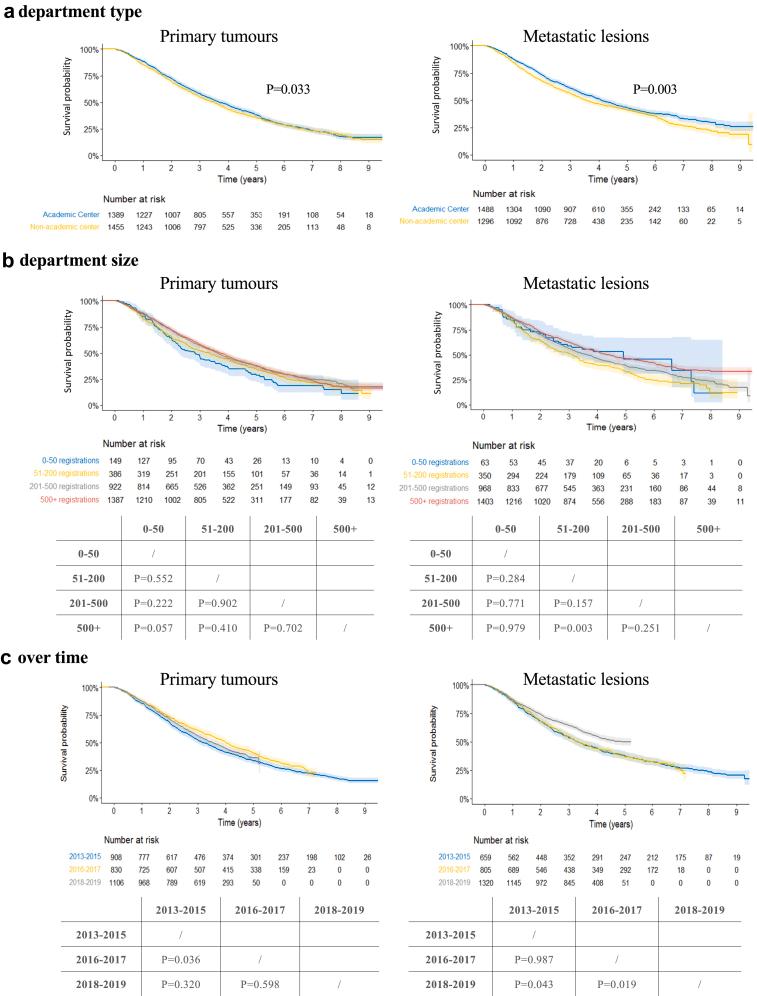
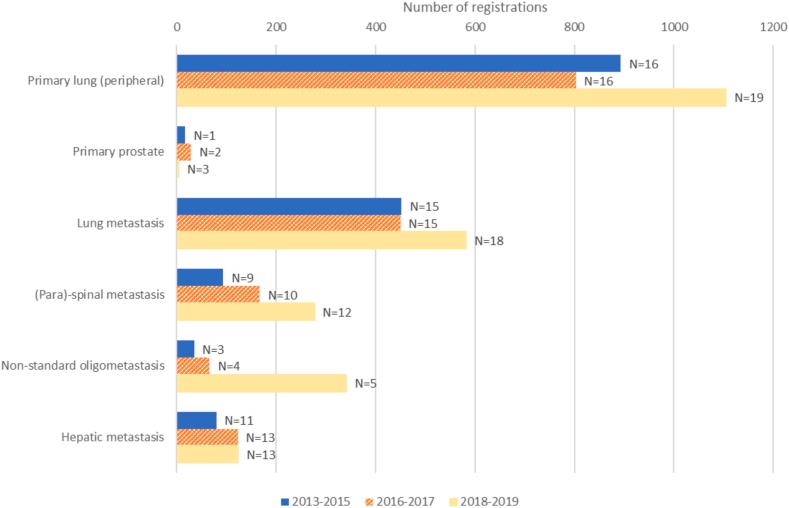
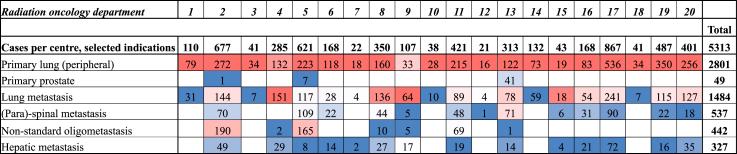
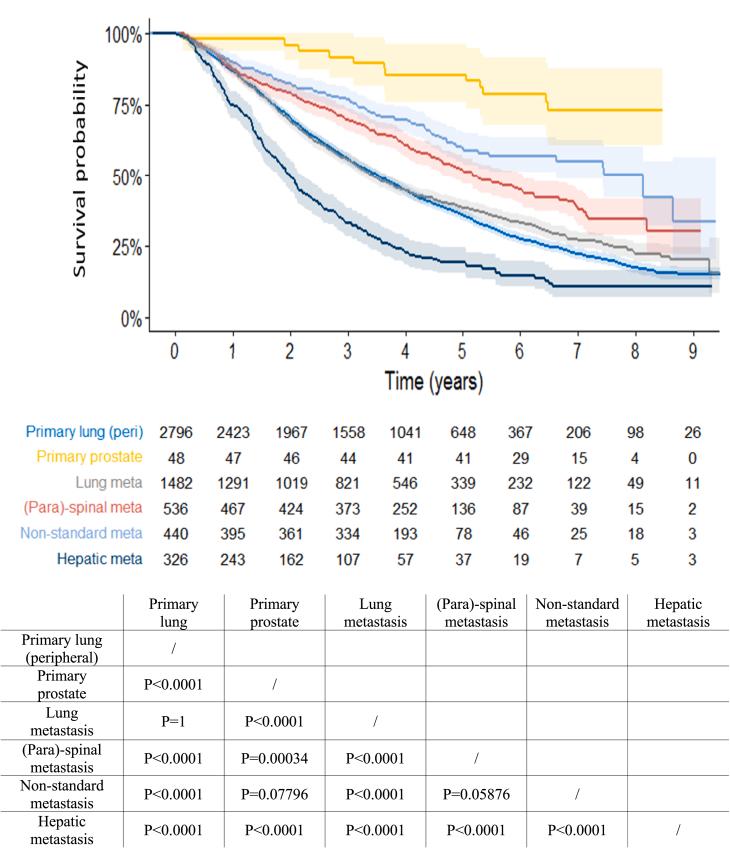
Between 10/2013 and 12/2019, 20 of the 24 accredited radiotherapy departments participated, 6 were academic. Registered cases per department ranged from 21 to 867. Of 5675 registrations analysed, the majority had good performance status and limited number of lesions. Enrolment of PTs remained stable over time, OMDs almost doubled. Peripheral lung lesions dominated in PTs as in OMDs. Other metastases were (para)spinal, 'non-standard' and hepatic. Thirty- and 90-days mortalities remained below 0.5% [95% CI 0.3%-0.8%] respectively 2.1% [95% CI 1.6%-2.7%]. 5YOS varied by indication, primary prostate patients performing best (85%, 95% CI [76%, 96%]), those with liver metastases worst (19%, 95% CI [15%, 24%]). Better OS was observed in academic departments, department size did not significantly impact survival. OMD survival was better in 2018-19.
INTERPRETATION
CED can be used to define patterns-of-care and real-life outcome of innovative radiotherapy. As the observed survival for different indications was in line with outcome in emerging literature, SBRT was included in the Belgian reimbursement system as of January 2020.
FUNDING
NIHDI financed participating departments per registered case.
背景
尽管立体定向体部放疗(SBRT)在比利时的临床实践中逐渐得到应用,但由于临床和经济方面仍存在不确定性,2011年的报销申请未获批准。2013年启动了一项关于SBRT的有证据支持的覆盖范围(CED)计划,旨在评估比利时的临床和技术护理模式,并按适应症监测生存率,以支持将其纳入报销系统。
方法
比利时国家健康与残疾保险研究所(NIHDI)启动了这项前瞻性观察登记研究。在临床实践中使用SBRT的参与科室签署了“NIHDI公约”。符合条件的患者患有原发性肿瘤(PT)或寡转移疾病(OMD)。通过比利时癌症登记处的在线模块收集患者、肿瘤和治疗特征,这是获得资助的前提条件。主要结局指标为五年总生存率(5YOS)以及30天和90天死亡率,这些数据来自生命状态信息。
研究结果
在2013年10月至2019年12月期间,24个获得认可的放疗科室中有20个参与,其中6个是学术性科室。每个科室登记的病例数从21例到867例不等。在分析的5675例登记病例中,大多数患者的体能状态良好且病灶数量有限。PT的登记人数随时间保持稳定,OMD的登记人数几乎翻了一番。PT和OMD中,周围型肺病灶均占主导。其他转移部位为(椎)旁、“非标准”和肝脏。30天和90天死亡率分别保持在0.5%以下[95%置信区间0.3%-0.8%]和2.1%以下[95%置信区间1.6%-2.7%]。5YOS因适应症而异,原发性前列腺癌患者的生存率最高(85%,95%置信区间[76%,96%]),肝转移患者的生存率最低(19%,95%置信区间[15%,24%])。学术性科室的总生存率更高,科室规模对生存率没有显著影响。2018 - 2019年OMD的生存率更高。
解读
CED可用于定义创新放疗的护理模式和实际疗效。由于观察到的不同适应症的生存率与新兴文献中的结果一致,自2020年1月起SBRT被纳入比利时报销系统。
资助
NIHDI按每个登记病例资助参与科室。
 Zotero 插件