School of Psychology, University of Auckland, Auckland, New Zealand.
Institute of Diagnostic and Interventional Radiology, Jena University Hospital, Jena, Germany.
Hum Brain Mapp. 2024 Aug 1;45(11):e26754. doi: 10.1002/hbm.26754.
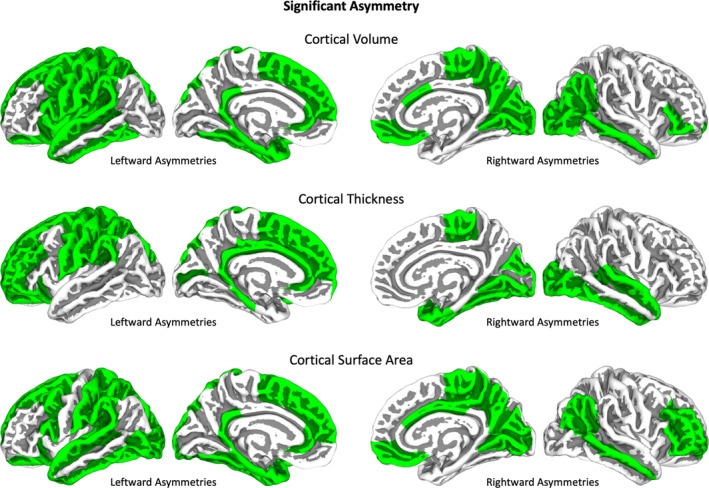
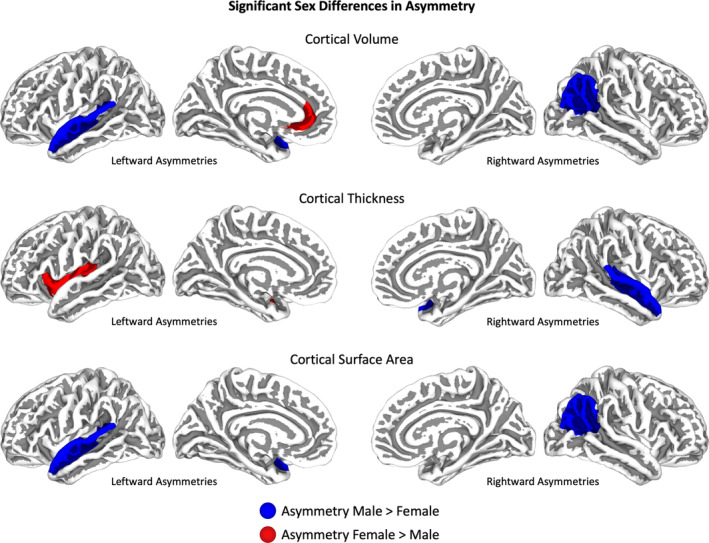
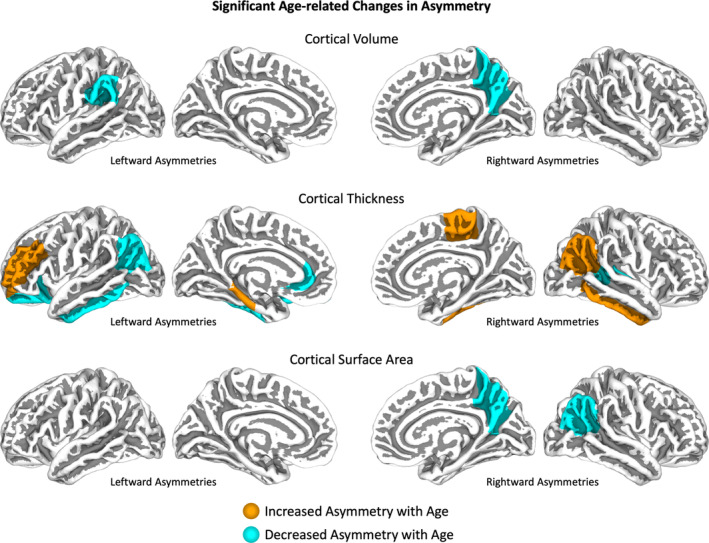
Only a small number of studies have assessed structural differences between the two hemispheres during childhood and adolescence. However, the existing findings lack consistency or are restricted to a particular brain region, a specific brain feature, or a relatively narrow age range. Here, we investigated associations between brain asymmetry and age as well as sex in one of the largest pediatric samples to date (n = 4265), aged 1-18 years, scanned at 69 sites participating in the ENIGMA (Enhancing NeuroImaging Genetics through Meta-Analysis) consortium. Our study revealed that significant brain asymmetries already exist in childhood, but their magnitude and direction depend on the brain region examined and the morphometric measurement used (cortical volume or thickness, regional surface area, or subcortical volume). With respect to effects of age, some asymmetries became weaker over time while others became stronger; sometimes they even reversed direction. With respect to sex differences, the total number of regions exhibiting significant asymmetries was larger in females than in males, while the total number of measurements indicating significant asymmetries was larger in males (as we obtained more than one measurement per cortical region). The magnitude of the significant asymmetries was also greater in males. However, effect sizes for both age effects and sex differences were small. Taken together, these findings suggest that cerebral asymmetries are an inherent organizational pattern of the brain that manifests early in life. Overall, brain asymmetry appears to be relatively stable throughout childhood and adolescence, with some differential effects in males and females.
只有少数研究评估了儿童和青少年时期两个半球之间的结构差异。然而,现有的研究结果缺乏一致性,或者仅限于特定的脑区、特定的脑特征或相对较窄的年龄范围。在这里,我们在迄今为止最大的儿科样本之一(n=4265)中研究了大脑不对称与年龄和性别的关系,年龄为 1-18 岁,在 69 个参与 ENIGMA(通过荟萃分析增强神经影像学遗传学)联盟的地点进行了扫描。我们的研究表明,大脑不对称在儿童时期就已经存在,但它们的大小和方向取决于所检查的脑区和使用的形态测量学指标(皮质体积或厚度、区域表面积或皮质下体积)。关于年龄的影响,一些不对称性随着时间的推移而减弱,而另一些则增强;有时甚至会反转方向。关于性别差异,表现出显著不对称性的区域总数在女性中多于男性,而指示显著不对称性的测量总数在男性中更多(因为我们每个皮质区域获得了不止一个测量值)。显著不对称的幅度在男性中也更大。然而,年龄效应和性别差异的效应大小都很小。总的来说,这些发现表明大脑不对称是大脑的一种固有组织模式,它在生命早期就表现出来。总体而言,大脑不对称在儿童和青少年时期相对稳定,男性和女性的影响存在差异。