Department II of Internal Medicine, Faculty of Medicine and University Hospital, University of Cologne, Cologne, Germany.
Center for Rare Diseases Cologne, Faculty of Medicine and University Hospital Cologne, University of Cologne, Cologne, Germany.
Kidney360. 2024 Sep 1;5(9):1289-1298. doi: 10.34067/KID.0000000000000525. Epub 2024 Jul 24.
Higher levels of IL-6, IL-8, monocyte chemoattractant protein-1, TNF-, and IFN- in patients with autosomal dominant polycystic kidney disease highlight inflammation's role in disease progression. Elevated inflammatory markers in autosomal dominant polycystic kidney disease could serve as biomarkers for progression and targets for therapy.
Autosomal dominant polycystic kidney disease (ADPKD) is a genetic ciliopathy that causes adult-onset progressive renal failure. Inflammation and the resulting fibrosis play a crucial role in the pathogenesis. In recent years, an increasing number of inflammatory markers, such as monocyte chemoattractant protein-1 (MCP-1) and TNF-, that are associated with the development and progression of ADPKD have been identified. The objective of this study was to identify and evaluate potential proinflammatory biomarkers in patients with ADPKD from the German AD(H)PKD registry.
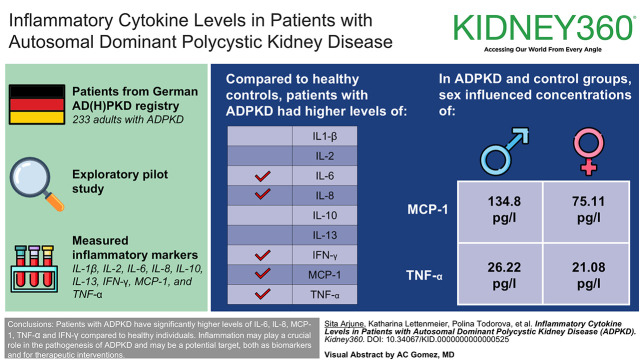
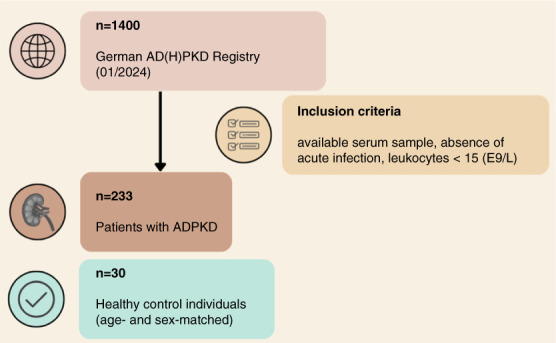
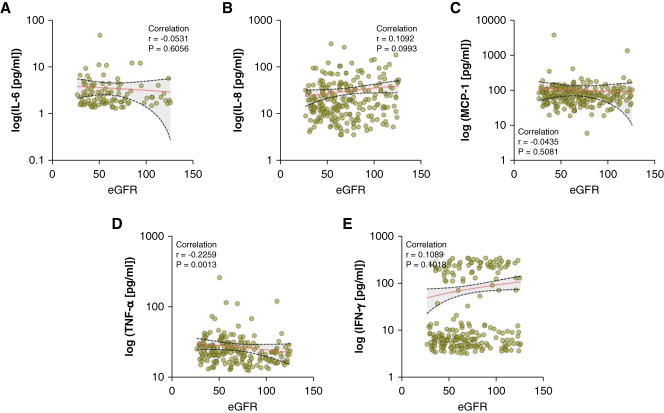
In this exploratory pilot study, serum concentrations of IL-1, IL-2, IL-6, IL-8, IL-10, IL-13, IFN-, MCP-1, and TNF- were measured by multiplex immunoassay in 233 adults patients with ADPKD from the German AD(H)PKD registry and compared with an age- and sex-matched healthy control group (=30).
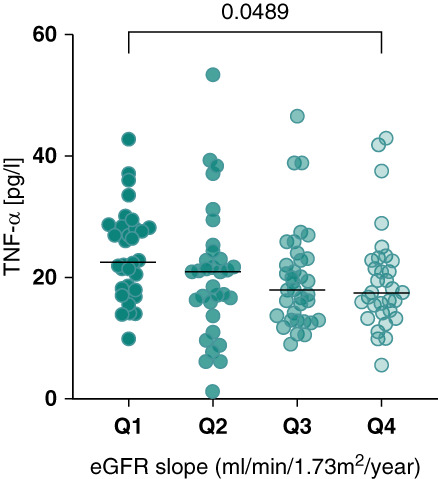
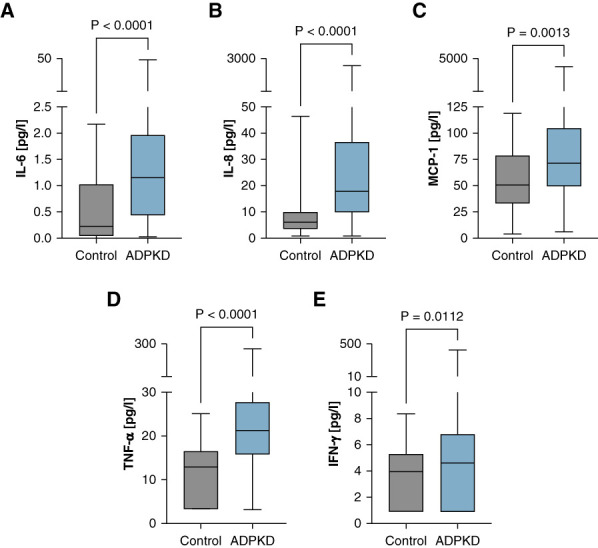
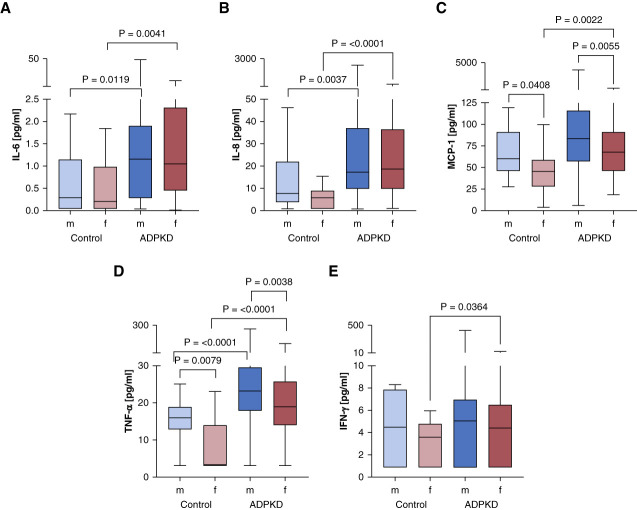
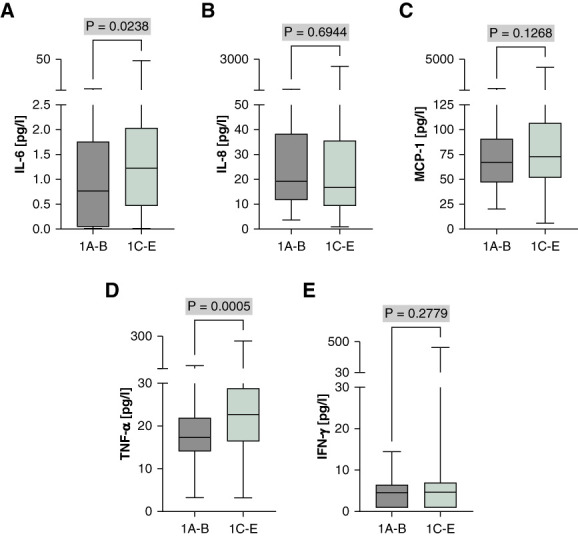
IL-6, IL-8, MCP-1, TNF-, and IFN- concentrations were significantly higher in patients with ADPKD than in healthy controls. In addition, sex influenced the concentrations of MCP-1 and TNF- in the ADPKD and control groups (MCP-1 male=134.8 pg/L, female=75.11 pg/L; = 0.0055; TNF- male=26.22 pg/L, female=21.08 pg/L; = 0.0038).
Patients with ADPKD have significantly higher levels of IL-6, IL-8, MCP-1, TNF-, and IFN- compared with healthy individuals. These findings underline that inflammation may play a crucial role in the pathogenesis of ADPKD and may be a potential target, both as biomarkers and for therapeutic interventions.
: NCT02497521.
常染色体显性多囊肾病(ADPKD)患者的 IL-6、IL-8、单核细胞趋化蛋白-1、TNF-和 IFN-水平升高,突出了炎症在疾病进展中的作用。ADPKD 中升高的炎症标志物可作为疾病进展的生物标志物和治疗靶点。
常染色体显性多囊肾病(ADPKD)是一种遗传性纤毛病,可导致成人发病的进行性肾功能衰竭。炎症及其导致的纤维化在发病机制中起着关键作用。近年来,越来越多与 ADPKD 的发生和发展相关的炎症标志物,如单核细胞趋化蛋白-1(MCP-1)和 TNF-等已被确定。本研究的目的是从德国 AD(H)PKD 登记处鉴定和评估 ADPKD 患者中潜在的促炎生物标志物。
在这项探索性试点研究中,通过多重免疫测定法测量了德国 AD(H)PKD 登记处的 233 名 ADPKD 成年患者(=233)和年龄及性别匹配的健康对照组(=30)血清中 IL-1、IL-2、IL-6、IL-8、IL-10、IL-13、IFN-、MCP-1 和 TNF-的浓度。
ADPKD 患者的 IL-6、IL-8、MCP-1、TNF-和 IFN-浓度明显高于健康对照组。此外,性别影响 ADPKD 和对照组中 MCP-1 和 TNF-的浓度(ADPKD 男性=134.8pg/L,女性=75.11pg/L;P=0.0055;TNF-男性=26.22pg/L,女性=21.08pg/L;P=0.0038)。
与健康个体相比,ADPKD 患者的 IL-6、IL-8、MCP-1、TNF-和 IFN-水平显著升高。这些发现强调了炎症可能在 ADPKD 的发病机制中起着关键作用,并且可能是一个潜在的治疗靶点,既可以作为生物标志物,也可以作为治疗干预措施。
NCT02497521。