Cristi-Montero Carlos, Martínez-Flores Ricardo, Espinoza-Puelles Juan Pablo, Doherty Anya, Zavala-Crichton Juan Pablo, Aguilar-Farias Nicolas, Reyes-Amigo Tomas, Salvatierra-Calderon Vanessa, Ibáñez Romualdo, Sadarangani Kabir P
IRyS Group, Physical Education School, Pontificia Universidad Católica de Valparaíso, Valparaíso, Chile.
Facultad de Educación, Universidad de Barcelona, Barcelona, Spain.
Front Psychol. 2024 Jul 10;15:1355434. doi: 10.3389/fpsyg.2024.1355434. eCollection 2024.
To determine how cognitive domains mediate the link between fitness components, their global score (GFS), and adolescents' academic achievement (ACA) across various school subjects.
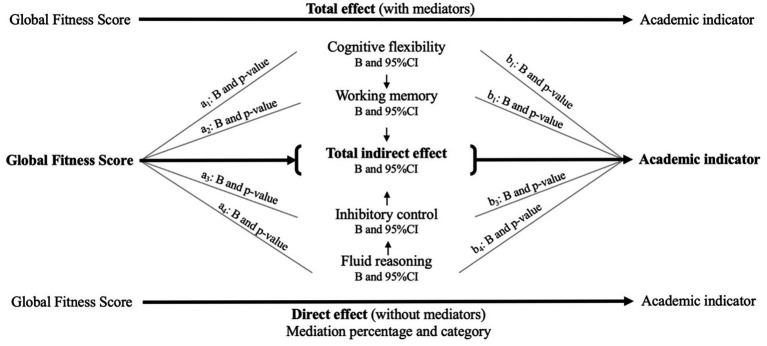
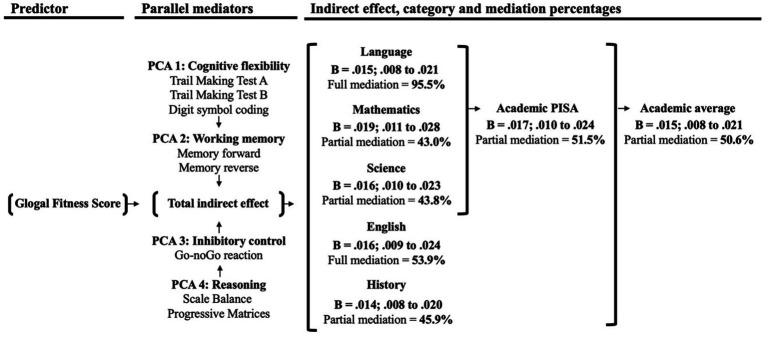
In this study, 1,296 adolescents aged 10-14 participated. GFS was computed by three fitness components (strength, muscular, and cardiorespiratory fitness) through the ALPHA-fitness test battery. ACA was determined by five school subjects (Language, English, Mathematics, Science, and History) and two academic scores (a) "Academic Average" (five subjects) and (b) "Academic-PISA" (Language, Mathematics, and Science). A principal component analysis was performed to establish four factors (working memory [WM], cognitive flexibility [], inhibitory control [IC], and fluid reasoning [FR]). A parallel mediation approach was implemented with 5,000 bootstrapped samples controlled for sex, maturity, central obesity, having breakfast before cognitive tasks, schools, and school vulnerability. Total, direct, indirect effects, and mediation percentages were estimated.
Overall, the finding showed a full parallel mediation effect for Language (92.5%) and English (53.9%), while a partial mediation for Mathematics (43.0%), Science (43.8%), History (45.9%), "Academic Average" (50.6%), and "Academic-PISA" (51.5%). In particular, WM, IC, and FR mediated all school subjects except mathematics, where IC was not significant. has not mediated any relationship between GF and academic performance.
This study underscores the pivotal role of cognitive domains, specifically WM, IC, and FR, in mediating the link between physical fitness and academic performance in adolescents. These insights have relevant implications for educational and public health policies.
确定认知领域如何在不同学校科目中调节健康成分、其综合得分(GFS)与青少年学业成绩(ACA)之间的联系。
本研究纳入了1296名10 - 14岁的青少年。通过ALPHA健康测试组合,由三个健康成分(力量、肌肉和心肺健康)计算得出GFS。ACA由五门学校科目(语言、英语、数学、科学和历史)以及两个学业成绩来确定:(a)“学业平均分”(五门科目)和(b)“学业 - PISA”(语言、数学和科学)。进行主成分分析以建立四个因素(工作记忆[WM]、认知灵活性[]、抑制控制[IC]和流体推理[FR])。采用平行中介方法,对5000个自抽样样本进行性别、成熟度、中心性肥胖、认知任务前是否吃早餐、学校及学校脆弱性的控制。估计了总效应、直接效应、间接效应和中介百分比。
总体而言,研究结果显示语言(92.5%)和英语(53.9%)存在完全平行中介效应,而数学(43.0%)、科学(43.8%)、历史(45.9%)、“学业平均分”(50.6%)和“学业 - PISA”(51.5%)存在部分中介效应。特别是,WM、IC和FR介导了除数学之外的所有学校科目,数学中IC不显著。[]未介导GFS与学业成绩之间的任何关系。
本研究强调了认知领域,特别是WM、IC和FR,在调节青少年身体素质与学业成绩之间联系方面的关键作用。这些见解对教育和公共卫生政策具有相关意义。