Department of Neurology, Faculty of Medicine, Ankara University, Ankara, Turkiye.
Department of Microbiology, Faculty of Medicine, Gazi University, Ankara, Turkiye.
Turk J Med Sci. 2024 May 7;54(3):579-587. doi: 10.55730/1300-0144.5825. eCollection 2024.
BACKGROUND/AIM: Amyotrophic lateral sclerosis (ALS) is a fatal neurodegenerative disease. Several studies have shown that alterations of microbiota increase the risk of neurodegenerative disorders. We aimed to reveal whether there is a difference in the gut microbiota of patients with ALS.
The participants are divided into three groups. Group 1 comprised patients with ALS. Healthy family members living in the same house of the patients formed Group 2. Lastly, sex- and age-matched healthy people were included in Group 3. Fecal samples were collected in 15-mL falcon tubes and stored at -80 °C. Genomic DNA isolation was performed on samples. Bacterial primers selected from the 16S rRNA region for the bacterial genome and ITS1 and ITS4 (internal transcribed spacer) were used for the identification of DNA. Next generation sequence analysis (NGS) and taxonomic analyses were performed at the level of bacterial phylum, class, order, family, genus, and species. Alpha and beta diversity indexes were used. The linear discriminant analysis (LDA) effect size method (LEfSe) was applied to identify a microbial taxon specific to ALS disease.
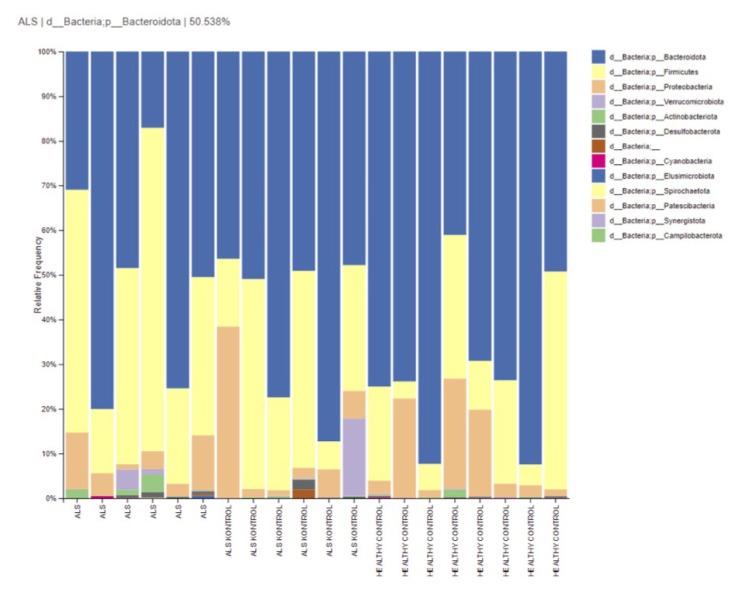
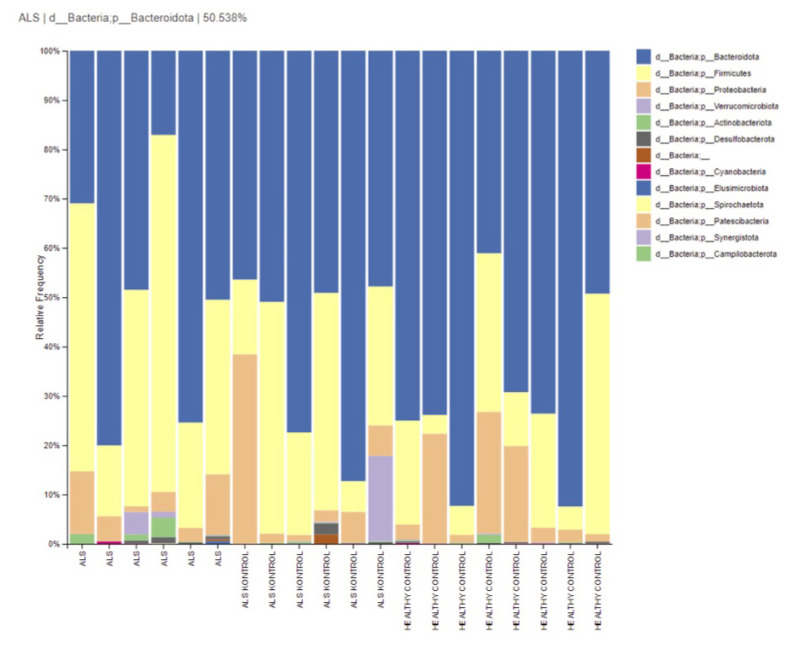
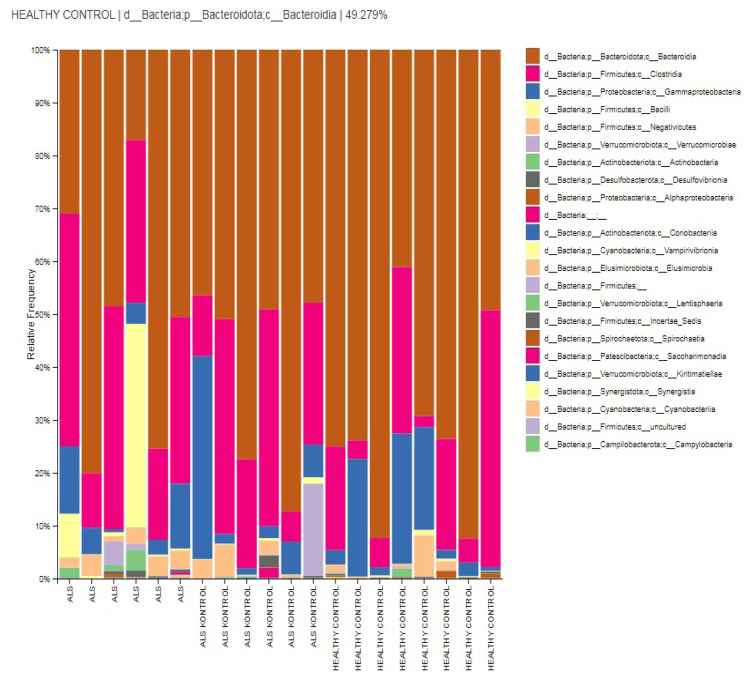
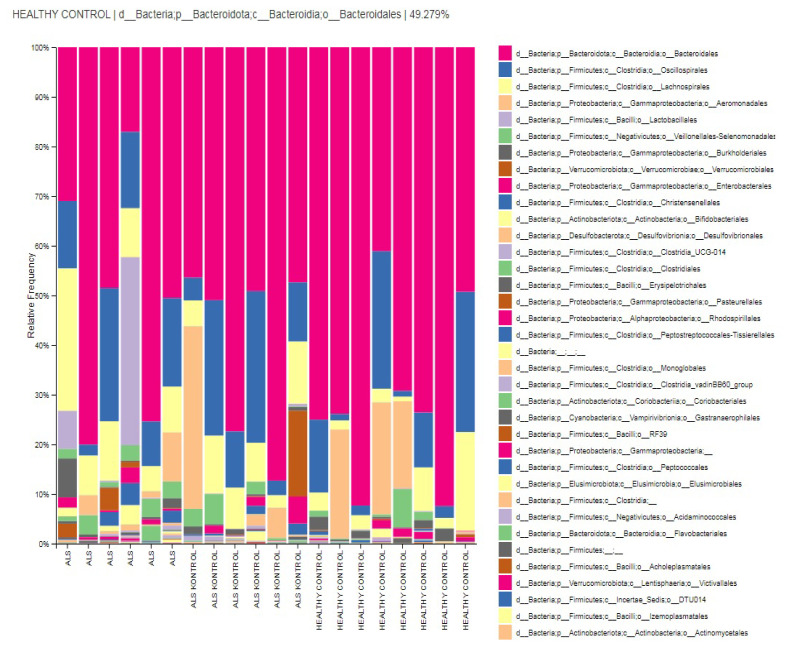
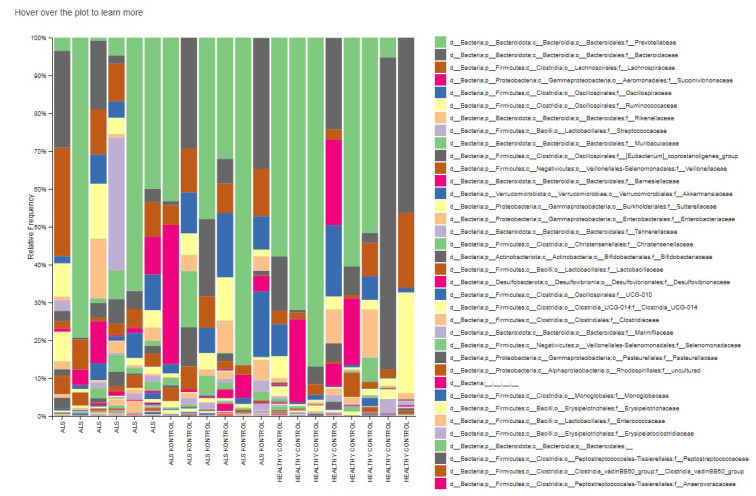
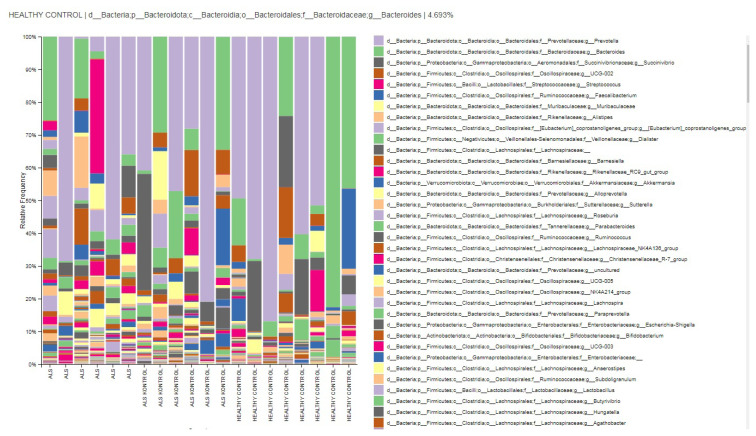
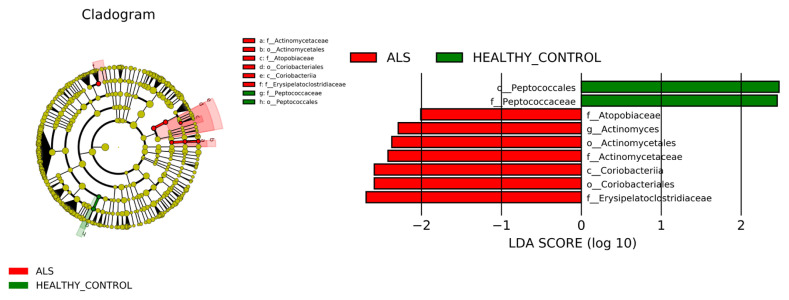
The relative abundances of the Succinivibrionaceae and Lachnospiraceae families were significantly lower in patients. The dominant families among patients were Streptococcaceae and Ruminococcaceae, while the dominant families among healthy controls were Bacteroidaceae and Succinivibrionaceae. The LEfSe analysis revealed that four families (Atopobiaceae, Actinomycetaceae, Erysipelatoclostridiaceae, Peptococcacceae) differed significantly between the patients and healthy controls (LDA values> 2.5, p < 0.05).
Comparison with family members living in the same house is the strength of this study. We found that there were changes in the microbiota of the patients, consistent with the literature. Studies that analyze the composition of the gut microbiota in the predisease period may be needed to understand whether dysbiosis is caused by the mechanisms inherent in the disease or whether it is dysbiosis that initiates the disease.
背景/目的:肌萎缩侧索硬化症(ALS)是一种致命的神经退行性疾病。几项研究表明,微生物群的改变会增加神经退行性疾病的风险。我们旨在揭示 ALS 患者的肠道微生物群是否存在差异。
参与者分为三组。第 1 组包括 ALS 患者。与患者同住的健康家庭成员构成第 2 组。最后,纳入了性别和年龄匹配的健康人作为第 3 组。采集粪便样本于 15-mL Falcon 管中,-80°C 保存。对样本进行基因组 DNA 分离。使用从细菌基因组的 16S rRNA 区域选择的细菌引物和 ITS1 和 ITS4(内部转录间隔区)对 DNA 进行鉴定。进行下一代序列分析(NGS)和细菌门、纲、目、科、属和种水平的分类分析。使用α和β多样性指数。应用线性判别分析(LDA)效应大小法(LEfSe)鉴定 ALS 疾病特异的微生物分类群。
Succinivibrionaceae 和 Lachnospiraceae 家族的相对丰度在患者中显著降低。患者中主要的科是链球菌科和真细菌科,而健康对照组中主要的科是拟杆菌科和 Succinivibrionaceae 科。LEfSe 分析显示,有 4 个科(Atopobiaceae、放线菌科、Erysipelatoclostridiaceae、Peptococcacaceae)在患者和健康对照组之间有显著差异(LDA 值>2.5,p<0.05)。
与同住的家庭成员进行比较是本研究的优势。我们发现患者的微生物群发生了变化,与文献一致。需要进行分析疾病前期肠道微生物群组成的研究,以了解肠道菌群失调是由疾病固有机制引起的,还是由疾病引发的。