Wan Jason, Fan Hongkuan
Department of Pathology and Laboratory Medicine, Medical University of South Carolina, Charleston, SC 29425, USA.
Charleston County School of the Arts High School, North Charleston, SC 29405, USA.
Microorganisms. 2023 Oct 13;11(10):2550. doi: 10.3390/microorganisms11102550.
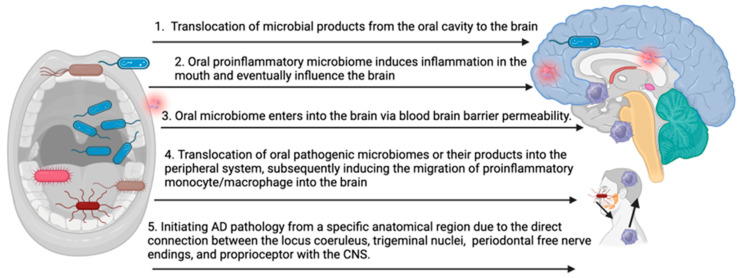
The accumulation of amyloid-beta plaques in the brain is a central pathological feature of Alzheimer's disease. It is believed that amyloid responses may be a result of the host immune response to pathogens in both the central nervous system and peripheral systems. Oral microbial dysbiosis is a chronic condition affecting more than 50% of older adults. Recent studies have linked oral microbial dysbiosis to a higher brain Aβ load and the development of Alzheimer's disease in humans. Moreover, the presence of an oral-derived and predominant microbiome has been identified in the brains of patients with Alzheimer's disease and other neurodegenerative diseases. Therefore, in this opinion article, we aim to provide a summary of studies on oral microbiomes that may contribute to the pathogenesis of the central nervous system in Alzheimer's disease.
大脑中β-淀粉样蛋白斑块的积累是阿尔茨海默病的核心病理特征。据信,淀粉样蛋白反应可能是宿主对中枢神经系统和外周系统中病原体的免疫反应的结果。口腔微生物失调是一种影响超过50%老年人的慢性疾病。最近的研究将口腔微生物失调与人类大脑中更高的β-淀粉样蛋白负荷以及阿尔茨海默病的发展联系起来。此外,在阿尔茨海默病和其他神经退行性疾病患者的大脑中已发现存在源自口腔且占主导地位的微生物群。因此,在这篇观点文章中,我们旨在总结关于口腔微生物群可能导致阿尔茨海默病中枢神经系统发病机制的研究。