
人工智能在缺血性中风图像中的应用:当前应用与未来方向
Artificial intelligence in ischemic stroke images: current applications and future directions.
作者信息
Liu Ying, Wen Zhongjian, Wang Yiren, Zhong Yuxin, Wang Jianxiong, Hu Yiheng, Zhou Ping, Guo Shengmin
机构信息
School of Nursing, Southwest Medical University, Luzhou, China.
Department of Oncology, The Affiliated Hospital of Southwest Medical University, Luzhou, China.
出版信息
Front Neurol. 2024 Jul 10;15:1418060. doi: 10.3389/fneur.2024.1418060. eCollection 2024.
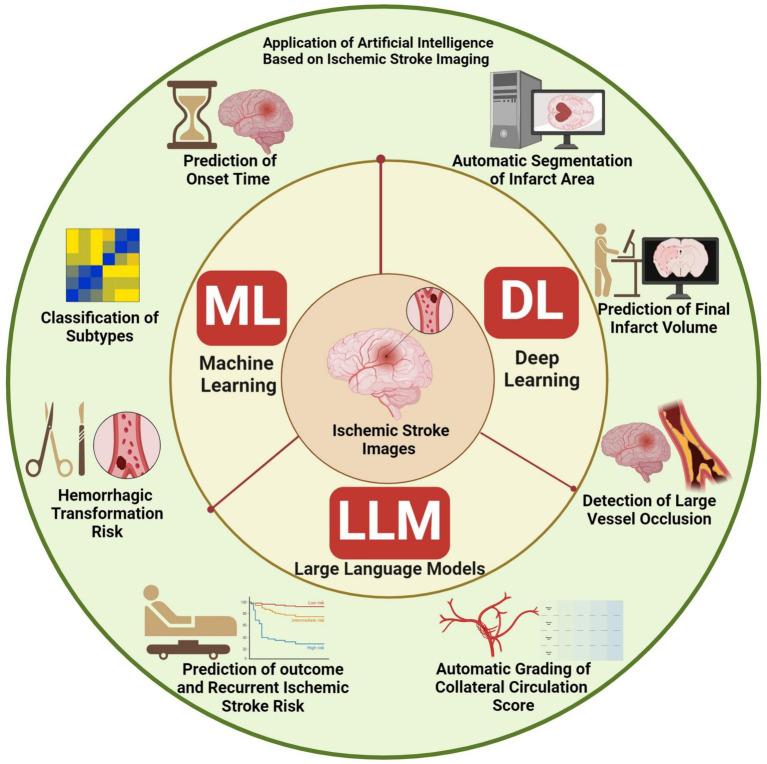
This paper reviews the current research progress in the application of Artificial Intelligence (AI) based on ischemic stroke imaging, analyzes the main challenges, and explores future research directions. This study emphasizes the application of AI in areas such as automatic segmentation of infarct areas, detection of large vessel occlusion, prediction of stroke outcomes, assessment of hemorrhagic transformation risk, forecasting of recurrent ischemic stroke risk, and automatic grading of collateral circulation. The research indicates that Machine Learning (ML) and Deep Learning (DL) technologies have tremendous potential for improving diagnostic accuracy, accelerating disease identification, and predicting disease progression and treatment responses. However, the clinical application of these technologies still faces challenges such as limitations in data volume, model interpretability, and the need for real-time monitoring and updating. Additionally, this paper discusses the prospects of applying large language models, such as the transformer architecture, in ischemic stroke imaging analysis, emphasizing the importance of establishing large public databases and the need for future research to focus on the interpretability of algorithms and the comprehensiveness of clinical decision support. Overall, AI has significant application value in the management of ischemic stroke; however, existing technological and practical challenges must be overcome to achieve its widespread application in clinical practice.
本文综述了基于缺血性脑卒中影像的人工智能(AI)应用的当前研究进展,分析了主要挑战,并探讨了未来的研究方向。本研究强调了AI在梗死区域自动分割、大血管闭塞检测、卒中预后预测、出血性转化风险评估、复发性缺血性卒中风险预测以及侧支循环自动分级等领域的应用。研究表明,机器学习(ML)和深度学习(DL)技术在提高诊断准确性、加速疾病识别以及预测疾病进展和治疗反应方面具有巨大潜力。然而,这些技术的临床应用仍面临诸如数据量限制、模型可解释性以及实时监测和更新需求等挑战。此外,本文讨论了将诸如变压器架构等大语言模型应用于缺血性脑卒中影像分析的前景,强调了建立大型公共数据库的重要性以及未来研究需要关注算法的可解释性和临床决策支持的全面性。总体而言,AI在缺血性脑卒中管理中具有重要应用价值;然而,必须克服现有的技术和实际挑战,才能在临床实践中实现其广泛应用。
 Zotero 插件