MDUK Neuromuscular Centre, Department of Paediatrics, University of Oxford.
Department of Paediatric Neurology, John Radcliffe Hospital.
Curr Opin Neurol. 2024 Oct 1;37(5):493-501. doi: 10.1097/WCO.0000000000001300. Epub 2024 Jul 25.
Congenital myasthenia syndromes (CMS) are treatable, inherited disorders affecting neuromuscular transmission. We highlight that the involvement of an increasing number of proteins is making the understanding of the disease mechanisms and potential treatments progressively more complex.
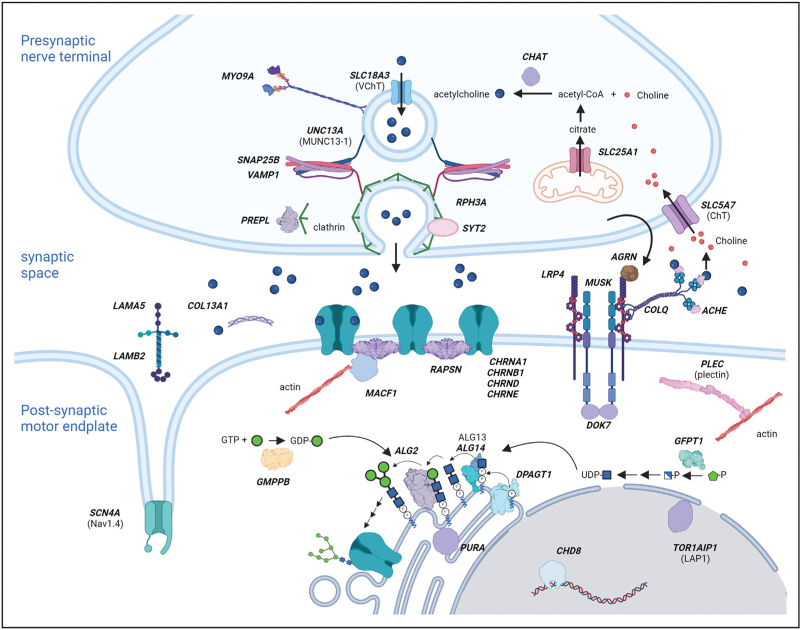
Although early studies identified mutations of proteins directly involved in synaptic transmission at the neuromuscular junction, recently, next-generation sequencing has facilitated the identification of many novel mutations in genes that encode proteins that have a far wider expression profile, some even ubiquitously expressed, but whose defective function leads to impaired neuromuscular transmission. Unsurprisingly, mutations in these genes often causes a wider phenotypic disease spectrum where defective neuromuscular transmission forms only one component. This has implications for the management of CMS patients.
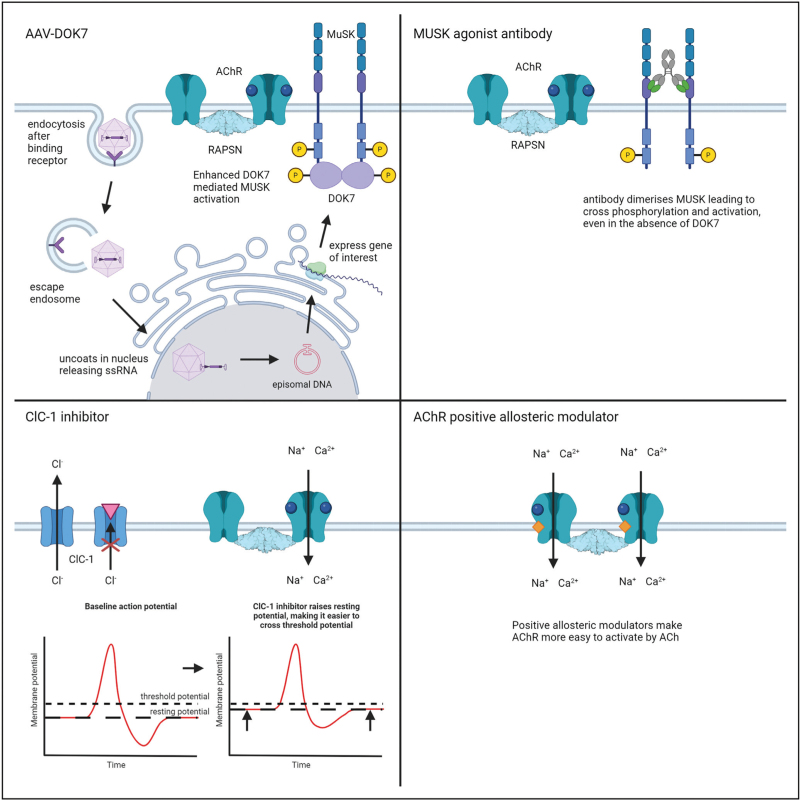
Given the widening nonneuromuscular junction phenotypes in the newly identified forms of CMS, new therapies need to include disease-modifying approaches that address not only neuromuscular weakness but also the multisystem involvement. Whilst the current treatments for CMS are highly effective for many subtypes there remains, in a proportion of CMS patients, an unmet need for more efficacious therapies.
先天性肌无力综合征(CMS)是一种可治疗的遗传性神经肌肉传递障碍。我们强调,越来越多的蛋白参与其中,使得对疾病机制和潜在治疗方法的理解变得越来越复杂。
尽管早期的研究确定了直接参与神经肌肉接头突触传递的蛋白的突变,但最近,下一代测序技术促进了许多编码蛋白的新基因突变的鉴定,这些蛋白的表达谱非常广泛,有些甚至是普遍表达的,但它们的功能缺陷会导致神经肌肉传递受损。毫不奇怪,这些基因突变通常会导致更广泛的表型疾病谱,其中神经肌肉传递缺陷只是其中一个组成部分。这对 CMS 患者的管理有影响。
鉴于新发现的 CMS 类型中非神经肌肉接头表型的不断扩大,新的治疗方法需要包括疾病修饰方法,不仅要针对神经肌肉无力,还要针对多系统受累。虽然 CMS 的当前治疗方法对许多亚型非常有效,但在一部分 CMS 患者中,仍存在对更有效治疗方法的未满足需求。