Department of Hygiene, Social-Preventive Medicine and Medical Statistics, School of Medicine, Aristotle University of Thessaloniki, Thessaloniki, Greece.
Eur J Gen Pract. 2024 Dec;30(1):2382218. doi: 10.1080/13814788.2024.2382218. Epub 2024 Jul 25.
Primary Health Care (PHC) was the cornerstone of the pandemic response.
We aimed to explore the positive and negative impact of the pandemic, during its final wave, through 'PHC providers' eyes', as well as their recommendations towards restructuring and enhancing PHC services.
A two-phase qualitative study was conducted, pursuing data triangulation from Focus Groups (FGs) and individual, semi-structured interviews for the purposes of data completeness and confirmation (summer 2022 and spring 2023, respectively). A purposive sample of settings was employed, including in total five PHC units according to location with different population distribution; one in Athens (FGs) and four in Northern Greece (interviews). Inductive content analysis was used.
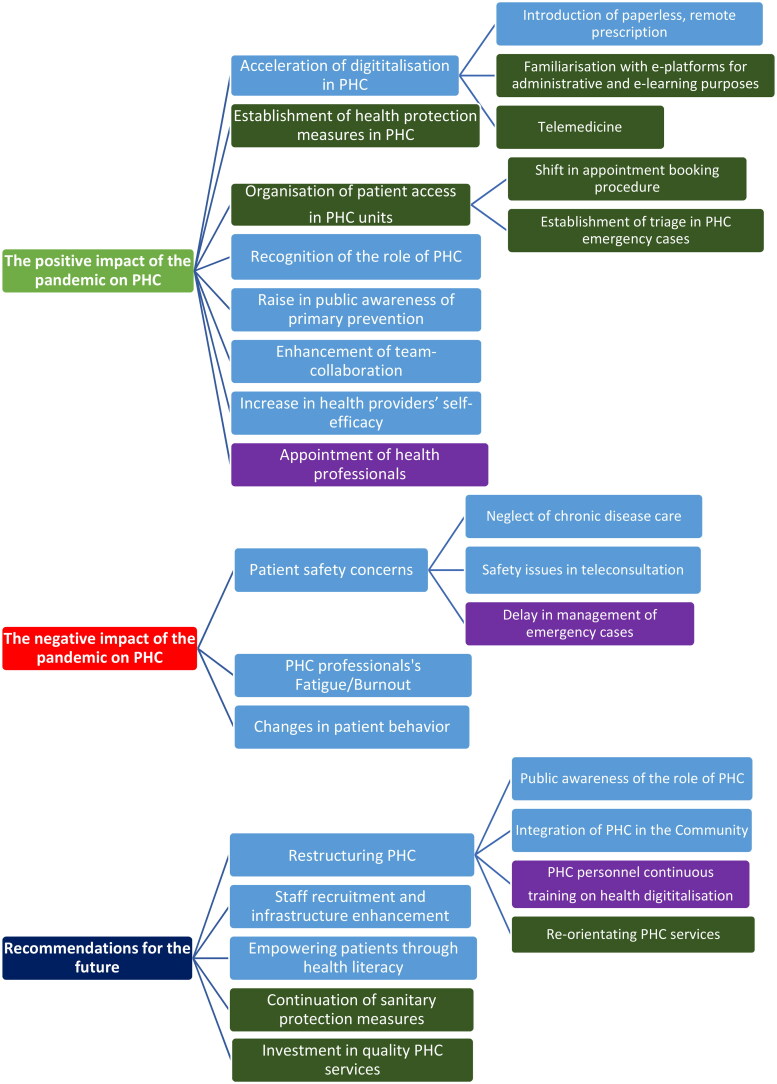
In total, 24 PHC professionals participated in FGs, whereas 17 were individually interviewed. Our findings reflect a general understanding of the pandemic's positive imprint, namely acceleration of digitalisation, establishment of health protection measures, recognition of PHC's role, raise in public awareness of primary prevention, team-cooperation, increase in providers' self-efficacy, appointment of health professionals and re-organisation of accessibility. The negative impact is summarised in fatigue/burnout in PHC providers, patient safety concerns and changes in patients' behaviour. To increase resilience, participants suggest restructuring PHC, recruiting PHC personnel and enhancing digital infrastructure, maintenance of sanitary protection measures, investment in quality, and empowering patients through health literacy.
Based on the lessons learnt, building further on the pandemic-accelerated digitalisation, emphasising on quality improvement and patient safety, ensuring providers' well-being, and empowering citizens through health literacy could be key in promoting PHC resilience.
初级卫生保健(PHC)是大流行应对的基石。
我们旨在通过“PHC 提供者的视角”,探索大流行最后一波的积极和消极影响,以及他们对重组和加强 PHC 服务的建议。
进行了两阶段的定性研究,旨在通过焦点小组(FGs)和个人半结构化访谈实现数据三角剖分,以确保数据的完整性和确认(分别为 2022 年夏季和 2023 年春季)。根据不同的人口分布,采用了有针对性的设置样本,包括总共五个 PHC 单位,其中一个在雅典(FGs),四个在希腊北部(访谈)。使用了归纳内容分析。
共有 24 名 PHC 专业人员参加了 FGs,而 17 人接受了个人访谈。我们的研究结果反映了对大流行积极影响的普遍理解,即数字化加速、建立健康保护措施、认识到 PHC 的作用、提高公众对初级预防的认识、团队合作、提高提供者的自我效能、任命卫生专业人员和重新组织可及性。负面影响总结为 PHC 提供者的疲劳/倦怠、患者安全问题和患者行为的变化。为了提高弹性,参与者建议重组 PHC、招聘 PHC 人员和加强数字基础设施、维护卫生保护措施、投资质量,并通过健康素养增强患者的能力。
基于所吸取的经验教训,在大流行加速数字化的基础上进一步发展,强调质量改进和患者安全,确保提供者的福祉,并通过健康素养赋予公民权力,这可能是促进 PHC 弹性的关键。