School of Public Health, Shanghai Jiaotong University, No. 227 South Chonqing Rd. Huangpu District, Shanghai, 200025, China.
Center for Health Technology Assessment, China Hospital Development Institute of Shanghai Jiaotong University, No. 227 South Chonqing Rd. Huangpu District, Shanghai, 200025, China.
Hum Resour Health. 2017 Aug 4;15(1):50. doi: 10.1186/s12960-017-0226-z.
Health reform in China since 2009 has emphasized basic public health services to enhance the function of Community Health Services as a primary health care facility. A variety of studies have documented these efforts, and the challenges these have faced, yet up to now the experience of primary health care (PHC) providers in terms of how they have coped with these changes remains underdeveloped. Despite the abundant literature on psychological coping processes and mechanisms, the application of coping research within the context of human resources for health remains yet to be explored. This research aims to understand how PHC providers coped with the new primary health care model and the job characteristics brought about by these changes.
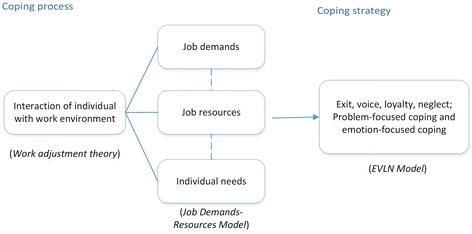
Semi-structured interviews with primary health care workers were conducted in Jinan city of Shandong province in China. A maximum variation sampling method selected 30 PHC providers from different specialties. Thematic analysis was used drawing on a synthesis of theories related to the Job Demands-Resources model, work adjustment, and the model of exit, voice, loyalty and neglect to understand PHC providers' coping strategies.
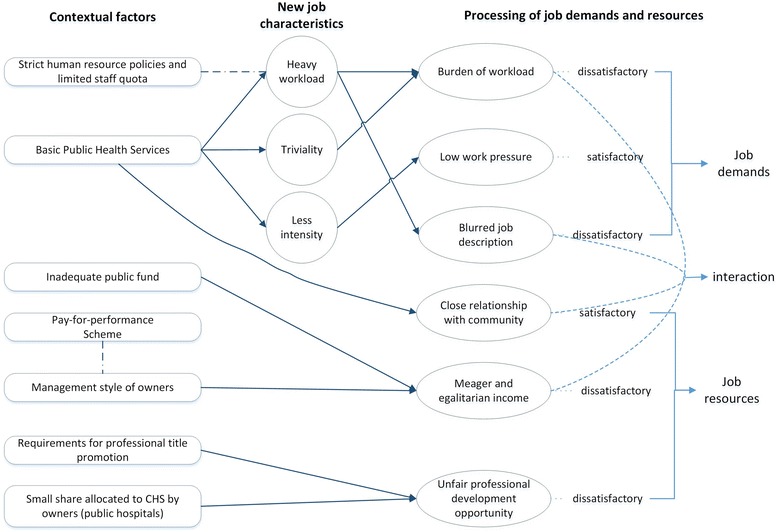
Our interviews identified that the new model of primary health care significantly affected the nature of primary health work and triggered a range of PHC providers' coping processes. The results found that health workers perceived their job as less intensive than hospital medical work but often more trivial, characterized by heavy workload, blurred job description, unsatisfactory income, and a lack of professional development. However, close relationship with community and low work pressure were satisfactory. PHC providers' processing of job demands and resources displayed two ways of interaction: aggravation and alleviation. Processing of job demands and resources led to three coping strategies: exit, passive loyalty, and compromise with new roles and functions.
Primary health care providers employed coping strategies of exit, passive loyalty, and compromise to deal with changes in primary health work. In light of these findings, our paper concludes that it is necessary for the policymakers to provide further job resources for CHS, and involve health workers in policy-making. The introduction of particular professional training opportunities to support job role orientation for PHC providers is advocated.
自 2009 年以来,中国的医疗改革强调了基本公共卫生服务,以增强社区卫生服务作为初级卫生保健机构的功能。各种研究都记录了这些努力,以及这些努力所面临的挑战,但到目前为止,初级卫生保健(PHC)提供者在应对这些变化方面的经验仍然不发达。尽管有大量关于心理应对过程和机制的文献,但应对研究在卫生人力资源背景下的应用仍有待探索。这项研究旨在了解 PHC 提供者如何应对新的初级卫生保健模式以及这些变化带来的工作特征。
在中国山东省济南市,对初级卫生保健工作者进行了半结构化访谈。采用最大变异抽样法,从不同专业中选择了 30 名 PHC 提供者。采用主题分析方法,借鉴与工作需求-资源模型、工作调整以及退出、声音、忠诚和忽视模型相关的理论,了解 PHC 提供者的应对策略。
我们的访谈发现,新的初级卫生保健模式显著影响了初级卫生工作的性质,并引发了一系列 PHC 提供者的应对过程。结果发现,卫生工作者认为他们的工作不像医院医疗工作那样紧张,但往往更琐碎,工作量大、工作描述模糊、收入不令人满意、缺乏职业发展等是不满意的方面。然而,与社区的密切关系和低工作压力是令人满意的。PHC 提供者对工作需求和资源的处理表现出两种相互作用的方式:加剧和缓解。工作需求和资源的处理导致了三种应对策略:退出、消极忠诚和与新角色和功能妥协。
初级卫生保健提供者采用退出、消极忠诚和妥协的应对策略来应对初级卫生工作的变化。鉴于这些发现,我们的论文得出结论,政策制定者有必要为 CHS 提供进一步的工作资源,并让卫生工作者参与决策。提倡为 PHC 提供者引入特定的专业培训机会,以支持其工作角色定位。