Tianjin Medical University General Hospital, Tianjin, China.
Sci Prog. 2024 Jul-Sep;107(3):368504241262116. doi: 10.1177/00368504241262116.
The objective of this study was to investigate the correlation between metformin exposure and the incidence of lactic acidosis in critically ill patients.
The patients with type 2 diabetes mellitus (T2DM) were included from Medical Information Mart for Intensive Care IV database (MIMIC-IV). The primary outcome was the incidence of lactic acidosis. The secondary outcomes were lactate level and in-hospital mortality. Propensity score matching (PSM) method was adopted to reduce bias of the confounders. The multivariate logistic regression was used to explore the correlation between metformin exposure and the incidence of lactic acidosis. Subgroup analysis and sensitivity analysis were used to test the stability of the conclusion.
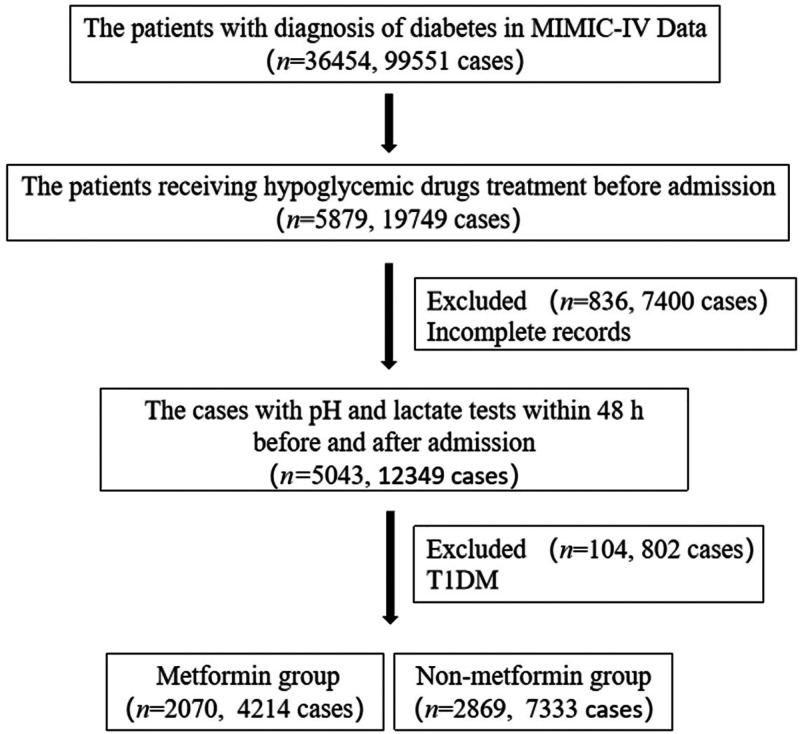
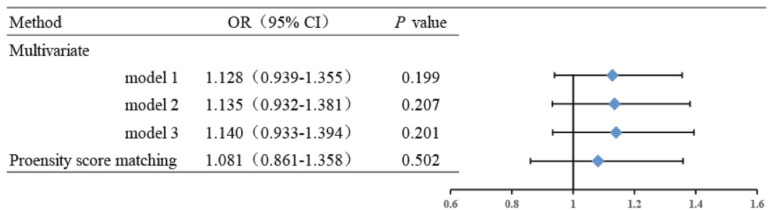
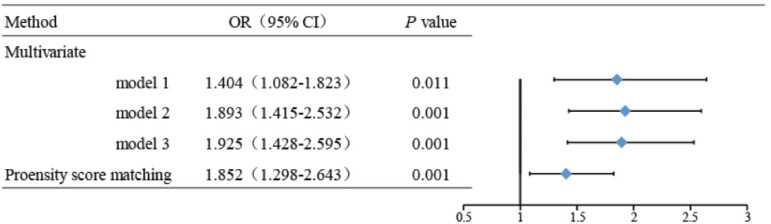
We included 4939 patients. There were 2070 patients in the metformin group, and 2869 patients in the nonmetformin group. The frequency of lactic acidosis was 5.7% (118/2070) in the metformin group and it was 4.3% (122/2869) in the nonmetformin group. There was a statistically significant difference between the two groups (0.05). The lactate level in the metformin group was higher than in the nonmetformin group (2.78 ± 2.23 vs. 2.45 ± 2.24, 0.001). After PSM, the frequency of lactic acidosis (6.3% vs. 3.7%, < 0.001) and lactate level (2.85 ± 2.38 vs. 2.40 ± 2.14, 0.001) were significantly higher in the metformin group compared with the nonmetformin group. In multivariate logistic models, the frequency of lactic acidosis was obviously increased in metformin group, and the adjusted odds ratio () of metformin exposure was 1.852 (1.298-2.643, < 0.001). The results were consistent with subgroup analysis except for respiratory failure subgroup. Metformin exposure increased lactate level but did not affect the frequency of lactic acidosis in patients of respiratory failure with hypercapnia. However, the in-hospital mortality between metformin and nonmetformin group had no obvious difference (= 0.215). In sensitivity analysis, metformin exposure showed similar effect as the original cohort.
In critically ill patients with T2DM, metformin exposure elevated the incidence of lactic acidosis except for patients of respiratory failure with hypercapnia, but did not affect the in-hospital mortality.
本研究旨在探讨二甲双胍暴露与危重症患者乳酸酸中毒发生率之间的相关性。
本研究纳入了来自医疗信息互操作知识库 IV 数据库(MIMIC-IV)的 2 型糖尿病(T2DM)患者。主要结局为乳酸酸中毒的发生率。次要结局为乳酸水平和院内死亡率。采用倾向评分匹配(PSM)方法来减少混杂因素的偏倚。采用多变量逻辑回归来探讨二甲双胍暴露与乳酸酸中毒发生率之间的相关性。进行亚组分析和敏感性分析以检验结论的稳定性。
共纳入 4939 例患者。其中,二甲双胍组 2070 例,非二甲双胍组 2869 例。二甲双胍组乳酸酸中毒的发生率为 5.7%(118/2070),而非二甲双胍组为 4.3%(122/2869),两组间存在统计学差异(0.05)。二甲双胍组的乳酸水平高于非二甲双胍组(2.78±2.23 比 2.45±2.24,0.001)。PSM 后,二甲双胍组的乳酸酸中毒发生率(6.3%比 3.7%,<0.001)和乳酸水平(2.85±2.38 比 2.40±2.14,0.001)明显高于非二甲双胍组。多变量逻辑回归模型显示,二甲双胍组乳酸酸中毒的发生率明显增加,二甲双胍暴露的调整比值比(OR)为 1.852(1.298-2.643,<0.001)。结果与亚组分析一致,除呼吸衰竭亚组外。二甲双胍暴露增加了乳酸水平,但并未影响伴有高碳酸血症的呼吸衰竭患者的乳酸酸中毒发生率。然而,二甲双胍组和非二甲双胍组的院内死亡率无明显差异(=0.215)。在敏感性分析中,二甲双胍暴露也表现出与原始队列相似的效果。
在伴有 T2DM 的危重症患者中,二甲双胍暴露除了会增加伴有高碳酸血症的呼吸衰竭患者的乳酸酸中毒发生率外,还会增加乳酸酸中毒的发生率,但不会影响院内死亡率。