Department of Pathology, University of Iowa, 431 Newton Road, Iowa City, IA, 52242, USA.
Department of Immunology, School of Basic Medical Sciences, Peking University, Beijing, China.
Breast Cancer Res. 2024 Jul 25;26(1):119. doi: 10.1186/s13058-024-01873-y.
Breast cancer is the most common cancer in women diagnosed in the U.S. and worldwide. Obesity increases breast cancer risk without clear underlying molecular mechanisms. Our studies demonstrate that circulating adipose fatty acid binding protein (A-FABP, or FABP4) links obesity-induced dysregulated lipid metabolism and breast cancer risk, thus potentially offering a new target for breast cancer treatment.
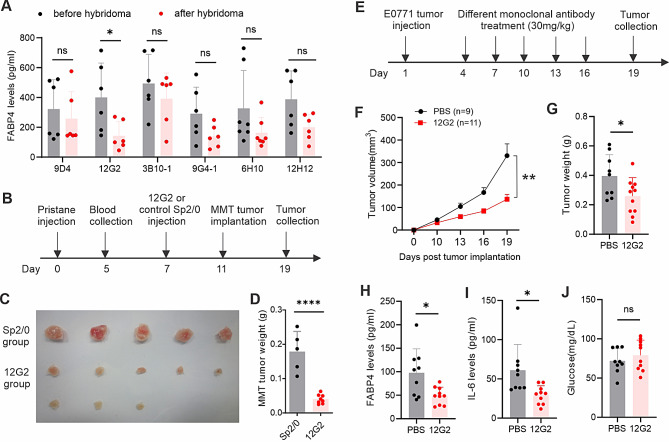
We immunized FABP4 knockout mice with recombinant human FABP4 and screened hybridoma clones with specific binding to FABP4. The potential effects of antibodies on breast cancer cells in vitro were evaluated using migration, invasion, and limiting dilution assays. Tumor progression in vivo was evaluated in various types of tumorigenesis models including C57BL/6 mice, Balb/c mice, and SCID mice. The phenotype and function of immune cells in tumor microenvironment were characterized with multi-color flow cytometry. Tumor stemness was detected by ALDH assays. To characterize antigen-antibody binding capacity, we determined the dissociation constant of selected anti-FABP4 antibodies via surface plasmon resonance. Further analyses in tumor tissue were performed using 10X Genomics Visium spatial single cell technology.
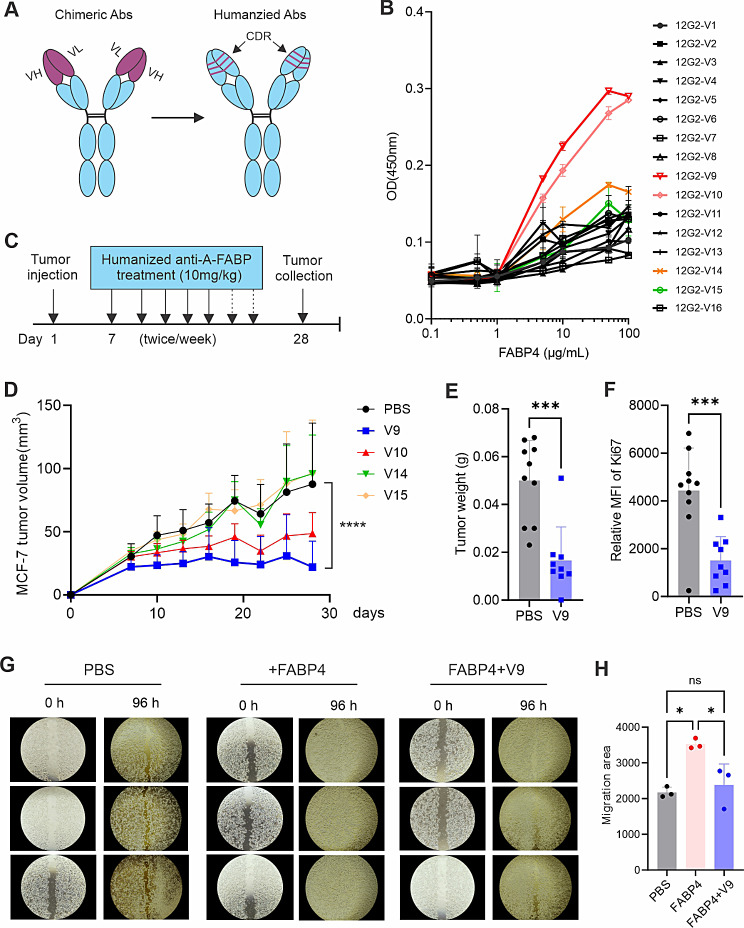
Herein, we report the generation of humanized monoclonal antibodies blocking FABP4 activity for breast cancer treatment in mouse models. One clone, named 12G2, which significantly reduced circulating levels of FABP4 and inhibited mammary tumor growth, was selected for further characterization. After confirming the therapeutic efficacy of the chimeric 12G2 monoclonal antibody consisting of mouse variable regions and human IgG1 constant regions, 16 humanized 12G2 monoclonal antibody variants were generated by grafting its complementary determining regions to selected human germline sequences. Humanized V9 monoclonal antibody showed consistent results in inhibiting mammary tumor growth and metastasis by affecting tumor cell mitochondrial metabolism.
Our current evidence suggests that targeting FABP4 with humanized monoclonal antibodies may represent a novel strategy for the treatment of breast cancer and possibly other obesity- associated diseases.
乳腺癌是美国和全球范围内女性最常见的诊断癌症。肥胖增加了乳腺癌的风险,但背后的分子机制尚不清楚。我们的研究表明,循环脂肪组织脂肪酸结合蛋白(A-FABP,也称为 FABP4)将肥胖引起的脂质代谢失调与乳腺癌风险联系起来,因此为乳腺癌治疗提供了新的靶点。
我们用重组人 FABP4 免疫 FABP4 敲除小鼠,并筛选出与 FABP4 特异性结合的杂交瘤克隆。使用迁移、侵袭和有限稀释测定法评估抗体对体外乳腺癌细胞的潜在影响。在包括 C57BL/6 小鼠、Balb/c 小鼠和 SCID 小鼠在内的各种肿瘤发生模型中评估体内肿瘤进展。使用多色流式细胞术对肿瘤微环境中的免疫细胞表型和功能进行了特征描述。通过 ALDH 测定检测肿瘤干细胞。为了表征抗原-抗体结合能力,我们通过表面等离子体共振确定了选定抗 FABP4 抗体的解离常数。进一步在肿瘤组织中使用 10X Genomics Visium 空间单细胞技术进行分析。
本文报道了用于治疗乳腺癌的人源化单克隆抗体阻断 FABP4 活性的生成。选择了一种名为 12G2 的克隆,该克隆可显著降低循环 FABP4 水平并抑制乳腺肿瘤生长,用于进一步鉴定。在确认由鼠可变区和人 IgG1 恒定区组成的嵌合 12G2 单克隆抗体的治疗效果后,通过将其互补决定区移植到选定的人种系序列中,生成了 16 种人源化 12G2 单克隆抗体变体。人源化 V9 单克隆抗体通过影响肿瘤细胞线粒体代谢,显示出一致的抑制乳腺肿瘤生长和转移的效果。
我们目前的证据表明,用人源化单克隆抗体靶向 FABP4 可能代表治疗乳腺癌和可能其他肥胖相关疾病的新策略。