Joint and Orthopaedic Trauma, Department of Orthopedics, The Third Affiliated Hospital of Sun Yat-Sen University, No. 600 Tianhe Road, Guangzhou, Guangdong, China.
Eur J Med Res. 2024 Jul 25;29(1):385. doi: 10.1186/s40001-024-01981-7.
To compare the iatrogenic radial nerve injury (iRNI) rate of different implant (plate vs. intramedullary nail) and surgical approaches during humeral shaft fracture surgery.
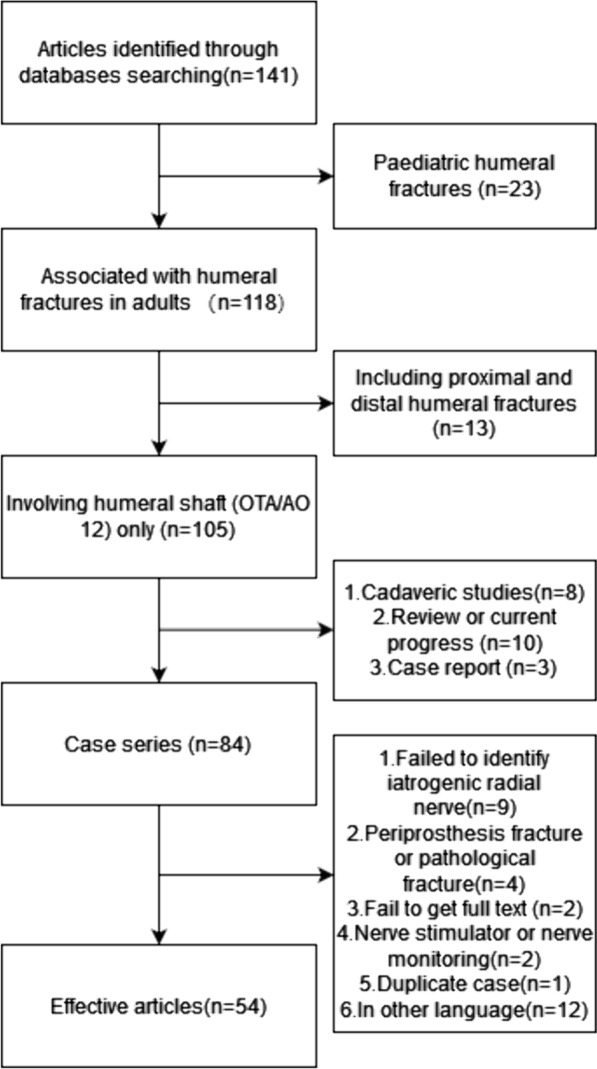
The online PubMed database was used to search for articles describing iRNI after humeral fracture with a publication date from Jan 2000 to October 2023. The following types of articles were selected: (1) case series associating with adult humeral shaft fracture, preoperative radial nerve continuity, non-pathological fracture and non-periprosthetic fracture; (2) involving humeral shaft (OTA/AO 12) fractures. Articles where we were unable to judge surgical approach or fracture pattern (OTA/AO 12) were excluded. The data were analyzed by SPSS 27.0 and Chi-square test was performed to identify incidence of iRNI associated with different implant and surgical approaches.
Fifty-four articles with 5063 cases were included, with 3510 cases of the plate, 830 cases of intramedullary nail and 723 cases of uncertain internal fixation. The incidences of iRNI with plate and intramedullary nail were 5.95% (209/3510) and 2.77% (23/830) (p < 0.05). And iRNI incidences of different surgical approaches were 3.7% (3/82) for deltopectoral approach, 5.74% (76/1323) for anterolateral approach, 13.54% (26/192) for lateral approach and 6.68% (50/749) for posterior approach. The iRNI rates were 0.00% (0/33) for anteromedial MIPO, 2.67% (10/374) for anterolateral MIPO and 5.40% (2/37) for posterior MIPO (p > 0.05). The iRNI rates were 2.87% (21/732) for anterograde intramedullary nail and 2.04% (2/98) for retrograde intramedullary nail (p > 0.05). In humeral bone nonunion surgery, the rate of iRNI was 15.00% (9/60) for anterolateral approach, 16.7% (2/12) for lateral approach and 18.2% (6/33) for posterior approach (p > 0.05).
Intramedullary nailing is the preferred method of internal fixation for humeral shaft fractures that has the lowest rate of iRNI. Compared with anterolateral and posterior approaches, the lateral surgical approach had a higher incidence of iRNI. The rate of iRNI in MIPO was lower than that in open reduction and internal fixation.
Level IV.
比较不同内固定物(钢板与髓内钉)和手术入路在肱骨干骨折手术中导致医源性桡神经损伤(iRNI)的发生率。
检索 2000 年 1 月至 2023 年 10 月期间在线 PubMed 数据库中描述桡神经连续性术前、非病理性骨折和非假体周围骨折的成人肱骨干骨折术后发生 iRNI 的文章。纳入的文章类型如下:(1)与成人肱骨干骨折相关的病例系列研究,术前桡神经连续性正常,非病理性骨折和非假体周围骨折;(2)涉及肱骨干(OTA/AO 12)骨折。排除无法判断手术入路或骨折类型(OTA/AO 12)的文章。使用 SPSS 27.0 进行数据分析,并采用卡方检验比较不同内固定物和手术入路与 iRNI 发生率的关系。
共纳入 54 篇文章,共计 5063 例患者,其中钢板固定 3510 例,髓内钉固定 830 例,内固定物不确定 723 例。钢板和髓内钉固定的 iRNI 发生率分别为 5.95%(209/3510)和 2.77%(23/830)(p<0.05)。不同手术入路的 iRNI 发生率分别为:三角肌胸大肌入路 3.7%(3/82),前外侧入路 5.74%(76/1323),外侧入路 13.54%(26/192),后侧入路 6.68%(50/749)。前内侧微创钢板内固定术(MIPO)的 iRNI 发生率为 0.00%(0/33),前外侧 MIPO 为 2.67%(10/374),后侧 MIPO 为 5.40%(2/37)(p>0.05)。顺行髓内钉固定的 iRNI 发生率为 2.87%(21/732),逆行髓内钉固定的 iRNI 发生率为 2.04%(2/98)(p>0.05)。在肱骨干骨不连手术中,前外侧入路的 iRNI 发生率为 15.00%(9/60),外侧入路为 16.7%(2/12),后侧入路为 18.2%(6/33)(p>0.05)。
髓内钉是肱骨干骨折内固定的首选方法,其 iRNI 发生率最低。与前外侧和后侧入路相比,外侧入路的 iRNI 发生率更高。MIPO 的 iRNI 发生率低于切开复位内固定术。
IV 级。