Zeb Faiza, Haleem Kashif Syed, Almuqbil Mansour, Rashid Maliha, Hussain Wajid, Maqbool Farhana, Tauseef Isfahan, Jafri Laila, Mannasaheb Basheerahmed Abdulaziz, Hussain Syed Arif, Quadri Mohammed Sharique Ahmed, Khormi Amro Mohammed Sawadi, Asdaq Syed Mohammed Basheeruddin
Department of Microbiology, Hazara University Mansehra, KPK, Pakistan.
Department of Clinical Pharmacy, College of Pharmacy, King Saud University, Riyadh, 11451, Saudi Arabia.
Heliyon. 2024 Jul 4;10(13):e34053. doi: 10.1016/j.heliyon.2024.e34053. eCollection 2024 Jul 15.
The aim of this study was to examine the impact of different stages of dengue infection on immune cell counts among dengue patients and to compare them with cases of non-dengue febrile illness.
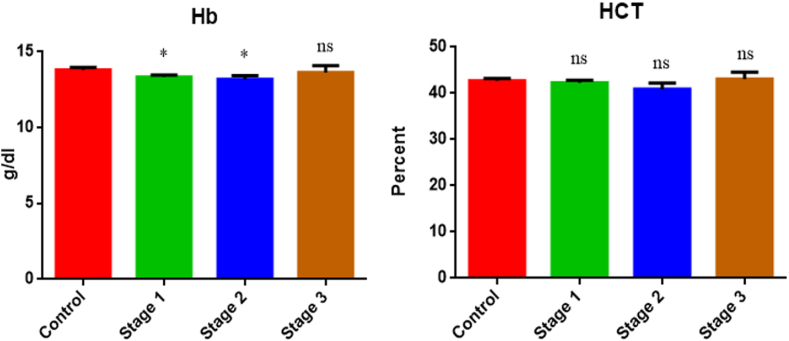
The recruited patients were divided into two groups: the first group served as a control (n = 55), representing non-dengue febrile illness, and the second group was identified as dengue febrile illness (n = 149), which was further divided into three groups based on infection stage. Blood samples were collected from the selected patients and subjected to blood cell component analysis. To find IgG and IgM as well as the dengue virus non-structural antigen-1 (NS1), an immunochromatographic test (ICT) kit was utilized. Additionally, a hematological analyzer was used to determine complete blood cell counts (CBC). Data was thoroughly analyzed using Graph Pad Prism 6 software. The differences in means of different groups were calculated by applying the student's t-test.
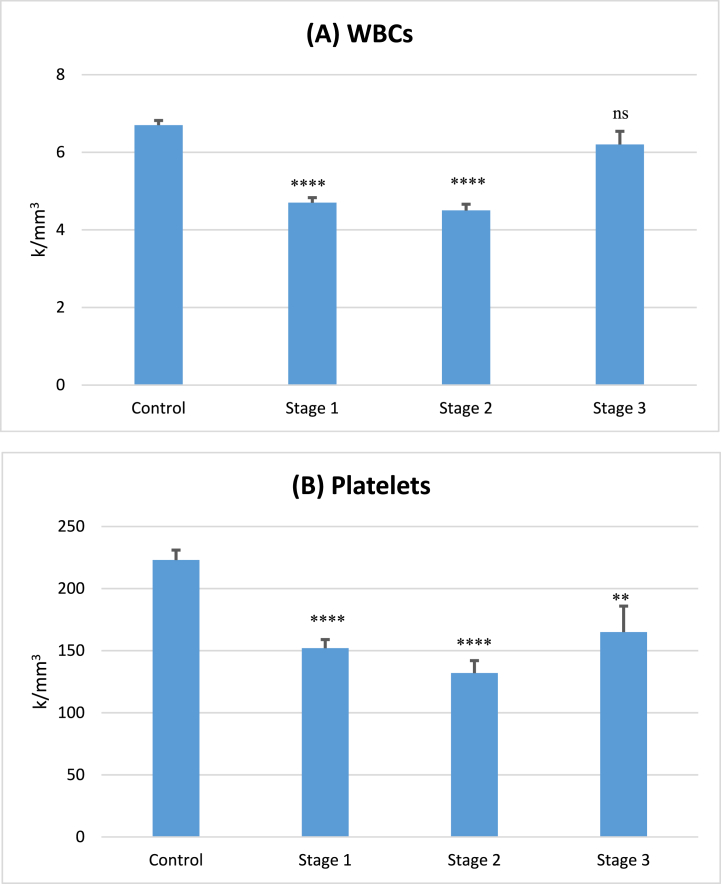
The findings revealed the presence of severe leucopenia and thrombocytopenia at stages 1 and 2, accompanied by lymphopenia at stage 1. Group comparisons indicated that only teenagers exhibited a significantly lower white blood cell count compared to older individuals, while no significant differences were observed in lymphocytes, platelets, and monocytes across all age groups. Comparing different age groups of normal individuals to dengue-infected patients, the results unveiled that leucopenia was most severe in adults, followed by teenagers and children, with no significant difference in the elderly. Furthermore, adults showed the greatest degree of thrombocytopenia, followed by teens and kids, with the elderly showing the greatest degree of thrombocytopenia. Adults and teens showed extreme neutrophilia, whereas young children and the elderly showed no discernible abnormalities. Elderly patients experienced a marked decrease in monocyte count, a phenomenon not observed in other age groups.
In conclusion both, leucopenia & thrombocytopenia, are most severe in stages 1 and 2, whereas neutrophilia & lymphopenia are predominantly severe in stage 1. These results imply that the consequences associated with dengue infection are more severe in the early stages and tend to ameliorate as the patient progresses toward recovery.
本研究的目的是检查登革热感染的不同阶段对登革热患者免疫细胞计数的影响,并将其与非登革热发热性疾病病例进行比较。
招募的患者分为两组:第一组作为对照组(n = 55),代表非登革热发热性疾病,第二组被确定为登革热发热性疾病(n = 149),根据感染阶段进一步分为三组。从选定的患者中采集血样,并进行血细胞成分分析。为了检测IgG、IgM以及登革热病毒非结构抗原-1(NS1),使用了免疫层析试验(ICT)试剂盒。此外,使用血液分析仪测定全血细胞计数(CBC)。使用Graph Pad Prism 6软件对数据进行全面分析。通过应用学生t检验计算不同组的均值差异。
研究结果显示,在第1阶段和第2阶段存在严重的白细胞减少和血小板减少,第1阶段伴有淋巴细胞减少。组间比较表明,只有青少年的白细胞计数明显低于老年人,而所有年龄组的淋巴细胞、血小板和单核细胞均无显著差异。将不同年龄组的正常个体与登革热感染患者进行比较,结果显示白细胞减少在成年人中最为严重,其次是青少年和儿童,老年人无显著差异。此外,成年人的血小板减少程度最大,其次是青少年和儿童,老年人的血小板减少程度最大。成年人和青少年表现出极度嗜中性粒细胞增多,而幼儿和老年人未表现出明显异常。老年患者的单核细胞计数明显下降,这一现象在其他年龄组中未观察到。
总之,白细胞减少和血小板减少在第1阶段和第2阶段最为严重,而嗜中性粒细胞增多和淋巴细胞减少在第1阶段主要较为严重。这些结果表明,登革热感染在早期阶段的相关后果更为严重,并且随着患者病情好转趋于改善。