Afarin Reza, Hatami Mahdi, Monjezi Sajad, Bineshfar Fatemeh, Ahangarpour Akram
Diabetes Research Center, Health Research Institute, Ahvaz Jundishapur University of Medical Sciences, Ahvaz, Iran.
Student Research Committee, Ahvaz Jundishapur University of Medical Sciences, Ahvaz, Iran.
Iran J Basic Med Sci. 2024;27(9):1096-1104. doi: 10.22038/IJBMS.2024.76264.16497.
Liver diseases, including non-alcoholic fatty liver disease (NAFLD) and non-alcoholic steatohepatitis (NASH), pose significant global public health challenges. This study investigates the therapeutic effects of quercetin (QC), (CS), a QC and CS combination, and Saroglitazar (SARO) on NASH in a Wistar rat model.
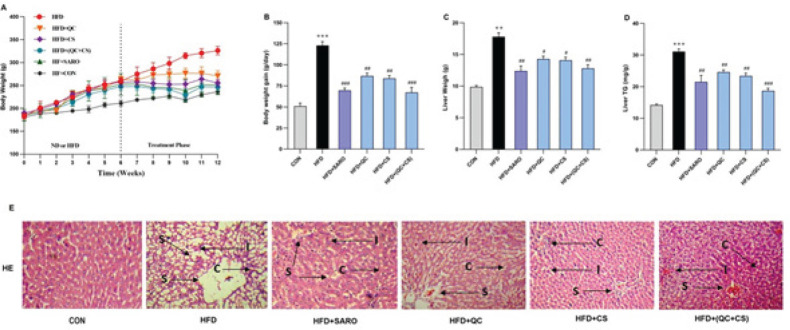
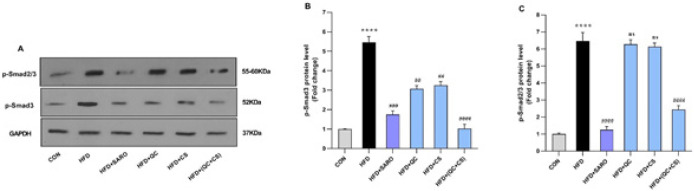
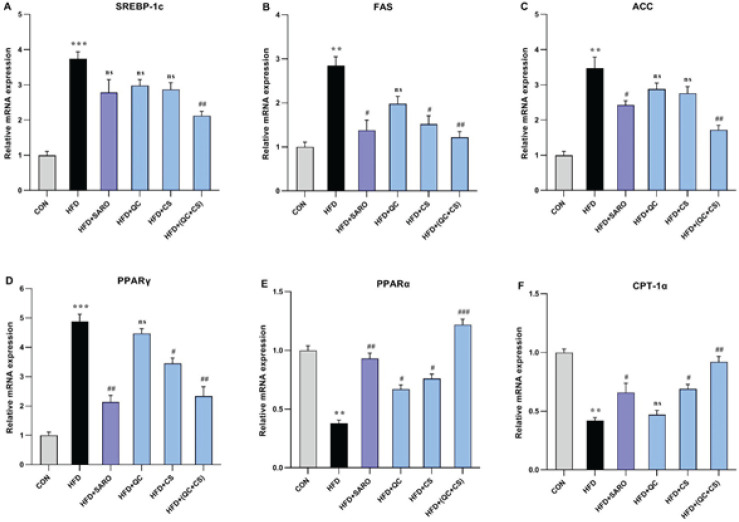
NASH was induced by a 42-day high-fat diet regimen in male Wistar rats. Post-induction, rats were divided into five groups receiving SARO, QC, CS, and CS+QC combination. We monitored changes in liver and body weights and evaluated the expression of genes associated with fatty acid biosynthesis (e.g., ACC and FAS), β-oxidation (e.g., CPT1, PPAR α), inflammation (e.g., TNF-α and IL-6), and fibrosis (e.g., TGF-β and COL1A), as well as protein expression levels of p-Smad2/3 and p-Smad3.
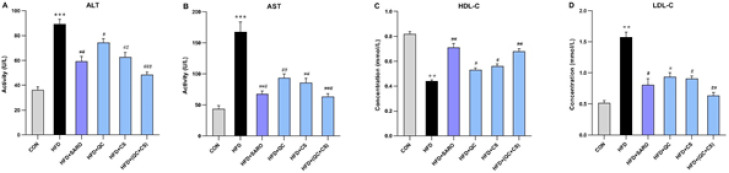
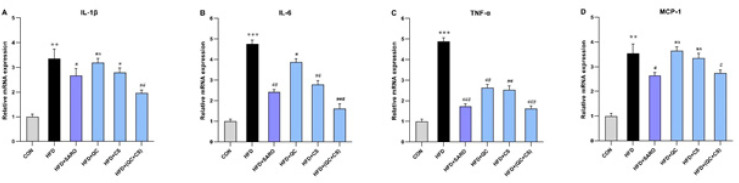
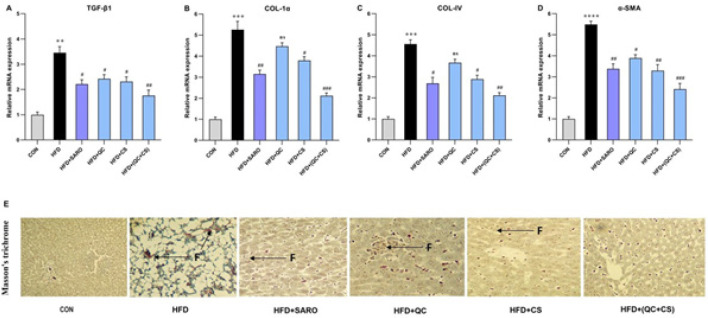
Treatment with QC+CS significantly decreased liver weight, body mass gain, and liver triglyceride (TG) compared to other treatments. The QC and CS combined therapy also resulted in a greater normalization of hepatic enzymatic activities, including decreases in ALT and AST levels, coupled with improvements in lipid profile indicated by decreased LDL-C and increased HDL-C concentrations, as compared to SARO and QC alone. Furthermore, this combined treatment significantly down-regulated the expression of TGF-β, TNF-α, IL-6 genes, and Smad2/3 and Smad3 protein levels.
Our study demonstrates that an interactive effect between QC and CS can effectively reduce liver fibrosis and steatosis by inhibiting the TGF-β/Smad3 signaling pathway in a diet-induced model of nonalcoholic steatohepatitis and fibrosis in rats.
肝病,包括非酒精性脂肪性肝病(NAFLD)和非酒精性脂肪性肝炎(NASH),对全球公共卫生构成重大挑战。本研究在Wistar大鼠模型中研究槲皮素(QC)、白藜芦醇(CS)、QC与CS的组合以及沙罗格列扎(SARO)对NASH的治疗效果。
通过42天的高脂饮食方案诱导雄性Wistar大鼠发生NASH。诱导后,将大鼠分为五组,分别接受SARO、QC、CS以及CS+QC组合治疗。我们监测肝脏和体重的变化,并评估与脂肪酸生物合成相关基因(如ACC和FAS)、β-氧化相关基因(如CPT1、PPARα)、炎症相关基因(如TNF-α和IL-6)以及纤维化相关基因(如TGF-β和COL1A)的表达,以及p-Smad2/3和p-Smad3的蛋白表达水平。
与其他治疗相比,QC+CS治疗显著降低了肝脏重量、体重增加和肝脏甘油三酯(TG)。与单独使用SARO和QC相比,QC和CS联合治疗还使肝脏酶活性得到更大程度的正常化,包括ALT和AST水平降低,同时脂质谱得到改善,表现为LDL-C降低和HDL-C浓度升高。此外,这种联合治疗显著下调了TGF-β、TNF-α、IL-6基因的表达以及Smad2/3和Smad3蛋白水平。
我们的研究表明,在饮食诱导的大鼠非酒精性脂肪性肝炎和纤维化模型中,QC和CS之间的相互作用可通过抑制TGF-β/Smad3信号通路有效减轻肝纤维化和脂肪变性。